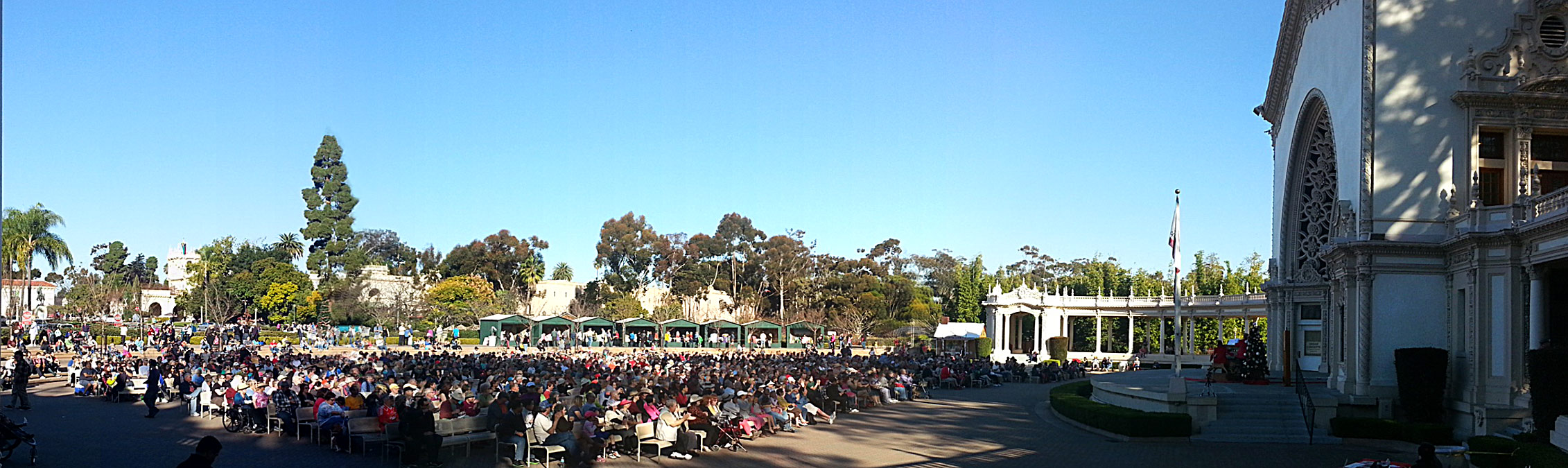
Spreckels Organ Pavilion
There is a peculiarity built into the Spreckels Organ Pavilion: because Brazil declined to participate in the 1915 Panama-California Exposition, the venue was constructed on the site originally reserved for the Brazilian pavilion — which means the audience faces south rather than north, an orientation dictated by an international snub a century ago. This is the kind of detail that accumulates around an outdoor pipe organ with more than 5,000 pipes: history piles up in unexpected ways.
A Rich Man's Gift
John D. Spreckels was one of San Diego's wealthiest residents, the son of sugar magnate Claus Spreckels and the owner of investments ranging from the Hotel del Coronado to the San Diego Union-Tribune. When the Panama-California Exposition was organized to celebrate the opening of the Panama Canal, Spreckels and his brother Adolph gave the organ and pavilion to the city on December 31, 1914 — a gift to 'the people of San Diego' and 'the people of all the world.' They spent $33,500 on the organ itself and $66,500 on the pavilion. Spreckels also donated the services of renowned organist Humphrey John Stewart for the exposition's two-year run, then extended Stewart's contract afterward. When Spreckels died in 1926, his memorial service was held here.
Presidents, Pipes, and Planes
On July 27, 1915, former President Theodore Roosevelt addressed nearly 19,000 people in the pavilion — speaking on world peace and urging the United States to maintain a minimum of 200,000 military members. Former President William Howard Taft spoke to 7,000 people here two months later. The organ's 5,000-plus pipes make it the world's largest pipe organ in a fully outdoor venue, and the pavilion's open design means sound travels without obstruction. It also means that commercial aircraft landing at San Diego International Airport — less than two miles to the northwest — occasionally compete with the organist. The New York Times noted in 2007 that landing jets could overwhelm the instrument. The organ plays on regardless.
War, Neglect, and Recovery
The U.S. Navy borrowed Balboa Park during World War II, and no organ concerts were given between 1942 and 1948. The pavilion fell into disuse during the 1970s and 1980s, and there were serious proposals to demolish it. Around $1.1 million was raised for repairs by the early 1980s through a combination of city funding and a local nonprofit organization. The stage was doubled during the 1935 California Pacific International Exposition, and a fountain was added at that time. The organ has had a continuous line of civic organists since Humphrey John Stewart in 1914, a tradition that continues under Raúl Prieto Ramírez, who has held the post since 2018.
Free Music, Monday Evenings
On Monday evenings in summer, the Spreckels Organ Society presents the Spreckels Summer International Organ Festival — free concerts in one of the most dramatically situated outdoor venues in America, with the Balboa Park landscape surrounding the pavilion on all sides. The concerts include silent films with organ accompaniment, evoking the original theatrical experience the organ was built to provide. Graduations, Christmas nativity displays, the annual December Nights celebration — the pavilion serves as a civic gathering place in a way that few purpose-built venues manage. In August 2014, the rock band Drive Like Jehu reunited here after nineteen years apart, accompanied by civic organist Carol Williams. The novelty of performing with 5,000 pipes brought them back together.
From the Air
Located at 32.729°N, 117.150°W in Balboa Park, approximately 2 miles northeast of San Diego International Airport (KSAN). The curved colonnaded pavilion is visible from the air as a distinct horseshoe shape within the park's greenery. Best viewed at 2,000-3,500 feet on approach to KSAN from the east.