Spring and Autumn Pavilions
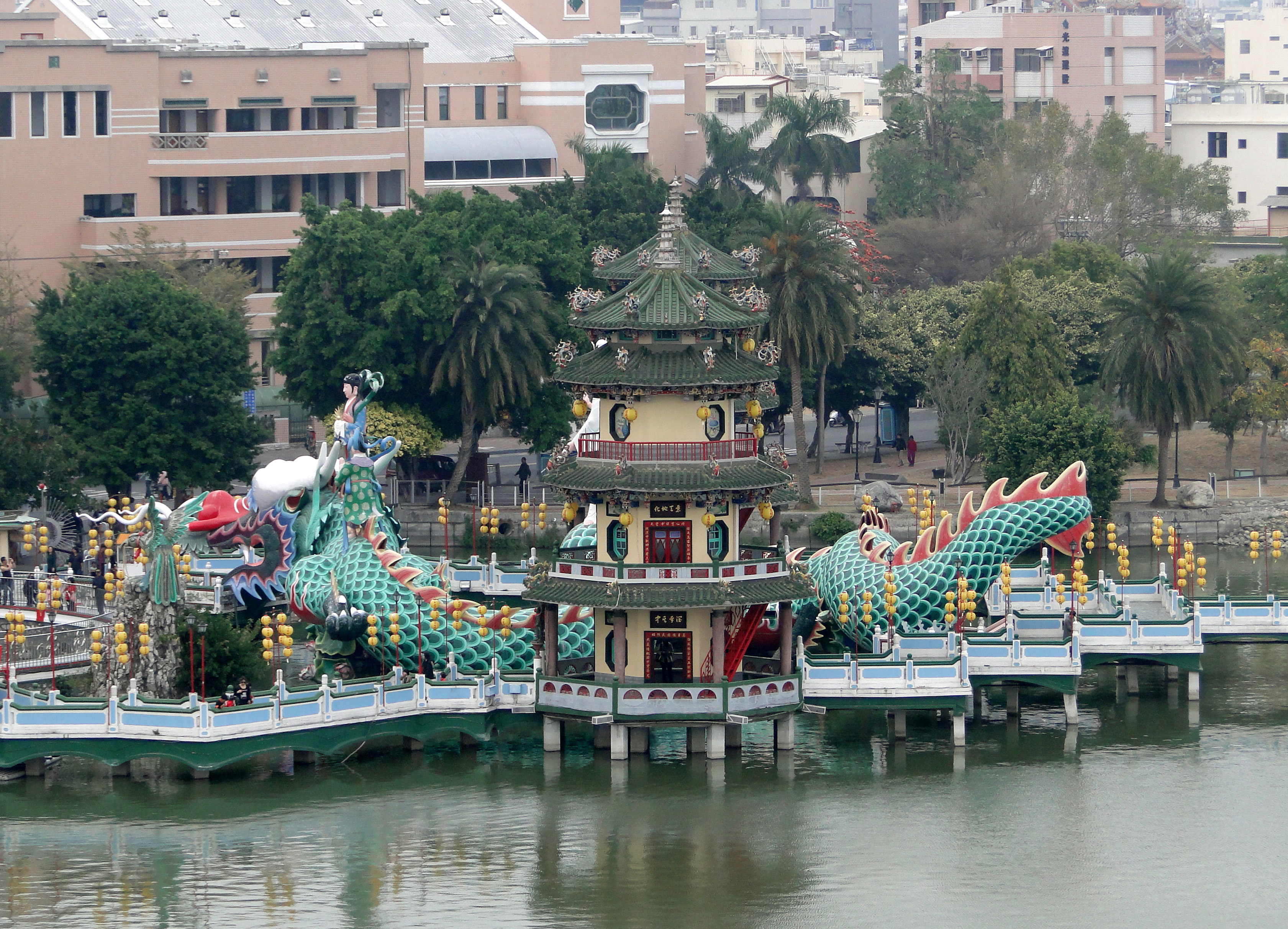
The origin story is delightfully specific. In the early 1950s, the Goddess of Mercy -- Guanyin -- appeared in the clouds above Lotus Pond, riding a dragon. She instructed her followers to build a statue of herself in that exact form, positioned between two pavilions. The followers complied. By 1953, the Spring and Autumn Pavilions stood on the lake's edge in Zuoying District, Kaohsiung, with a dragon-riding Guanyin at their entrance, exactly as the vision prescribed. Whether you take this as divine mandate or communal determination, the result is the same: one of the most photographed temple complexes in southern Taiwan.
Twin Towers on the Water
The two pavilions -- the Spring Pavilion and the Autumn Pavilion -- are each four stories tall and octagonal in shape. Their green-tiled roofs and yellow walls give them the appearance of antique pagodas, and on still days their reflections double in the water below. The complex was built by Chi Ming Palace as a landmark commemorating Lord Kuan, the martial saint revered across Chinese culture. The pavilions have been selected as one of Taiwan's top ten beauty spots, a recognition that has only intensified the steady flow of visitors and photographers who crowd the Nine-Bend Bridge connecting the two structures. That bridge -- colorful, angular, and designed to prevent evil spirits from following you across the water -- is itself a destination, offering one of the best vantage points for viewing the lotus blooms that carpet the lake every summer.
The Dragon at the Gate
The Guanyin statue at the entrance is not subtle. The Goddess of Mercy sits atop a writhing dragon that emerges from the water, its body arching between the two pavilions. Visitors approach by walking through the dragon's open mouth, passing through its body before reaching the pavilion complex. The statue draws on a deep tradition of dragon imagery in Taiwanese temple architecture, but its scale and placement -- between two pavilions, at the edge of a lake, accessible only by bridge -- give it a theatrical presence that transcends the merely devotional. Thousands of turtles gather in a half-moon pond in front of the pavilions, their slow movements contrasting with the drama of the dragon above them.
The Neighborhood of Gods
The Spring and Autumn Pavilions do not stand alone. They are part of a dense spiritual landscape around Lotus Pond that includes the Dragon and Tiger Pagodas, Chi Ming Palace, the Confucius Temple, and over a dozen other temples and shrines. From the top of the Dragon and Tiger Pagodas, the Spring and Autumn Pavilions are visible across the water, their octagonal forms punctuating the lakeshore. The nearby 5-mile Pavilion extends the complex further along the waterfront. This clustering of sacred architecture creates an environment where Taoist, Buddhist, and Confucian traditions exist in close proximity, each temple's elaborate decorations competing for the visitor's attention. The Spring and Autumn Pavilions hold their own in this company through sheer symmetry: two matched towers reflected in the lake, a dragon between them, a goddess above.
Sunset and Reflection
The pavilions are widely regarded as being at their most beautiful at sunset, when the low light turns the green tiles and yellow walls to amber and the water becomes a mirror. At night, illumination transforms the complex again, its outlines traced in light against the dark lake. The effect is something between a temple and a stage set -- sacred architecture performing for an audience of both devotees and tourists. The lotus flowers that bloom across the pond's surface from June through August add a living element to the composition, their pink and white petals opening fresh each morning. The Nine-Bend Bridge, with its angular path, encourages slow movement and frequent stops, turning the approach to the pavilions into a contemplative walk regardless of the visitor's spiritual disposition.
From the Air
The Spring and Autumn Pavilions are located at 22.682N, 120.293E on Lotus Pond in Zuoying District, Kaohsiung. From the air, they appear as twin octagonal structures at the water's edge, distinguishable by their green-tiled roofs. The dragon statue between them is visible at lower altitudes. Lotus Pond itself is a clear rectangular water feature in an otherwise dense urban area. Nearest major airport is Kaohsiung International Airport (RCKH), approximately 10 km south. Best viewed at 1,500-2,500 feet.