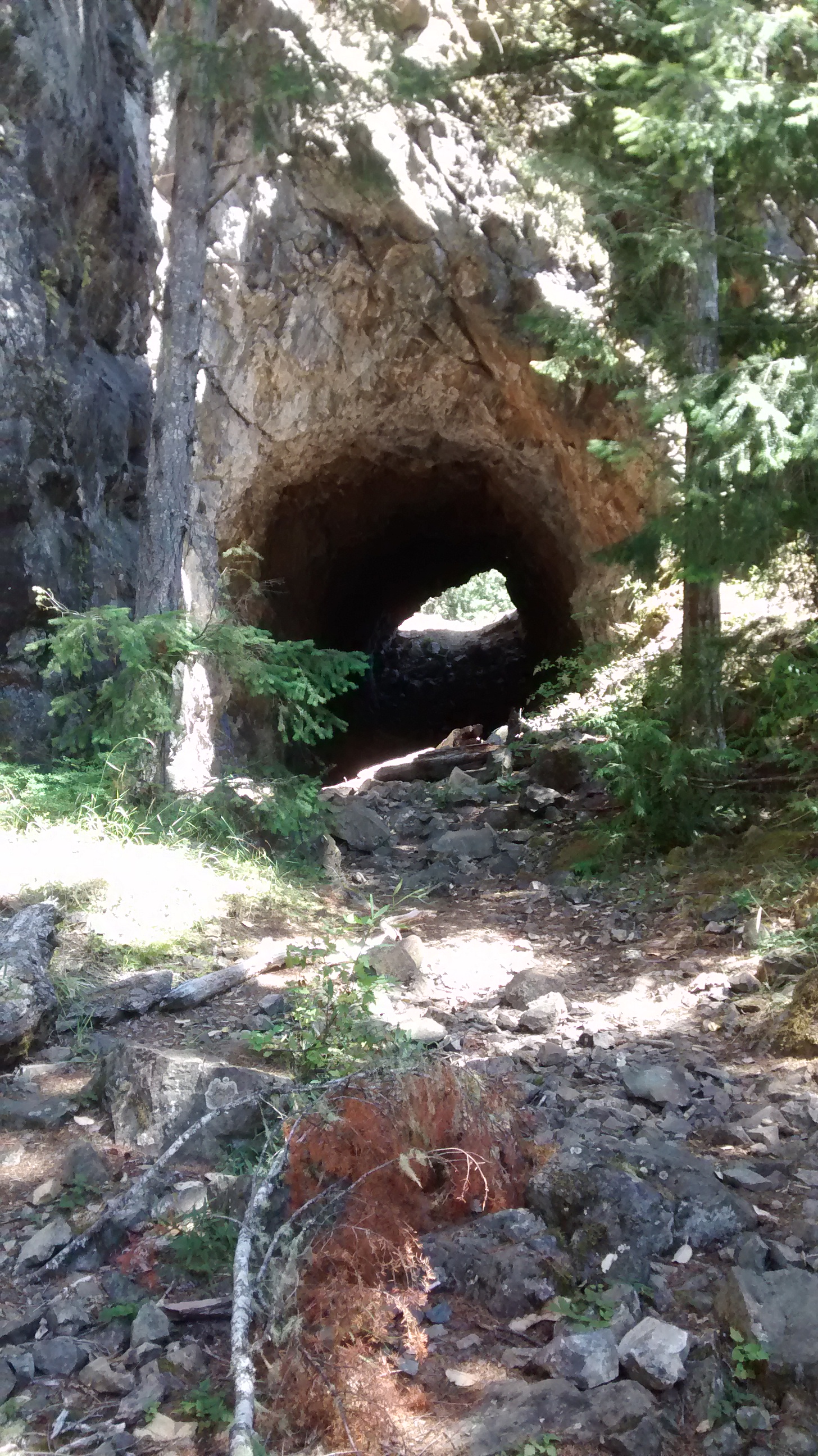
Spruce Railroad Trail
The railroad was finished in 1919, one year after the armistice silenced the guns it was meant to feed. Spruce was the miracle wood of early aviation -- light, strong, flexible enough to absorb the shock of landing on a grass strip -- and the U.S. Army's Spruce Production Division needed vast quantities of it from the old-growth forests of the Olympic Peninsula. So they punched a rail line along the shores of Lake Crescent, blasting tunnels through solid rock and laying track above water so impossibly blue it looks dyed. By the time the last spike was driven, the Great War was over. The railroad hauled timber for another three decades before it, too, fell silent in 1951.
Through the Mountain's Bones
Two railroad tunnels define the trail's character. The McFee Tunnel stretches 450 feet through the headland, a passage blasted during World War I that spent decades sealed and forgotten after railroad operations ended. When the tunnels were closed, tradition says they were deliberately collapsed -- rendered too dangerous to enter, a blunt farewell to the line's brief industrial life. The second tunnel, the Daley-Rankin, is shorter but no less atmospheric. For years, both were pitch-black cavities littered with old railroad ties and the debris of abandonment. Between 2017 and 2019, a $1.2 million restoration project reopened the McFee Tunnel, reinforcing its walls and widening the passage to twelve feet. The Daley-Rankin followed in late 2020, completing a full ten miles of connected trail linked to the larger Olympic Discovery Trail.
Lake Crescent's Impossible Blue
The lake beside the trail is the real draw. Lake Crescent sits in a glacially carved basin about twenty miles west of Port Angeles, its waters so deep and clear they refract light into shades of vivid turquoise and cobalt. The trail hugs the northern shore for roughly four miles, tracing the old railroad grade at a gentle incline that makes it accessible to casual hikers, cyclists, and wheelchair users alike -- the 2017-2019 renovation brought the path to universal accessibility standards, paving sections and widening the tread to about ten feet. Along the way, a bridge spans a bay called Devils Punch Bowl, and Harrigan Point offers views across the full expanse of the lake to the forested ridges beyond. On a still morning, the water mirrors the surrounding peaks with such precision that the reflection is indistinguishable from the real thing.
Spruce and the War in the Air
Why spruce? In 1917, airplane fuselages and wings were built from wood, and Sitka spruce was the finest aircraft timber available -- stronger per pound than any alternative, with a straight grain that resisted splitting under stress. The western Olympic Peninsula held the continent's richest stands of it, but the trees grew in roadless wilderness, unreachable by conventional logging operations. The Army activated the Spruce Production Division, deploying thousands of soldiers to the forests of Washington and Oregon to fell timber and build the infrastructure to move it. The Port Angeles Western Railroad grade along Lake Crescent was one piece of that logistical puzzle. At its peak the Division employed over 30,000 soldiers and civilians, making it one of the largest industrial mobilizations of the war. The armistice came before much of that spruce reached the front.
The Trail Reborn
After the railroad was abandoned in 1951, the grade slowly rewilded. Ferns colonized the ballast. Moss softened the tunnel mouths. Hikers discovered it informally, picking their way around the sealed tunnels on steep, unofficial scrambles. The formal conversion to a public trail came later, folding the route into the 134-mile Olympic Discovery Trail that stretches from Port Townsend to the Pacific coast. Today, the Spruce Railroad Trail is one of the most popular segments of that larger system -- flat enough for families, scenic enough for photographers, and layered with enough history to reward anyone who pauses to read the interpretive signs. The tunnels, once sealed in darkness, are now the trail's signature experience: stepping from bright sunlight into cool stone and emerging to another sweep of that improbable blue water.
From the Air
Located at 48.09N, 123.80W along the north shore of Lake Crescent in Olympic National Park. The lake is a vivid blue landmark visible from altitude, roughly 20 miles west of Port Angeles. Nearest airport: William R. Fairchild International (KCLM) in Port Angeles. The trail runs east-west along the lakeshore; look for the narrow blue crescent of water set among dark evergreen ridges.