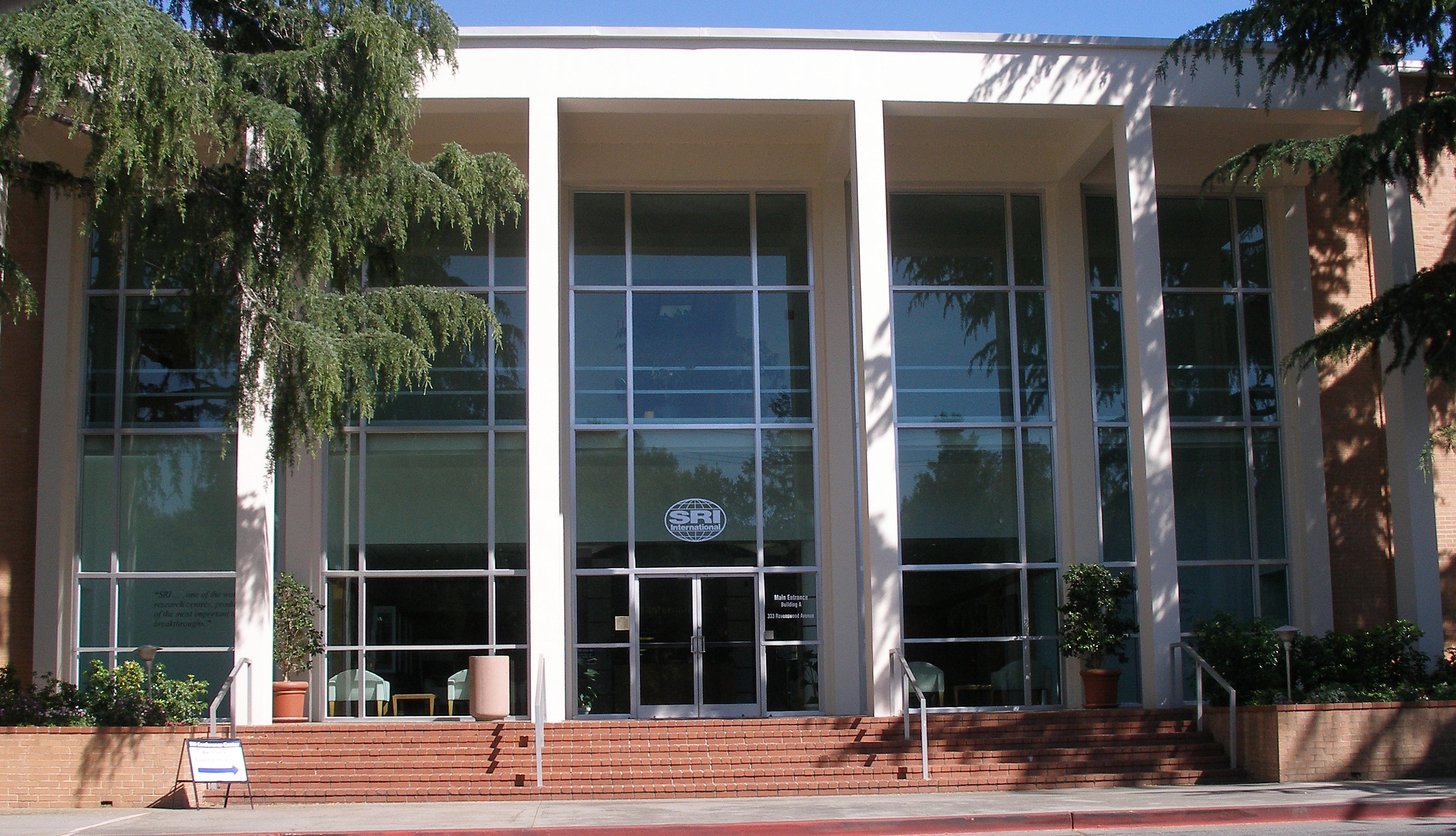
SRI International
In 1968, engineer Douglas Engelbart sat on a stage at a computer conference in San Francisco and demonstrated a small wooden box with two wheels and a single button. He moved it across his desk, and a cursor moved on the screen above him. The audience was watching the debut of the computer mouse, and the institution behind it was the Stanford Research Institute, a nonprofit lab in Menlo Park that would go on to help create the internet, develop the first digital address book, pioneer artificial intelligence, and spin off technologies that generated billions of dollars in commercial value. Today it is known as SRI International.
Born of Stanford, Freed from Stanford
SRI was established in 1946 by the trustees of Stanford University to serve as a center of innovation that could translate academic research into practical applications. For its first quarter-century, the institute operated under Stanford's umbrella, tackling projects that ranged from defense electronics to chemical processes. But the relationship grew complicated. During the Vietnam War era, students protested SRI's defense-related research, and the university faced mounting pressure to distance itself from military work. In 1970, SRI formally separated from Stanford. It adopted the name SRI International in 1977, severing the last nominal tie to the university while retaining its Menlo Park headquarters just a few miles from campus.
The Mother of Invention
The list of technologies that emerged from SRI's labs reads like a catalog of the modern world. Beyond the computer mouse, SRI researchers were instrumental in developing ARPANET, the precursor to the internet. The institute pioneered work in artificial intelligence, speech recognition, and robotic surgery. The da Vinci Surgical System, now used in operating rooms worldwide, traces its lineage to SRI research. Siri, the voice assistant that Apple acquired in 2010, was developed at SRI's Artificial Intelligence Center as a DARPA-funded project called CALO, Cognitive Assistant that Learns and Organizes. The institute has generated more than 60 spinoff companies and holds thousands of patents.
A Nonprofit That Thinks Like a Startup
SRI operates as a nonprofit scientific research institute, but its relationship with commerce is anything but arm's length. The institute licenses technologies, launches ventures, and partners with both government agencies and private industry. Its research portfolio spans biosciences, computing, education, energy, national defense, and economic development. The organizational model, a nonprofit that aggressively commercializes its discoveries, has proved remarkably durable. From a handful of researchers in 1946 to a global operation, SRI has maintained its founding premise: that a research institute unencumbered by academic tenure requirements or quarterly earnings pressure can move faster and take bigger swings than either a university or a corporation.
From the Air
Located at 37.46°N, 122.18°W in Menlo Park, California. The SRI campus is a large institutional complex visible from low altitude near the intersection of Ravenswood Avenue and Middlefield Road. Palo Alto Airport (KPAO) is approximately 2 miles east. San Carlos Airport (KSQL) is about 4 miles northwest.