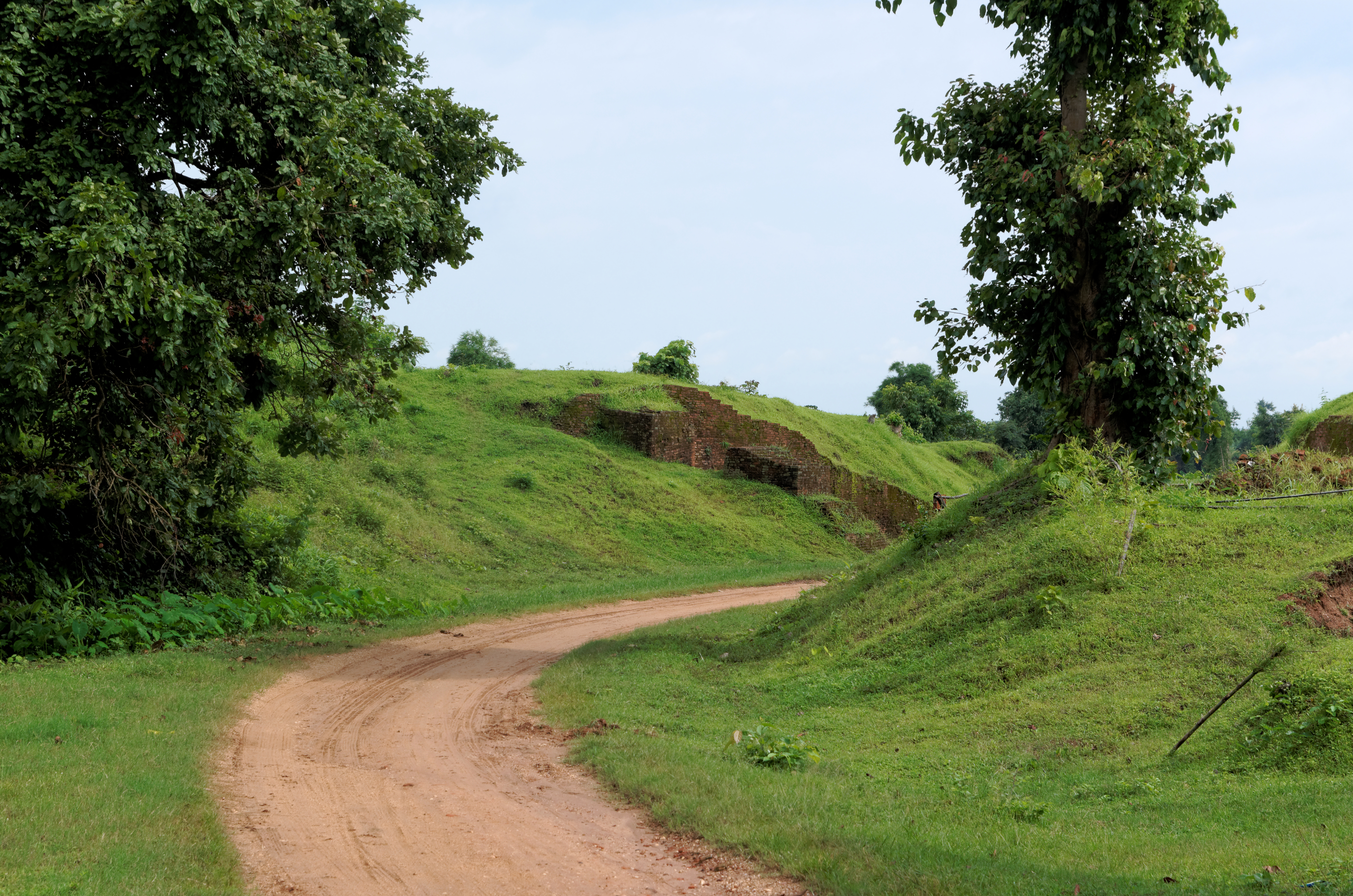
Sri Ksetra Kingdom
Somewhere beneath the rice paddies near modern Hmawza, Myanmar, radiocarbon dating has found cremation burials from around 270 CE -- evidence that the Pyu people were building an urban civilization here while Rome was still intact. Sri Ksetra, whose Sanskrit name translates to "Field of Glory," was no village. Its monumental brick walls enclosed nearly 1,900 hectares, making it the largest city in Southeast Asia before the temples of Angkor rose centuries later. Chinese pilgrim Xuanzang mentioned it in 648 CE; his contemporary Yijing confirmed it was a Buddhist country. Yet for all its significance, this Pyu capital remains one of the least-known ancient cities on Earth.
A Civilization Older Than Its Dates
Scholars long placed Sri Ksetra's founding between the fifth and seventh centuries CE, a comfortable estimate based on surviving inscriptions and architectural comparisons with Indian sites. Then the radiocarbon dates started coming back. Charcoal samples yielded ranges of 50 to 200 CE. Excavations led by Janice Stargardt at the Yahanda mound between 2015 and 2016 uncovered sherds stamped with Buddhist motifs dated to around 340 CE, alongside those cremation burials from roughly 270 CE. If accurate, these dates place the Pyu among the earliest urbanized peoples in all of Southeast Asia -- contemporaries of the late Roman Empire, not mere precursors to Bagan. The academic debate over these dates continues, but the sheer scale of the city walls, the largest of any Pyu settlement, suggests that whatever civilization built Sri Ksetra had been growing for a long time before anyone wrote it down.
Where India Met China on the Irrawaddy
Sri Ksetra's power rested on geography. Before the Irrawaddy delta formed, the city sat close enough to the sea that Indian Ocean vessels could sail upriver to trade directly with the Pyu and with Chinese merchants traveling south. The result was a cultural crossroads where Buddhism arrived from India and took deep root alongside existing Hindu worship -- sculptures of Vishnu have been found alongside Buddhist votive tablets throughout the site. Tang dynasty histories record a Pyu embassy arriving at the Chinese court in 801 CE, complete with musicians and performers. The art recovered from Sri Ksetra reflects this cosmopolitan position: silver Buddha sculptures display stylistic features found in Sri Lanka, while stone reliefs echo the Gupta traditions of southern India, and certain motifs parallel the Mon of Lower Burma and the Dvaravati of Thailand. It was a city that looked in every direction at once.
Blind Princes and an Ogress
The Burmese chronicles tell a different origin story entirely. According to the Hmannan Yazawin, the Glass Palace Chronicle of the Konbaung dynasty, Sri Ksetra was founded in 484 BCE by two brothers, Maha Thanbawa and Sula Thanbawa, scions of the ancient Tagaung kingdom. Born blind, the brothers were condemned to death by their own father. Their mother set them adrift on the Irrawaddy in a raft, and somewhere downriver an ogress restored their sight. Arriving at the environs of present-day Pyay, they found the Pyu at war with the Kanyan people, and the leaderless Pyu chose Maha Thanbawa as their chief. The chronicles claim twenty-seven kings of this line reigned for 578 years before civil war tore the kingdom apart. One refugee prince, Thamoddarit, reportedly wandered for a dozen years before founding the city of Pagan in 107 CE -- the seed of what would become Bagan. Archaeology cannot confirm these legends, but they reveal how deeply Myanmar's later dynasties tied their legitimacy to the memory of Sri Ksetra.
Stupas, Gold Leaves, and a Silver Reliquary
The ruins that survive above ground are striking. The Baw Baw Gyi Paya, a circular brick stupa rising roughly 46 meters, is often compared to the Dhamek Stupa at Sarnath in India. The Payama stupa north of the ramparts dates between the fourth and seventh centuries, its conical profile characteristic of early Pyu architecture. But the most significant discoveries came from beneath the Khin Ba mound, first excavated in 1926. There, archaeologists found the "great silver reliquary," inscribed in both Pyu and Pali, accompanied by golden leaves bearing a Buddhist text from the sixth century. These golden Pali manuscripts are generally regarded as the oldest surviving examples of the Pali language anywhere in the world. In 1993, a massive stone urn inscribed with what appears to be a memorial record of Pyu kings was discovered in the Payahtaung complex. It now resides in the National Museum of Myanmar in Yangon, a fragment of a civilization that lasted centuries and then, around the ninth century, simply faded away.
The Silence After Glory
By the ninth century CE, Sri Ksetra's prominence had waned. When the Bagan king Anawrahta arrived, he opened the Baw Baw Gyi stupa and removed its sacred relic to his own capital, leaving votive tablets in its place -- a gesture that was both reverent and imperial. The final mention of the Pyu appears on a twelfth-century stone at Pagan bearing inscriptions in four languages: Pyu, Mon, Burmese, and Pali. After that, the Pyu vanish from the written record. Today the circular plan of the city remains legible from the air, its semicircle of ramparts still traceable on the north, south, and western sides. A moat once surrounded the walls, visible now only as a succession of tanks in the dry season. UNESCO inscribed Sri Ksetra as part of the Pyu Ancient Cities World Heritage Site in 2014, recognizing what scholars have long known: this was where urbanization, Buddhism, and long-distance trade first converged in mainland Southeast Asia.
From the Air
Located at 18.82N, 95.32E near modern Pyay (Prome) along the Irrawaddy River in central Myanmar. From altitude, the circular plan of the ancient city is traceable -- semicircular ramparts on the north, south, and western sides enclosing roughly 1,900 hectares of flat ground. The Baw Baw Gyi stupa (46 meters tall) is the most prominent vertical feature. The Irrawaddy River runs nearby to the west. Nearest airport is Pyay Airport (no ICAO code commonly listed), though Bagan-Nyaung U Airport (VYBG) is approximately 250 km to the north and Yangon International Airport (VYYY) is roughly 290 km to the south.