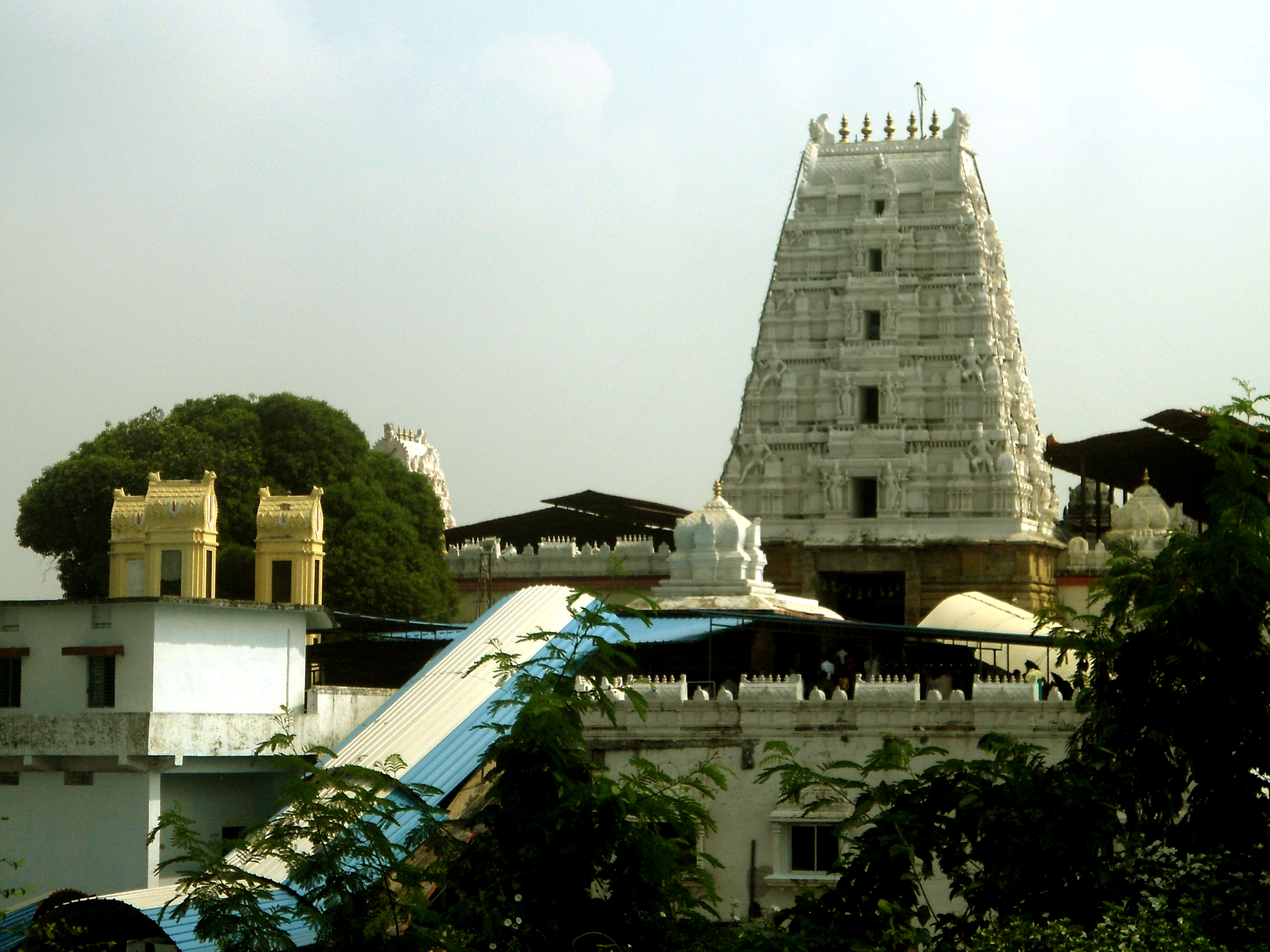
Sri Lakshmi Narasimha Swamy Temple, Yadagirigutta
Five gods inhabit a single cave. According to the Skanda Purana, the sage Rishyasringa's son Yada performed such devoted penance on this hillock that Narasimha -- Vishnu's fierce lion-headed avatar -- appeared before him not once but five times, in five different forms. Jvala, in the shape of a serpent. Gandabherunda, manifesting in a crack in the rock itself. Yogananda, seated in meditative stillness. Ugra, embodying divine wrath. And Lakshmi Narasimha, the deity with his consort, installed in silver in the main shrine. Yada asked all five to remain, and they did. The hillock sixty-five kilometers east of Hyderabad took his name -- Yadagirigutta -- and for centuries, pilgrims have climbed its slopes to worship in a sanctum sanctorum nestled inside the rock itself.
A God in the Stone
The original temple is not a building in the conventional sense. It is a cave -- twelve feet high and thirty feet long, carved by geology rather than human hands, tucked behind a temple hall and reached by a stairway that descends into the chamber. A massive slanting rock covers half the structure, forming a natural ceiling over the garbhagriha. The five forms of Narasimha are enshrined in stone within this space, positioned so that pilgrims encounter each manifestation in sequence as they move deeper into the cave. To the right of the main door stands a Hanuman temple, and just below it, a long horizontal gap in the rock marks the spot where Gandaberunda Narasimha is said to have emerged from the earth itself. The temple has followed the Tenkalai tradition of the Vaishnava Agama Shastras, the same ritual framework practiced across South Indian Vishnu temples, anchoring Yadagirigutta within a wider network of devotion that stretches from Tirupati to Srirangam.
Rebuilt from the Mountain Up
In 2016, the state government of Telangana decided to do something extraordinary: demolish every structure on the temple hillock and rebuild the entire complex from scratch. The original temple sat on two acres. The new one would expand to sixteen. The renovation budget reached 1,800 crore rupees -- roughly two hundred million U.S. dollars -- making it one of the most expensive temple projects in modern India. The Yadadri Temple Development Authority acquired around 1,900 acres of surrounding land for an additional 300 crores. Construction used Krishna Sila, a black stone whose tiny pores absorb ritual offerings of milk, curd, and oil, growing stronger and harder over time. Joining the stones required centuries-old lime mortar techniques rather than modern cement. The lead architect, P. Madhusudhan, and film set designer Anand Sai worked with chief sthapathi Sundararajan Srinivasan to ensure the designs followed ancient silpa and Agama principles. The new temple was inaugurated on March 28, 2022.
Patronage Across Faiths and Centuries
The temple's patronage history defies easy categorization. The seventh Nizam of Hyderabad, Mir Osman Ali Khan -- a Muslim ruler -- granted 82,825 rupees to this Hindu temple during his reign, a gesture that reflected the composite culture of the old Hyderabad State. In February 2023, Princess Esra, wife of the eighth Nizam, continued that tradition by gifting jewelry worth eight lakh rupees on behalf of the Nizam family. The temple itself holds thirty-nine kilos of gold and 1,753 tonnes of silver, used to line the seven gopurams and interior walls. Pillars depicting the twelve Alvars -- the Tamil poet-saints of Sri Vaishnavism -- stand in the main temple, linking Telangana's devotional traditions to the broader Bhakti movement that transformed South Indian religion between the sixth and ninth centuries. The entrance arch depicts the five Mahabhuta, the classical elements, grounding the visitor in cosmic symbolism before they even enter.
Telangana's Own Tirupati
The comparison to Tirupati -- India's richest and most visited temple -- is one the state government has actively encouraged. After the 2022 reopening, annual footfall crossed one crore visitors, and temple revenue reached 169 crore rupees. New infrastructure supports the ambition: a fifteen-acre bus stand, a renamed railway station (Raigir became Yadadri), and proposals for extending Hyderabad's metro rail system all the way to the temple town. The Hyderabad Regional Ring Road is planned to pass through Yadagirigutta, ensuring that the hillock which once required a pilgrim's dedicated trek will soon sit within the commuter orbit of a city of ten million. Whether this accessibility enriches or diminishes the experience depends on what a visitor seeks. For those who make the climb and descend into the cave, the encounter remains intimate -- five forms of divinity in stone, lit by oil lamps, under a rock ceiling older than any dynasty that claimed it.
From the Air
Located at 17.585N, 78.944E on a hillock approximately 65 km east of Hyderabad. The temple complex and its seven gopurams are visible from altitude in clear weather, sitting prominently atop the hill. The surrounding terrain is semi-arid Deccan plateau. Nearest major airport: Rajiv Gandhi International Airport, Hyderabad (VOHS), approximately 70 km west. The nearby town of Bhongir (13 km away) features a distinctive hilltop fort that serves as a visual landmark. Raigir railway station is 5 km from the temple.