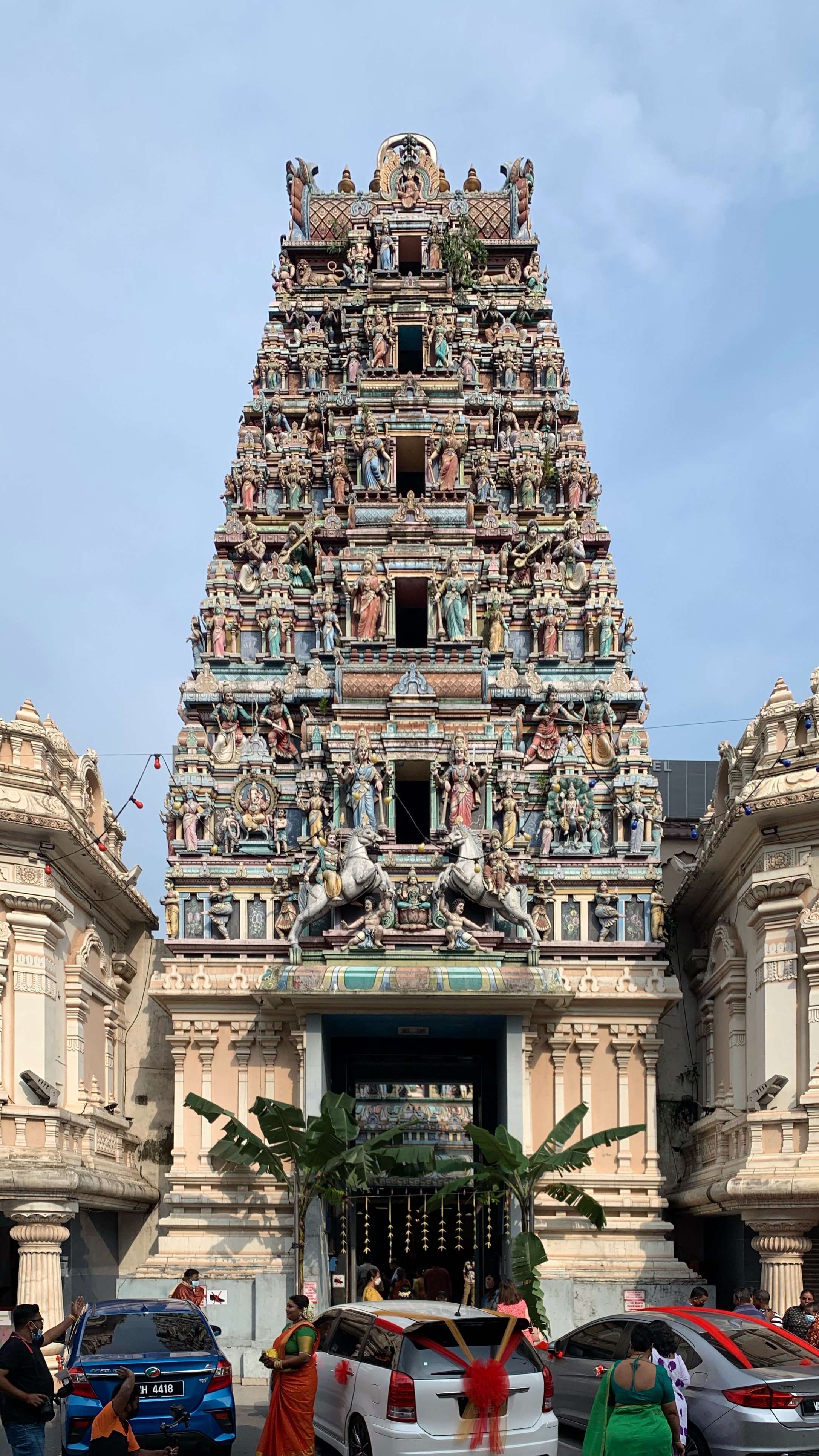
Sri Mahamariamman Temple, Kuala Lumpur
Two hundred and twenty-eight gods crowd the gopuram. Carved by S.T. Muniappa of Tamil Nadu, they climb the five-tiered gateway in a riot of color and gesture, each figure sculpted by artisans who traveled from southern India to shape a tower on the edge of Kuala Lumpur's Chinatown. Below them, at street level, the temple entrance is guarded by Pillaiyar -- Ganesha, the remover of obstacles -- because in Hindu tradition, no threshold should be crossed without first acknowledging what might stand in the way. The Sri Mahamariamman Temple has stood in some form on this stretch of Kuala Lumpur since 1873, making it the oldest Hindu temple in the city and, by most accounts, the richest.
A Family Shrine Opens Its Doors
K. Thamboosamy Pillai founded the temple as a private family shrine, a place of devotion for one household among the many Indian immigrants making new lives in the tin-mining boomtown that Kuala Lumpur was becoming. For more than fifty years, the temple remained a Pillai family affair. It was not until the late 1920s that the doors opened to the public, and eventually the family handed management to a board of trustees. The temple's original location was near the Kuala Lumpur railway station; in 1885 it shifted to its present site along Jalan Tun H.S. Lee, at the edge of what is now Chinatown. The initial structure was built of attap -- palm-leaf thatch -- which was demolished in 1887 and replaced with brick. That brick building, too, was eventually torn down to make way for the current temple, completed in 1968 and consecrated in 1973.
A Body Lying in Prayer
The temple's layout follows a principle that is invisible from the street but unmistakable once explained: the entire complex is shaped to resemble a human body lying on its back, head to the west, feet to the east. The five-tiered gopuram -- that dramatic 22.9-meter pyramid of gods at the entrance -- corresponds to the feet, the threshold between the material and spiritual worlds. At the rear lies the garbhagriha, the sanctum sanctorum, corresponding to the head. It is a freestanding structure with its own roof and walls, a single east-facing entrance, and inside it, the chief deity: Sri Maha Mariamman. When the priest performs puja, he stands before this inner chamber, mediating between the faithful and the goddess. Three onion domes mark the locations of shrines within the main hall, visible from outside like signals rising above the roofline.
The Goddess Who Travels with You
Mariamman is not a deity of grand temples and imperial patronage. She is the protector of those who leave home -- the goddess overseas Indians, especially Tamils, turn to when they find themselves in foreign lands. As a manifestation of Parvati, she embodies Mother Earth in all her ferocity, shielding devotees from forces they cannot control. For the Indian immigrants who built their lives in Malaya's tin mines, rubber plantations, and railway works, Mariamman's presence in Kuala Lumpur was not ornamental. It was essential. The temple's board of trustees still manages both the Batu Caves Sri Subramaniam Temple and the Kortumalai Pillaiyar Temple, and serves as Hindu Religious Consultant to the Malaysian government for determining the yearly Hindu calendar -- a quiet institutional authority that belies the temple's origins as a single family's shrine.
Silver Bells Through the City Streets
Each year during Thaipusam, thousands of devotees gather at the temple before dawn. They come for the silver chariot -- 6.5 meters tall, built from 350 kilograms of silver at a cost of RM350,000, shipped from India in twelve pieces and assembled on site. Its 240 bells chime as it carries statuettes of Lord Muruga and his consorts, Valli and Teivayanni, through the city streets to Batu Caves, 13 kilometers to the north. The chariot made its debut in 1983, replacing a wooden predecessor built in 1930 by Indian craftsmen. Devotees follow on foot, some carrying pots of milk as offerings, others bearing elaborate kavadi frames on their shoulders. The procession transforms central Kuala Lumpur for hours, turning a modern Asian capital into something older and more elemental -- a river of faith flowing through glass and concrete.
Reconsecrated Every Twelve Years
Hindu tradition calls for temples to be reconsecrated on a twelve-year cycle, and Sri Mahamariamman follows this practice faithfully. Each reconsecration is both a spiritual renewal and a physical one, an occasion for repair, restoration, and rededication. The temple has also grown in recent decades: the Bangunan Mariamman, a six-story building behind the temple on Jalan Tun H.S. Lee, was completed at a cost of RM13 million, giving the institution auditoriums, a hall, and basement parking. It sits beside the Klang Bus Station, opposite the Pasar Seni LRT and MRT station -- anchoring the temple firmly in the infrastructure of a city that has grown up around it. From attap thatch to silver chariot to modern multiplex, the Sri Mahamariamman Temple has reinvented itself at every turn without losing the essential thing: a place where those far from home can feel that home has followed them.
From the Air
Located at 3.143N, 101.696E at the edge of Kuala Lumpur's Chinatown (Petaling Street), near the Klang River confluence that gives the city its name. The colorful gopuram tower is difficult to spot from altitude but the adjacent Chinatown market streets provide a visual reference. Sultan Abdul Aziz Shah Airport (WMSA/SZB) at Subang is 18nm west; Kuala Lumpur International Airport (WMKK/KUL) is 30nm south. The KL Railway Station, Masjid Negara, and Merdeka Square are all within 500 meters. Best viewed at 1,500-2,500 feet AGL.