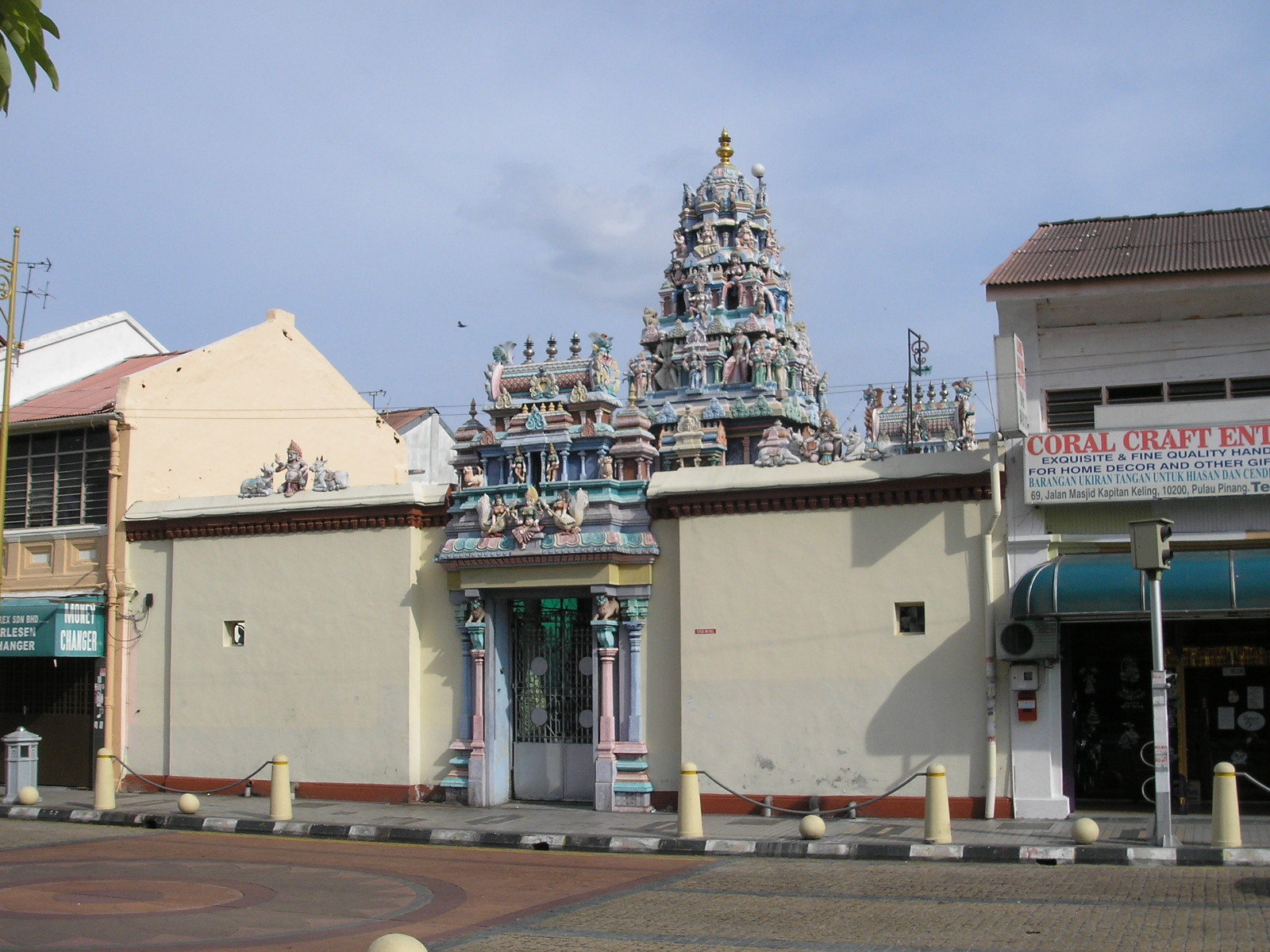
Sri Mahamariamman Temple, Penang
A four-tiered tower of painted gods rises above Queen Street in George Town, its 38 statues of deities staring down at the morning traffic with the serene indifference of figures who have been watching this street for nearly two centuries. The Arulmigu Sri Mahamariamman Temple, Penang's oldest Hindu temple, has occupied this spot since 1833, though worship on this ground stretches back even further, to 1801, when the site was little more than a simple shrine on land granted by the British to the headman of the Tamil community. What began as an act of devotion by early Indian settlers far from home became one of the most elaborately adorned temples in Malaysia.
Seeds of a Shrine
In the early nineteenth century, Penang was booming. The tropical island off the northwest coast of Peninsular Malaysia had become a magnet for traders dealing in nutmegs, cloves, and pepper, drawing merchants from Europe, Arabia, India, and China. Among those who arrived were Tamil Indians, who settled into what became George Town's Little India and built a spiritual anchor for themselves in an unfamiliar land. In 1801, the British granted land to Betty Lingam Chetty, the Kapitan, or community leader, of the local Tamils and South Indians. A place of worship took root on that plot, though no records survive to explain exactly how or by whom the first shrine was established. By 1833, the shrine had grown into a proper temple. Captain James Low confirmed its existence in Georgetown by 1835, and from that point forward, the Sri Mahamariamman Temple became the spiritual center of Penang's Hindu community.
Stone Gods in Tropical Light
The temple's most striking feature is its gopuram, the sculptured tower that rises 23.5 feet above the entrance. Four tiers of painted figures depict the goddess Mahamariamman in her many incarnations: Meenatchi, Kamatchi, Visalatchi, Bhuvaneswari, each attended by soldiers, swans, and cascades of floral decoration, the whole assembly capped by five small kalasams. Step inside and the ornamentation deepens. Lord Ganesha occupies the left pillar; his brother Lord Muruga stands on the right. Eight figures of Ashta Lakshmi, the goddess of wealth in her eight forms, adorn the interior pillars, while the left wall bears sculptures of Nadaraja and Sivakami frozen mid-step in the cosmic dance. At the heart of the temple, in the sanctum sanctorum known as the karuvarai, the primary deity Goddess Mahamariamman sits at the moolastanam. Generations of Hindu artisans and sculptors from India and Penang have layered the interior with stonework, precious stones, and diamonds, transforming what began as a makeshift hut into a space that gleams.
The Chariot and the Hill
Every year in the Tamil month of Chithirai, usually April or May, the temple becomes the starting point for the Chitraparuvam Festival, a three-day celebration marking the first full moon of the Tamil new year. A panchaloha deity of Lord Subramaniyaswami is placed on a chariot and carried in procession from Queen Street through the surrounding neighborhoods, eventually reaching the Waterfall Arulmigu Sri Ganesha Temple and climbing to the hilltop Arulmigu Sri Balathadayuthapani Temple. On the second day, the deity circles the hilltop temple compound. On the third evening, it descends and begins the chariot journey home. Since the early 1970s, the festival has grown from a single day to three. In 1992, the Hindu Mahajana Sangam imported a new silver chariot from India, and in 2017, a golden chariot valued at RM3 million made its maiden journey through George Town's streets in the rain, a debut that sparked fierce community debate about tradition and display.
Faith Between Empires
The temple's survival across two centuries is itself a kind of story about resilience. It weathered British colonial administration, the Japanese occupation during World War II, and Malaysia's transition to independence. Through each era, the temple continued to serve as the gravitational center of Penang's Tamil community, a place where language, ritual, and identity could be maintained far from the Indian subcontinent. In 2016, after extensive renovation work that brought fresh color to the gopuram and restored interior elements, the temple was reconsecrated in a ceremony that drew worshippers from across Malaysia. The Penang Hindu Endowment Board oversees its operation today, ensuring the daily rhythm of pujas continues each morning at 7:30 and each evening at 6:30, open to visitors who remember to remove their shoes before stepping onto ground that has been sacred for more than two hundred years.
From the Air
Located at 5.417°N, 100.338°E in the heart of George Town, Penang, Malaysia. The temple sits on Queen Street in the Little India district, within the UNESCO World Heritage zone. Nearest airport is Penang International Airport (WMKP), approximately 10 nm to the south. From cruising altitude, the George Town UNESCO core zone is visible along Penang Island's northeastern coast, with the Penang Bridge providing a clear visual reference to the south.