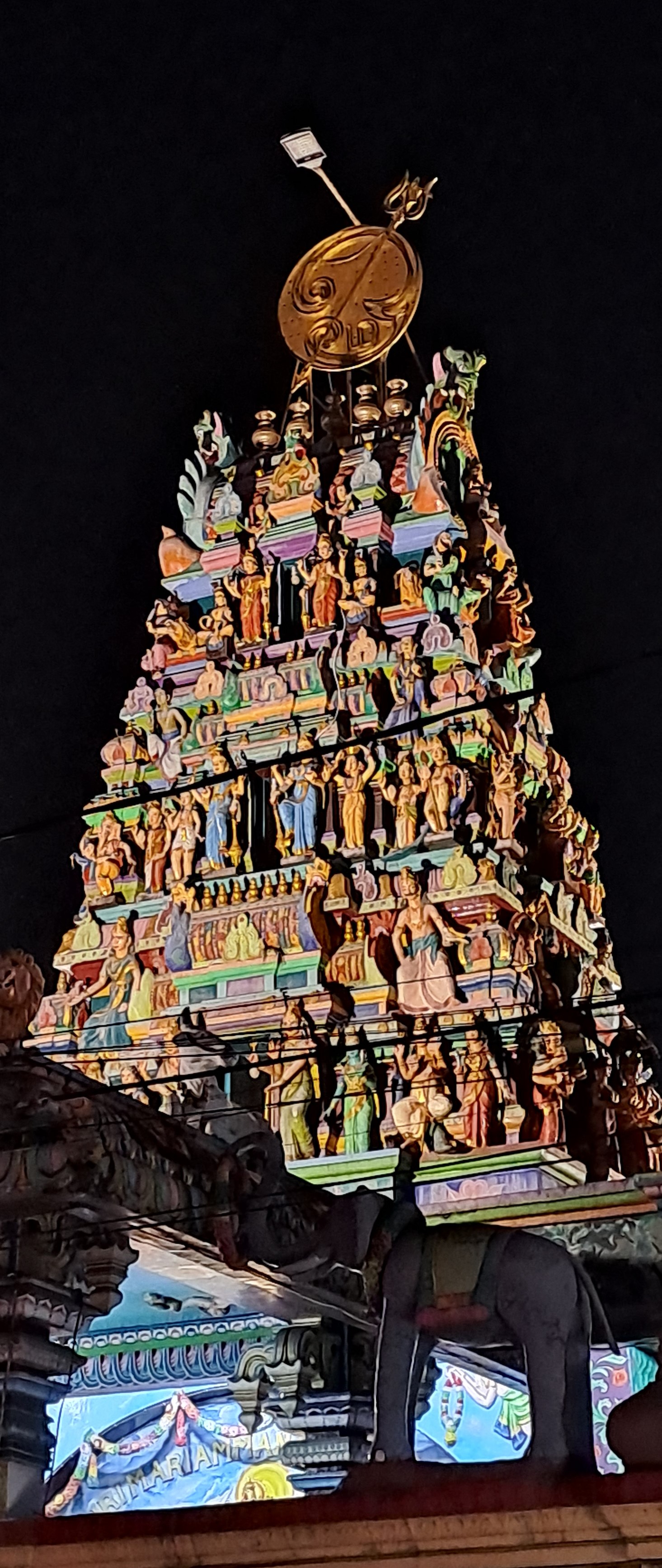
Sri Mariamman Temple, Medan
In a city shaped by mosques, Chinese temples, and Dutch colonial offices, a South Indian gopuram tower rises above Kampung Madras like a signpost from Tamil Nadu. The Sri Mariamman Temple, built in 1884, is the oldest Hindu temple in Medan -- constructed not by priests or princes but by Tamil laborers who had crossed the Indian Ocean to work North Sumatra's colonial plantations. They carried their goddess with them. Mariamman, the deity who cures disease and summons rain, found a new home on Jalan Teuku Umar, and the community that built her temple never left.
Plantation Workers and Sacred Ground
The temple's origins belong to the great migration that transformed Sumatra's east coast in the nineteenth century. Dutch plantation companies recruited Tamil workers from South India to labor in the tobacco and rubber estates of North Sumatra. These workers settled in what became Kampung Madras -- Medan's Little India -- clustering around the familiar rhythms of temple life, Tamil language, and Hindu worship. Led by donors including Sami Rangga Naiker, Somusundram Vaithiyar, and Ramasamy Vaithiyar, the community pooled its resources to build the Sri Mariamman Temple in 1884. It was a cooperative act of faith by people far from home, and it endures as the oldest Hindu temple in a city that would grow to become North Sumatra's capital.
A Goddess for Hard Times
Mariamman is not a goddess of luxury or abstract philosophy. In the villages of Andhra Pradesh, Tamil Nadu, and Karnataka where her worship originates, she is the deity you pray to when cholera arrives, when the monsoon fails, when children fall ill. She cures disease, eases suffering, and brings rain to parched land. For Tamil plantation workers in the tropical lowlands of Sumatra -- exposed to malaria, harsh labor conditions, and the uncertainties of life in a foreign land -- Mariamman was the deity who understood their daily reality. The temple also houses altars to Vishnu, Shiva, Ganesha, Durga, and Murugan, but it is Mariamman who gives the place its name and its emotional center.
Stone, Color, and the Gopuram Gate
Unlike many Hindu temples elsewhere in Indonesia, which adopt Javanese or Balinese architectural styles, Sri Mariamman follows the South Indian and Sri Lankan tradition faithfully. The gopuram -- a tiered gateway tower dense with sculpted figures -- marks the entrance, announcing the temple's South Indian identity from blocks away. Walls 2.5 meters high enclose the compound. Above the main entrance stands a relief of Tuwarasakti, the female guardian of Mariamman, depicted with four arms carrying a trident, mace, and pasa. Inside, three worship chambers hold statues of the Hindu trinity: Vishnu, Shiva, and Brahma. The inner sanctum enshrines Murugan and Narayanan. Behind the main structure, Krishna, Raja Rajeswari, and Thillai Natarajar occupy their own shrine. Statues of Lakshmi and Parvathi flank the front walls, while a mustachioed Hindu priest figure, carved in the typology of the Tamil people, watches from the center.
Thaipusam in the Tropics
During Thaipusam and Diwali, the temple becomes the gravitational center of Medan's Tamil Hindu community. Devotees gather on Jalan Teuku Umar, where the temple sits adjacent to the modern Sun Plaza shopping center -- a juxtaposition that captures Medan in miniature: the sacred and the commercial, the nineteenth century and the twenty-first, separated by a property line. The temple was officially re-inaugurated for Hindu Dharma on October 23, 1991, by the Governor of North Sumatra, H. Raja Inal Siregar, formalizing a status the community had maintained on its own for over a century. Just 500 meters away stands the Gunung Timur Temple, Medan's largest Chinese place of worship, and nearby rises the Masjid Agung. Together, these three sites form a corridor of living faith that makes central Medan one of Southeast Asia's most concentrated multireligious landscapes.
From the Air
Located at 3.584N, 98.671E in the Kampung Madras district of central Medan, North Sumatra. The gopuram tower is the most distinctive visual marker, rising above the surrounding low-rise commercial area. Nearest major airport is Kualanamu International Airport (WIMM), approximately 38 km southeast. The temple is 500 meters from Gunung Timur Temple and roughly 1 km from Maimun Palace, all within the dense central urban area. Best observed at 1,500-2,500 feet for context within the surrounding neighborhood.