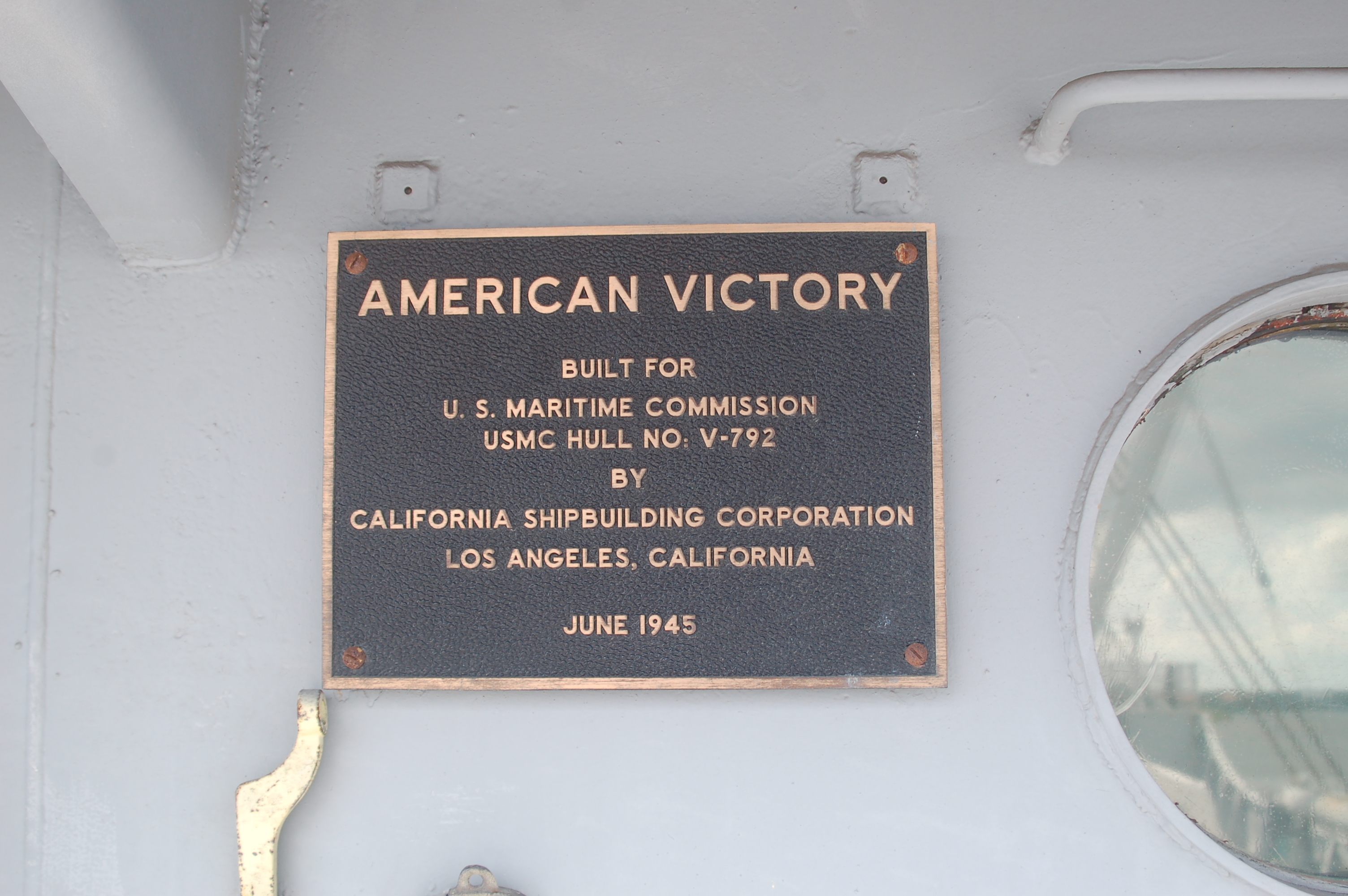
SS American Victory
She was built in just 55 days. Launched from the California Shipbuilding Yard in Los Angeles in June 1945, the SS American Victory slid into the water as World War II was grinding toward its final months in the Pacific. Named after American University in Washington, D.C., this Victory ship would go on to serve in not one but three American wars, survive two typhoons and a hurricane, spend decades mothballed in reserve fleets, and dodge the scrapyard by the narrowest of margins. Today she sits along Tampa's waterfront, one of only three Victory ships in the world still open to the public, and the only one that remains fully operational and seaworthy.
Three Wars, One Ship
American Victory's first assignment came fast. Within weeks of her commissioning, she was hauling ammunition and cargo from Los Angeles to Southeast Asia for the final push against Japan. When the war ended, she reversed course, ferrying troops, equipment, and the exhausted machinery of conflict back to American ports. Between wars she drifted in and out of service, sometimes chartered to commercial carriers, sometimes languishing in the government's reserve fleets along the Sabine and James Rivers. The Korean War pulled her back to active duty from 1951 to 1954, carrying supplies across the Pacific once more. Then, in 1966, she was reactivated yet again, this time to deliver military equipment to American forces in South Vietnam under charter to the Hudson Waterways Corporation. By the time she was deactivated for the last time in October 1969, American Victory had logged service across the defining conflicts of the twentieth century.
The Ship That Almost Wasn't
In 1963, the Navy hatched a plan to convert American Victory and fourteen other Victory ships into "forward depot" vessels, pre-loaded with supplies and stationed near global flashpoints. Had the plan gone through, she would have been renamed USNS Carthage and given a new hull classification. But the scheme was cancelled in February 1966 after only three conversions were completed, and American Victory kept her name. Then came a stranger chapter: in 1985, the government spent $2.5 million to renovate her as a test case for reactivating mothballed Victory ships. After all that money and effort, she sailed for exactly 26 hours before returning to the Naval Reserve Fleet. It was a brief and expensive demonstration, but it proved her engines still had life in them. That proof of seaworthiness would matter more than anyone expected a decade later.
Rescued from the Breakers
By the late 1990s, American Victory and several other surviving Victory ships were slated for scrapping. Of the 534 Victory ships completed during World War II, nearly all had been broken up or sunk. Preservation efforts began in October 1998, and on September 16, 1999, she arrived in Tampa under tow to begin a new career as a museum ship and memorial. Volunteers and donors poured into the project. By 2003, a full overhaul had restored the ship to operational status, and she was placed on the National Register of Historic Places. Today, visitors can walk through officer and crew quarters, the galley and mess hall, the wheelhouse and chartroom, the radio room, the hospital, and three forward cargo holds, all decorated with original period memorabilia.
Guns, Artifacts, and a U-Boat Propeller
American Victory carries her wartime armament in reconstructed gun tubs: a 3-inch/50-caliber bow gun and a 5-inch/50-caliber stern gun, with an additional 3-inch gun mounted alongside. Below decks, the No. 3 cargo hold has been converted into a museum exhibit space holding an original submarine propeller recovered in 1979 from a German U-boat sunk by the U.S. Coast Guard in May 1942. Nearby sit a mannequin of a Kriegsmarine sailor in uniform, detailed ship models including a German Type VII U-boat, vintage Merchant Marine recruiting posters, and a collection of plaques from Victory and Liberty ships that have since been scrapped or sunk. The ship has also been upgraded with modern VHF radio and radar equipment, visible from the bridge deck, a practical reminder that this is not merely a relic but a vessel that still passes U.S. Coast Guard safety inspections twice a year.
Still Seaworthy
What sets American Victory apart from most museum ships is that she can still move under her own power. With considerable preparation, she can cruise Tampa Bay, making her one of the very few World War II-era vessels anywhere in the world capable of getting underway. That distinction matters. A ship that floats at a dock tells one story; a ship that can fire her engines and clear the harbor tells quite another. She sits today in Tampa's Water Street District, directly behind the Florida Aquarium, her gray hull and clean lines a stark contrast to the glass towers rising around her. Of the 534 Victory ships completed, only two others survive as public museums: one in Los Angeles and one in Richmond, California. Together, the three are the last tangible link to the Merchant Marine fleet that kept the supply lines open across three wars and two oceans.
From the Air
Located at 27.94N, 82.44W along the Tampa waterfront in the Water Street District, directly behind the Florida Aquarium. The ship's gray hull is visible along the Garrison Channel. Best viewed from low altitude on approach from Tampa Bay. Nearest airport: KTPA (Tampa International Airport), approximately 6 nm west. Peter O. Knight Airport (KTPF) on Davis Islands is closer at roughly 1.5 nm south. The Hillsborough Bay shoreline and downtown Tampa skyline provide strong visual references.