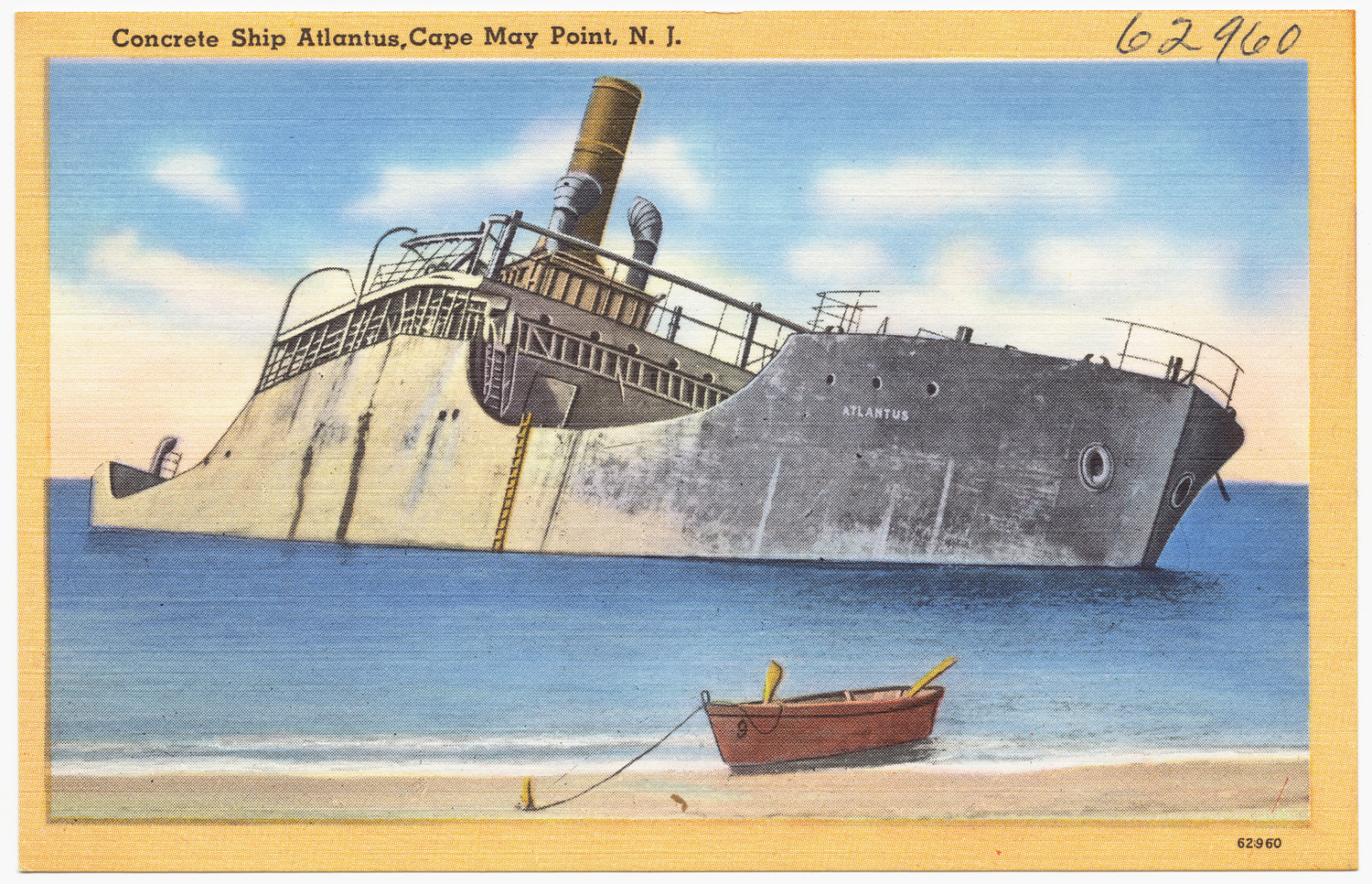
SS Atlantus
She was built of concrete because the world was running out of steel. During World War I, Germany's U-boats were sinking cargo ships faster than American shipyards could replace them, and the steel needed for new hulls was being diverted to weapons and ammunition. So the Emergency Fleet Corporation tried something desperate: ships made of reinforced concrete. The Liberty Ship Building Company in Brunswick, Georgia, launched twelve of them. The SS Atlantus, the second off the line, splashed into the water on December 5, 1918, less than a month after the armistice. The war she was built to fight was already over.
A Ship Made of Stone
Concrete ships sound like a contradiction, but the engineering was sound enough. Reinforced with steel rebar and shaped into a proper hull, concrete could float by the same physics that keeps any vessel afloat: displace more water than the weight of the structure, and buoyancy does the rest. The Atlantus completed her sea trials with a 400 to 500-mile shakedown voyage and made her maiden run to Wilmington, Delaware, on May 26, 1919. The Liberty Ship Building Company, headquartered in Wilmington, had designed her for service between New York and the West Indies. She made seventeen voyages before the economics caught up. Concrete ships were heavy, slow, and expensive to operate. The Atlantus was laid up at Norfolk and left to rust, or rather, to crack.
Colonel Rosenfeld's Grand Plan
In 1926, Colonel Jesse Rosenfeld saw an opportunity. He purchased the Atlantus and two of her concrete sister ships to serve as the foundation for a ferry dock at Cape May. The plan was audacious: dig a channel to shore, sink the Atlantus in place, and position her sisters in a Y formation to create a sheltered slip where ferries could dock. It was the kind of plan that works beautifully on paper. Groundbreaking ceremonies were held in March 1926. The Atlantus was repaired and towed south to Cape May. Then, on June 8, a storm rolled in. The ship broke free of her moorings and drifted 150 feet off the coast of Sunset Beach, where she ran aground on a sandbar. Several attempts to free her failed. Colonel Rosenfeld's ferry terminal was never completed.
A Slow Disappearing Act
The stranded hulk became an accidental landmark. The Coast Guard base at nearby Sewell Point used the wreck for breeches buoy training, firing rescue lines to the grounded ship as practice for saving sailors from real wrecks. Someone painted a billboard on her exposed side advertising boat insurance, a bit of dark humor that delighted beachgoers. Over the decades, waves and weather have split the Atlantus into three pieces. The stern section remains the most visible, a gray slab of concrete jutting from the surf. The midsection has slipped completely beneath the surface. The bow appears only at low tide, like a secret the ocean reveals and then takes back. Each year there is a little less to see, and each year tourists still come to Sunset Beach to watch the sun set behind what remains.
The Concrete Fleet's Legacy
The twelve concrete ships of the Emergency Fleet were an experiment born of wartime desperation. Most were scrapped or scuttled within a decade. A few found second lives as breakwaters or fishing piers. The Atlantus is the most famous of the twelve precisely because of her failure. Stuck in the sand off one of America's most popular resort beaches, visible from shore, photographed on postcards since the 1940s, she became a monument to both ingenuity and miscalculation. The concrete that was meant to carry cargo across the Atlantic now slowly returns to the sea, grain by grain, while visitors stand on Sunset Beach and try to imagine a world desperate enough to build ships out of stone.
From the Air
The SS Atlantus wreck sits at 38.944N, 74.972W, approximately 150 feet offshore of Sunset Beach at Cape May Point, New Jersey. From altitude, look for the dark shape breaking the surf line just off the southwestern tip of the peninsula. The wreck is best spotted at low tide when more structure is exposed. Cape May County Airport (KWWD) is approximately 5nm to the north. The Cape May Lighthouse is visible less than half a mile to the southeast. The Cape May-Lewes Ferry terminal lies to the north along the bay shore. At 1,500-2,500 feet AGL, the wreck, Sunset Beach, and the lighthouse form a tight triangle of landmarks at the peninsula's tip.