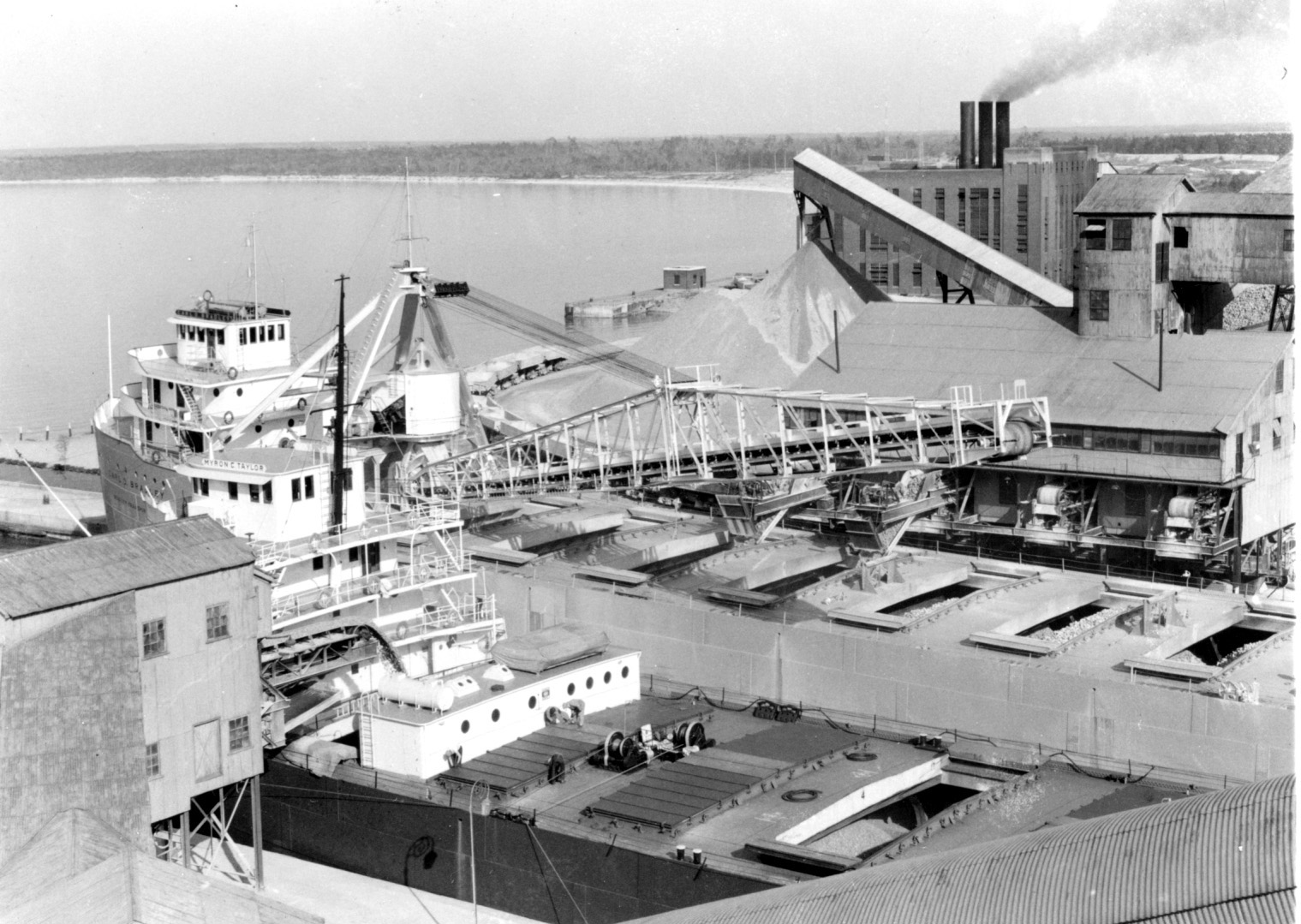
SS Carl D. Bradley
A common joke among the crew was that she was being held together by her rust. Sailors swept sheared rivets off the deck by the bucketful after storms, listening to the hull groan and twist in the November swells. The SS Carl D. Bradley had been the queen of the Great Lakes for 22 years, the longest and largest freighter on the inland seas, and her crew knew better than anyone that age was catching up with her. On the evening of November 18, 1958, somewhere southwest of Gull Island in northern Lake Michigan, the joke stopped being funny. The 638-foot limestone carrier broke apart in a storm and sank in minutes, killing 33 of her 35 crew members. Twenty-three of the dead came from a single town -- Rogers City, Michigan, population 3,873.
Queen of the Lakes
The Carl D. Bradley slid into the water at Lorain, Ohio, on April 9, 1927, built by the American Ship Building Company for the Bradley Transportation Company. She was a self-unloading freighter designed to haul limestone from Michigan Limestone's quarry at Calcite Harbor in Rogers City to ports across the Great Lakes. At her launch, she was the longest freighter on the lakes and held that title for 22 years until the SS Wilfred Sykes took over in 1949. She was the flagship of the fleet, her gray and red paint always fresh, her decks hosed down, carrying corporate officials in her staterooms. She was the only fully electric ship in the Bradley fleet, powered by two Foster-Wheeler boilers driving a generator that ran everything from propeller to running lights. In 1929 she loaded her largest cargo -- a haul of limestone so enormous it would have required 300 railroad cars to move. She was traditionally the first boat through the Straits of Mackinac each spring, her concrete-filled forepeak smashing through the ice while smaller vessels waited.
A Town on the Water
Rogers City and the Carl D. Bradley were inseparable. The Bradley Transportation fleet drew its crews almost entirely from this small Lake Huron port town, where Michigan Limestone was the economic heartbeat. Crewmen were friends, neighbors, cousins. The boats departed and returned every few days, so the men raised their families right there, within sight of the harbor. The ship's registered port was New York City, a legal formality that meant nothing -- her true home was Calcite Harbor. By the late 1950s, the Bradley was showing her age. A collision on the St. Clair River in 1957, two groundings near Cedarville in 1958, and a hull so deteriorated that an $800,000 overhaul of her cargo hold and bulkheads was already planned. The Coast Guard inspected her in April and October of 1958 and found her seaworthy both times, but the company's focus, as investigators later noted, was on industrial safety rather than the material condition of the vessel.
The Night of November 18
The Bradley departed Gary, Indiana, empty on November 17 at 10:00 p.m., headed for winter layup at Manitowoc, Wisconsin. Then came a last-minute order from U.S. Steel: turn around and pick up one more load of stone at Calcite Harbor. Captain Roland Bryan, known as a "heavy weather captain" who prided himself on delivering cargo on time, altered course north up Lake Michigan. Two separate weather systems were merging into a monster -- thirty tornadoes across the Midwest, record snowfall in Arizona, blizzards burying the Dakotas. Bryan hugged the Wisconsin shore for shelter, and the ship rode smoothly through the building seas. By 4:00 p.m. on November 18, winds were at storm force from the southwest. At 5:35 p.m., southwest of Gull Island, the hull cracked. The ship broke in two. The captain shouted for the crew to run for their life jackets. The first mate managed a mayday call before power lines severed. One lifeboat tangled in cables; the other hung at an impossible angle. Only the life raft cleared the wreck when the bow sank.
Headlights on the Beach
The German cargo vessel Christian Sartori witnessed the sinking through binoculars -- the bow lights going dark, then the stern, then an explosion sending a column of red, yellow, and white flame into the sky. She fought through the waves for ninety minutes to reach the site but found nothing. The Coast Guard Cutter Sundew battled out of Charlevoix and arrived five hours after the sinking. The Hollyhock, coming from Sturgeon Bay, took seven hours in conditions her captain called "a visit to hell." Through the night, families from Rogers City drove to Charlevoix and lined the beach, turning their car headlights toward the lake, keeping vigil. Four men reached the life raft, but waves kept throwing them off. They fired two signal flares. The third was wet and failed just as the Christian Sartori passed close by without seeing them. By morning, only two survived: First Mate Elmer Fleming and Deck Watchman Frank Mays. A third man, Gary Strzelecki, was pulled alive from the lake but died shortly after rescue. Seventeen more bodies were recovered wearing life jackets and brought to Charlevoix City Hall for identification.
A Town Forever Changed
The loss hollowed out Rogers City. Twenty-three women were widowed. Fifty-three children lost their fathers. Two wives were pregnant. Friends and relatives flooded in for the funerals, nearly doubling the town's population. A mass funeral at St. Ignatius Catholic Church laid nine of the recovered men to rest. Ships at sea dropped anchor at noon for memorial services. The Coast Guard investigation concluded the ship sank from excessive hogging stresses -- the hull bending beyond what its brittle, pre-1948 steel could bear. Maritime historian Mark Thompson later wrote that the Coast Guard knew about the shortcomings of this notch-sensitive steel but had no program to warn owners or crews, a failure that contributed to the loss of the SS Daniel J. Morrell eight years later. In 2007, divers John Janzen and John Scoles recovered the ship's bell from the wreck and replaced it with a memorial bell engraved with the names of the 33 lost crew. The original bell was returned to Rogers City and tolled at the 50th anniversary memorial in 2008. Every November 18, by mayoral proclamation, Rogers City remembers.
From the Air
The wreck of the Carl D. Bradley lies at approximately 45.56N, 85.99W in northern Lake Michigan, southwest of Gull Island near the Beaver Island archipelago. The site is in deep water and not visible from the air, but the surrounding waters between Beaver Island and the Door Peninsula mark one of Lake Michigan's most storied stretches. Charlevoix Airport (KCVX) lies about 20 nm to the east on the Michigan shore. Pellston Regional Airport (KPLN) is approximately 30 nm to the northeast. The Beaver Island Airport (KSJI) sits on the island just north of the wreck site. From cruising altitude, the open water here shows no islands between the Michigan and Wisconsin shores -- a vast, exposed stretch where November storms build unobstructed.