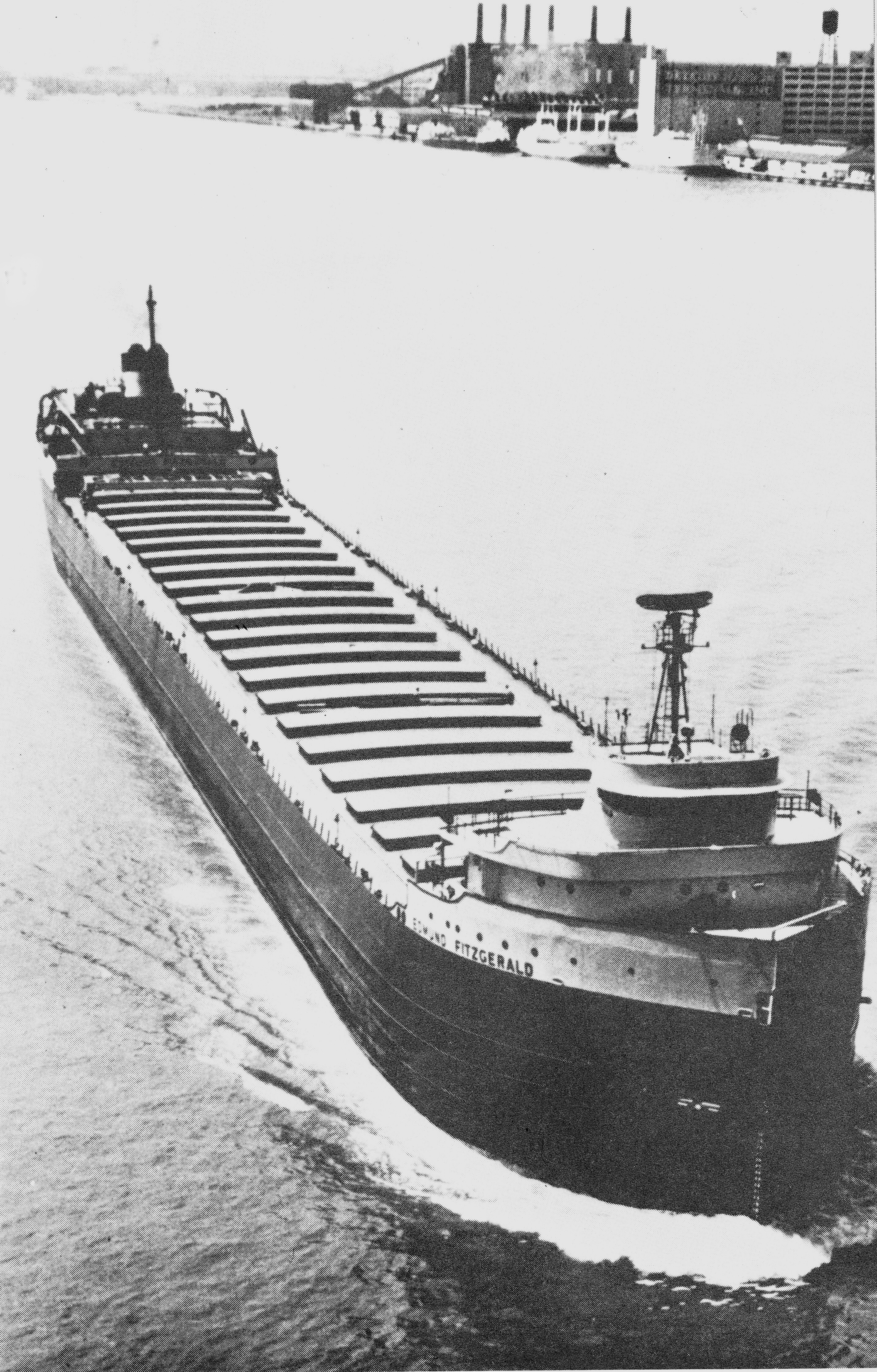
SS Edmund Fitzgerald
"We are holding our own." Those were the last words anyone heard from Captain Ernest McSorley, transmitted by radio at approximately 7:10 p.m. on November 10, 1975. Ten minutes later, the SS Edmund Fitzgerald vanished from radar. No distress signal. No warning. A 729-foot ore freighter carrying 26,000 tons of taconite pellets and 29 souls simply ceased to exist on the surface of Lake Superior. The Arthur M. Anderson, trailing behind and providing radar guidance through the blinding snow, could no longer raise the Fitzgerald by radio. The ship that had been the pride of the Great Lakes fleet when she launched in 1958 was gone, broken in two on the lake floor in Canadian waters close to the international boundary, at a depth of over 500 feet.
Into the Teeth of It
Edmund Fitzgerald left Superior, Wisconsin, at 2:15 p.m. on November 9, 1975, bound for the steel mill on Zug Island near Detroit. The weather forecast was routine for November. Captain McSorley joined up with the Arthur M. Anderson, and the two freighters headed east across Lake Superior along the standard Lake Carriers' Association downbound route. But Captain Dudley Paquette of the Wilfred Sykes, loading at the same dock, had been charting a low-pressure system over Oklahoma since November 8 and predicted it would cross directly over the lake. He chose a sheltered route along the north shore. The National Weather Service caught up to Paquette's assessment by 7:00 p.m., issuing gale warnings for the whole of Lake Superior. By 2:00 a.m. on November 10, warnings were upgraded to storm. McSorley and the Anderson altered course northward, seeking shelter along the Ontario shore, but the storm found them anyway.
The Afternoon Everything Failed
Shortly after 3:30 p.m. on November 10, McSorley radioed the Anderson with troubling news: the Fitzgerald was taking on water, had lost two vent covers and a fence railing, and had developed a list. Two of the ship's six bilge pumps were running continuously. By 4:10 p.m., McSorley reported that both radars had failed. The Fitzgerald was effectively blind in heavy snow, slowing to stay within range of the Anderson's radar guidance. McSorley contacted the Coast Guard to ask whether the Whitefish Point light and navigation beacon were operational -- both were out. Captain Cedric Woodard of the Avafors overheard McSorley say, "I have a bad list, I have lost both radars, and am taking heavy seas over the deck in one of the worst seas I have ever been in." The Anderson logged sustained winds as high as 86 miles per hour. Waves reached 25 feet, with rogue waves towering even higher.
Twenty-Nine Names
The crew ranged from 20-year-old watchman Karl Peckol to 63-year-old Captain McSorley. There were mates and engineers, oilers and deckhands, a cook, a steward, wheelsmen, porters, and a cadet -- 29 people who had shipped out on what was supposed to be an ordinary November run. None were found. The search recovered debris -- lifeboats, rafts, wreckage -- but no survivors. When divers later discovered the remains of a crew member alongside the bow, partly dressed in coveralls and wearing a deteriorated life jacket with cork blocks, it confirmed that at least one person aboard had known the ship was going down. The Whitefish Point area had claimed at least 240 ships between 1816 and 1975. The Edmund Fitzgerald was the largest and most famous to join them.
Broken on the Surface or the Bottom
A U.S. Navy P-3 Orion found the wreck on November 14, 1975, using a magnetic anomaly detector. The ship lay in two large pieces: the bow section upright in the mud, the stern capsized at a 50-degree angle, with a field of taconite pellets and scattered wreckage between them. The Coast Guard concluded in 1977 that ineffective hatch closures caused flooding, and that the ship broke apart when it hit the lake floor. But maritime historian Frederick Stonehouse argued that the pattern of taconite covering the wreck site proved the stern had floated briefly on the surface, spilling cargo into the forward section before sinking separately. Former crew members testified that the hull had a tendency to flex like a diving board in storms, and that keel welds were cracked. The debate continues -- structural failure, rogue waves, shoal damage, or some fatal combination -- but the lake keeps its answer.
The Bell and the Ballad
The day after the wreck, Mariners' Church in Detroit rang its bell 29 times. Ontario singer-songwriter Gordon Lightfoot, angered when he saw the ship's name misspelled as "Edmond" in Newsweek, wrote "The Wreck of the Edmund Fitzgerald" for his 1976 album Summertime Dream. The ballad made the sinking one of the most recognized maritime disasters in history. In 1995, the ship's bell was recovered from the wreck and placed in the Great Lakes Shipwreck Museum at Whitefish Point, near Paradise, Michigan. A replica engraved with the names of all 29 crew members took its place on the sunken hull. Every November 10, Split Rock Lighthouse near Silver Bay, Minnesota, emits a light in the Fitzgerald's honor. The sinking transformed Great Lakes shipping regulations -- depth finders became mandatory, survival suits were required, load line rules were tightened, and annual fall inspections of hatch closures began. As deckhand Joe Warren of the Arthur M. Anderson put it: "After that, when a gale came up we dropped the hook. We dropped the hook because they found out the big ones could sink."
From the Air
The SS Edmund Fitzgerald's wreck site lies at approximately 46.000N, -85.000W in eastern Lake Superior, in Canadian waters close to the U.S.-Canada international boundary. The wreck is not visible from the air but lies roughly northwest of Pancake Bay Provincial Park on the Ontario shore and southeast of the entrance to Whitefish Bay. From cruise altitude, the open expanse of eastern Lake Superior dominates the view -- there are no surface landmarks at the wreck site. Sault Ste. Marie Airport (CYAM) on the Canadian side is approximately 50 nm to the southeast, and Chippewa County International Airport (KCIU) on the American side is a similar distance. Whitefish Point, where the Great Lakes Shipwreck Museum houses the ship's bell, is visible as a narrow peninsula extending into the lake to the south. Weather in this region can deteriorate rapidly, particularly in November -- the same conditions that doomed the Fitzgerald.