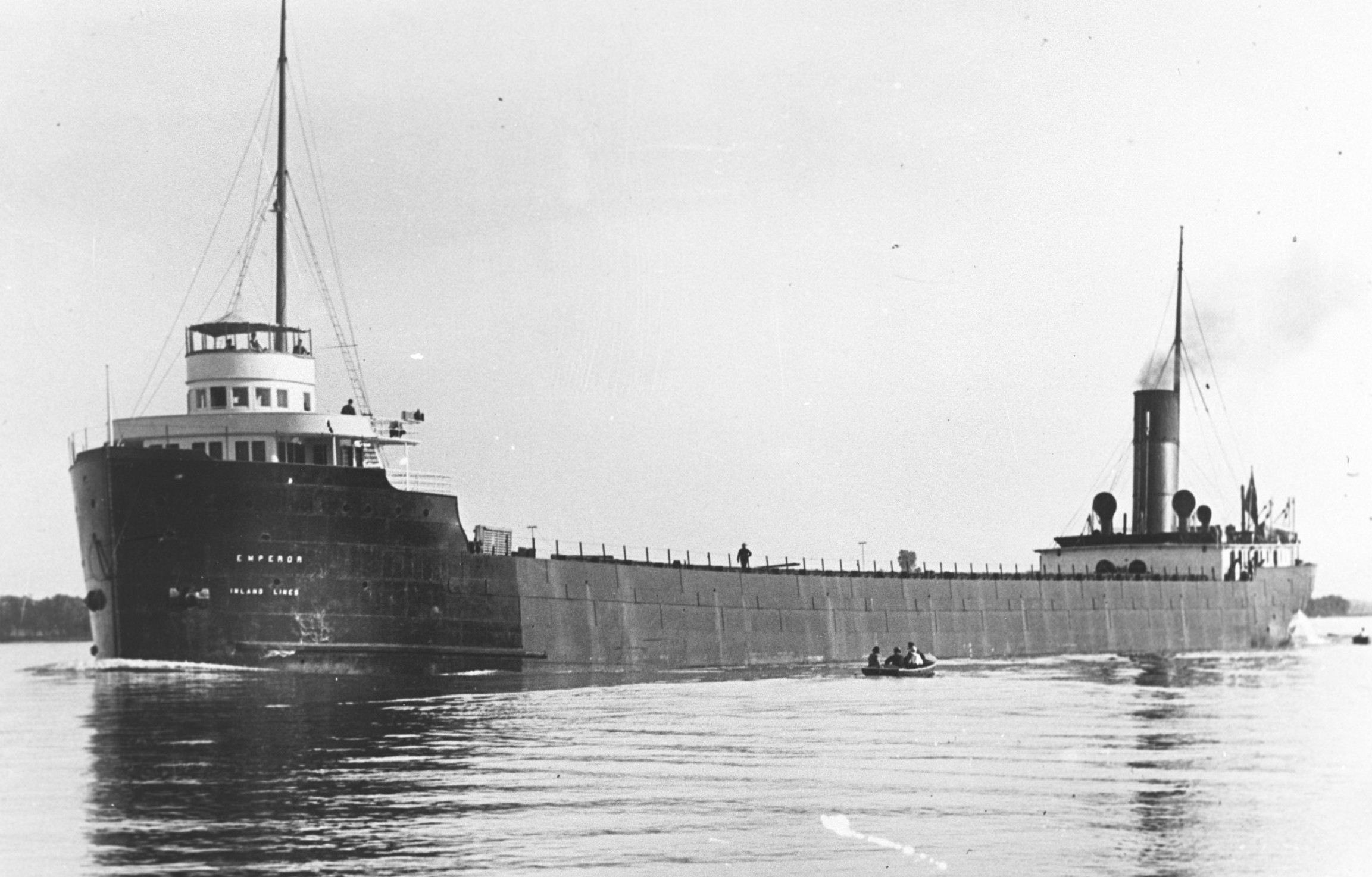
SS Emperor
First mate James Morrey had been awake for over twenty hours. He had supervised the loading of iron ore at the Canadian National Railway dock in Port Arthur, a job that took six or seven hours. Then, instead of sleeping, he took the midnight watch as the Emperor steamed southeast through calm, clear darkness toward Ashtabula, Ohio. Captain Eldon Walkinshaw had gone to bed, trusting his first mate. Sometime before 4:15 a.m. on June 4, 1947, the Emperor crashed into Canoe Rocks at the northeast point of Isle Royale and broke apart. She sank in twenty to thirty-five minutes. Twelve men died, including Morrey, Walkinshaw, and the helmsman. It was the same reef that had claimed the Chester A. Congdon twenty-nine years earlier. The investigation would blame Morrey -- a man too exhausted to navigate, operating under a system that had worked him to collapse.
The Pride of Canada
When the Emperor slid into Collingwood harbour on December 17, 1910, she was the largest Canadian-built ship afloat. James Playfair, who managed Inland Lines and had a fondness for naming his vessels after royalty, christened her himself. At over 525 feet long with a gross tonnage of 7,031, she was built exclusively for the iron ore trade -- her cargo hold divided into five compartments with 30 hatches. A triple-expansion steam engine powered by two coal-fired Scotch marine boilers drove her across the lakes. She earned the nickname 'The Pride of Canada,' and when she commenced her maiden voyage on May 3, 1911, she represented the ambitions of a young nation building its industrial backbone one shipload of ore at a time.
Thirty-Six Years of Hard Luck
The Emperor's career read like a catalog of Great Lakes hazards. On her first upbound trip in May 1911, she broke her propeller shaft in Thunder Bay and had to be towed to port. That October, carrying 310,000 bushels of wheat through the Soo Locks, canal employees flooded the lock before she was ready. The surging water snapped her lines, and the Emperor's anchor tore a hole in her own bow. She sank in the channel, blocking it for months. A court inquiry placed blame on a canal watchman who 'happened to be a deck hand, and therefore irresponsible.' She ran aground on Lake Erie in 1914, on Major Shoal near Mackinaw City in 1926, and on an unknown object near Michipicoten Island before 1932. In November 1936, she lost her rudder in a storm between Passage Island and Lamb Island, drifting helplessly until the canaller Renvoyle towed her to Fort William. One deckhand drowned. In 1937, fog on Lake Ontario caused her to miss a turn and run aground near Bronte. First mate Morrey himself fell overboard from a bridge wing in 1940, though he survived.
The Last Night
On June 3, 1947, the Emperor discharged coal at Fort William and then moved to Port Arthur to load iron ore from the Steep Rock Mine. The loading took hours, and Morrey supervised it all. Two of the thirty-five crew were left behind at Fort William. At 10:55 p.m., she departed for Ashtabula under Captain Walkinshaw. The weather was clear, the wind light. At midnight, Walkinshaw handed the watch to Morrey and went to sleep. The ship needed to thread the gap between Isle Royale and Passage Island -- a passage that demanded precise navigation. Morrey, who had been awake since early morning and had spent hours managing the ore loading, was now solely responsible for guiding the Emperor through the dark.
Twenty Minutes
Shortly before 4:15 a.m., the Emperor struck Canoe Rocks at the northeast point of Isle Royale. The impact broke her hull. Within ten minutes, Walkinshaw -- roused from sleep -- gave the order to abandon ship. The vessel was already listing badly. The starboard lifeboat launched successfully but leaked because its bilge plug was missing. The port lifeboat capsized as the Emperor's sinking hull sucked it under. The night steward swore the boilers exploded, but underwater examination later proved them intact. In twenty to thirty-five minutes, the Emperor was gone. The Coast Guard cutter Kimball, nearby maintaining navigation lights at Blake Point, intercepted the SOS and reached the scene in thirty-five minutes. She picked up twenty-one survivors and the body of cook Evelyn Schultz. Twelve crew members perished, including Walkinshaw, Morrey, and helmsman J. Prokup -- the three people who might have explained what went wrong.
The Wreck That Remembers
The investigation blamed Morrey for failing to keep proper watch, but the court also condemned the system that forced a first mate to supervise cargo loading during his off-duty hours, leaving him sleep-deprived for the critical night passage. Helmsman Prokup, unfamiliar with that stretch of Lake Superior, had not caught the navigational error. Captain Walkinshaw was fully exonerated. Today the Emperor is Isle Royale's most visited shipwreck, drawing more than 350 of the park's 1,062 recorded dives in 2009. She rests in two partially attached sections: the bow battered by decades of ice, the stern remarkably intact with its engine room, mast, and cabin still penetrable. Iron ore still fills her cargo holds. In 1975, sport divers discovered a preserved crew member's body near the engine room, the clothes and hair still intact after nearly three decades in the cold, dark water. Listed on the National Register of Historic Places in 1984, the Emperor endures as both a monument to the men who sailed the iron ore trade and a warning about the cost of exhaustion at sea.
From the Air
The wreck of SS Emperor lies at approximately 48.20°N, 88.49°W, on Canoe Rocks at the northeast point of Isle Royale in Lake Superior -- the same reef that claimed the Chester A. Congdon. From altitude, the reef extends from Isle Royale's northeastern tip toward Passage Island. The shallow bow section may be visible on clear days. The nearest airports include Thunder Bay International (CYQT) approximately 55 nm to the north across the border, and Houghton County Memorial Airport (KCMX) about 65 nm to the southeast on Michigan's Keweenaw Peninsula. Best viewed at 2,000-4,000 feet AGL. The wreck sites of the Congdon and Emperor are within a few hundred yards of each other on the same reef, making the area a compelling flyover destination.