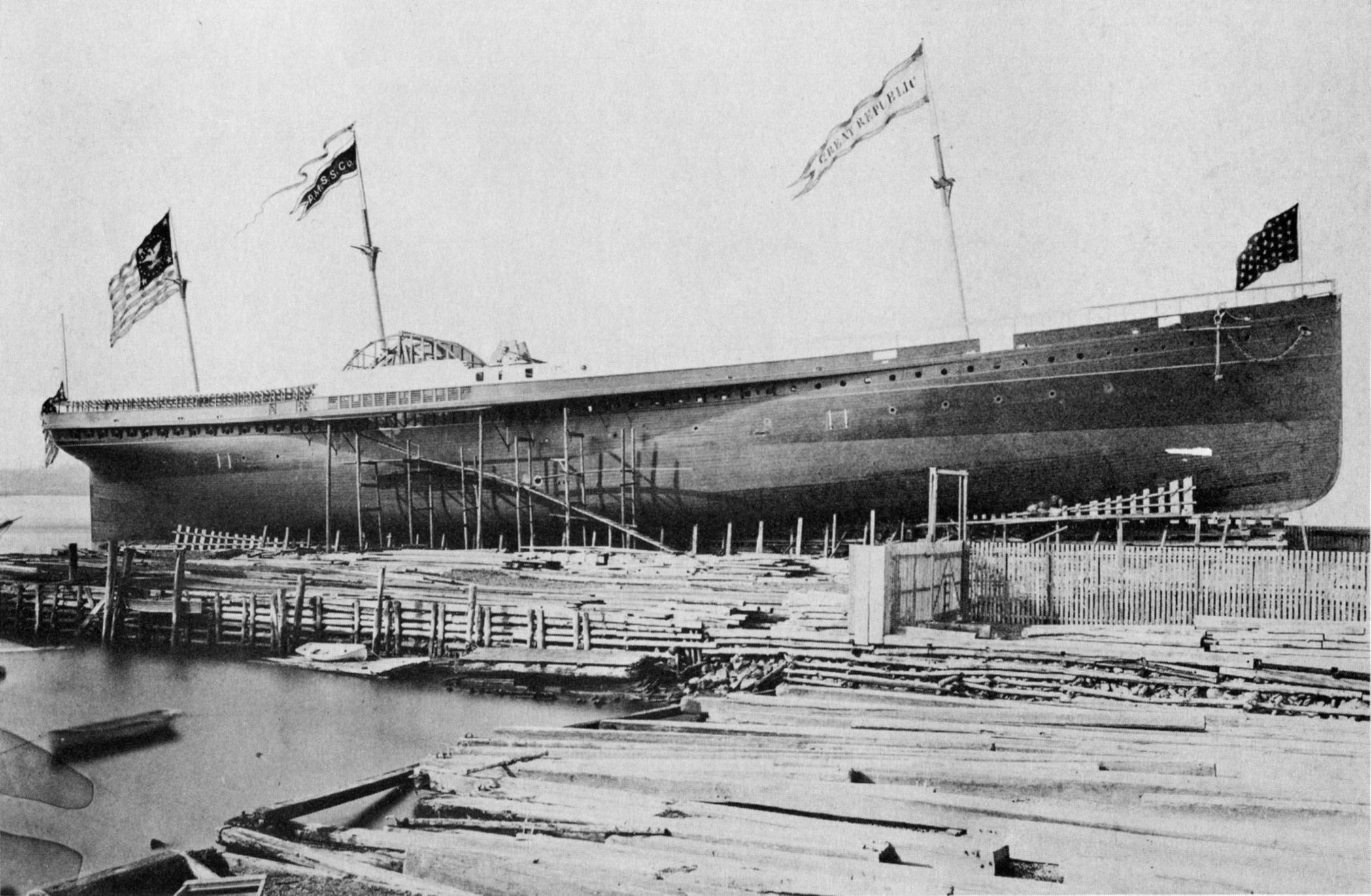
SS Great Republic (1866)
Captain James Carroll saw Sand Island coming. He reported it to the pilot. He warned the pilot they were too close. He told the pilot to haul up. He said it again, more urgently: port your helm, hard over. The pilot made no reply. Five minutes later, the ebb tide caught the largest passenger liner on the American west coast broadside and shoved her onto the spit. The SS Great Republic -- 380 feet of white oak, live oak, copper, and Georgia yellow pine, built to cross oceans -- would never leave the mouth of the Columbia River.
Built for the China Trade
Great Republic launched from Henry Steers's shipyard at Greenpoint, Long Island on November 8, 1866 -- the largest commercial vessel ever constructed in the United States at that date. The Pacific Mail Steamship Company had commissioned her for the new San Francisco-to-China line, and her builders spared nothing. Her frame was white and live oak, braced with iron straps crossing diagonally every four feet, planked in double layers of Georgia yellow pine, and bolted with a combination of locust treenails, iron spikes, and copper bolts. She was designed to survive the Pacific. Three masts carried a full ship rig for sail power. Four horizontal boilers, each heated by four furnaces, drove paddle wheels forty feet in diameter with twelve-foot faces. At 3,881 gross register tons, she was an engineering statement: America could build ships as ambitious as any on the Atlantic.
From Shanghai to the Spit
The China trade did not cooperate. Great Republic proved unprofitable on the transpacific route, and in 1878, Pacific Mail sold her to P. B. Cornwall for service along the U.S. Pacific coast. It was a comedown -- a ship built to bridge continents now shuttled between San Francisco and Portland. On April 19, 1879, she entered the Columbia River on a clear, calm night carrying somewhere between 579 and over 900 passengers and crew, depending on the account. Captain Carroll brought her across the Columbia Bar under a slow bell, crossing safely and reaching the inside buoy. He spotted Sand Island through his glasses and found the bearings correct. He reported it to the pilot, who had not yet seen it. Then he watched the pilot ignore him.
A Captain's Testimony
Carroll's account at the special hearing that followed is a study in escalating dread. He told the pilot they were getting too close to the island. The pilot replied that he did not think they were in far enough. A minute later, Carroll said it again: port your helm, hard over, you are getting too near. No reply. The pilot ran along for another five minutes before finally putting the helm hard aport. Great Republic swung toward Astoria, but it was too late. The ebb tide caught her starboard bow and drove her onto the spit. Stranded on sand in a falling tide with a storm approaching by morning, Carroll evacuated passengers to Astoria on local boats. The crew stayed aboard, hoping to refloat her when conditions improved. They could not. Storm-driven waves began tearing the hull apart, and they abandoned ship. The last boat off -- apart from the captain's and pilot's -- overturned when a steering oar snapped, throwing fourteen men into the water. Between eleven and all fourteen drowned, depending on the source.
Lost and Found
Great Republic vanished beneath the shifting sands of the Columbia's mouth for over a century. In 1986, a diver working to free a snagged fishing net found a wreck that was initially identified as the Isabella, a vessel lost in 1830 while carrying cargo to the Hudson's Bay Company outpost at Fort Vancouver. The identification seemed reasonable -- the location was right, and old wrecks in the Graveyard of the Pacific are common enough that one more surprise was unremarkable. But later analysis told a different story. The planking was American yellow pine, not the European timber expected of the Isabella. The wreck was far too large for an 1830s trading vessel. The evidence pointed to Great Republic -- a ship that once represented the peak of American shipbuilding ambition, reduced to an anonymous tangle of wood and iron on the ocean floor. She had been the biggest, the most powerful, the most elaborately built. The Columbia Bar did not care.
From the Air
The SS Great Republic wreck site lies at approximately 46.278N, 124.024W near Sand Island at the mouth of the Columbia River, south of Ilwaco, Washington. The wreck is buried beneath shifting sands and not visible from the surface. From the air, Sand Island is the key landmark -- a low, narrow island in the river's mouth between Cape Disappointment to the north and Clatsop Spit to the south. The Columbia Bar is often visible as a line of breaking white water where river current meets ocean swell. The Astoria-Megler Bridge spans the river to the east. Cape Disappointment Lighthouse and North Head Lighthouse are visible on the headlands to the north. Nearest airports: Astoria Regional Airport (KAST) approximately 8nm east-southeast, Southwest Washington Regional (KELSO) approximately 45nm northeast. Best viewed at 2,000-3,000 feet to see the bar, Sand Island, and the geography that made this stretch lethal.