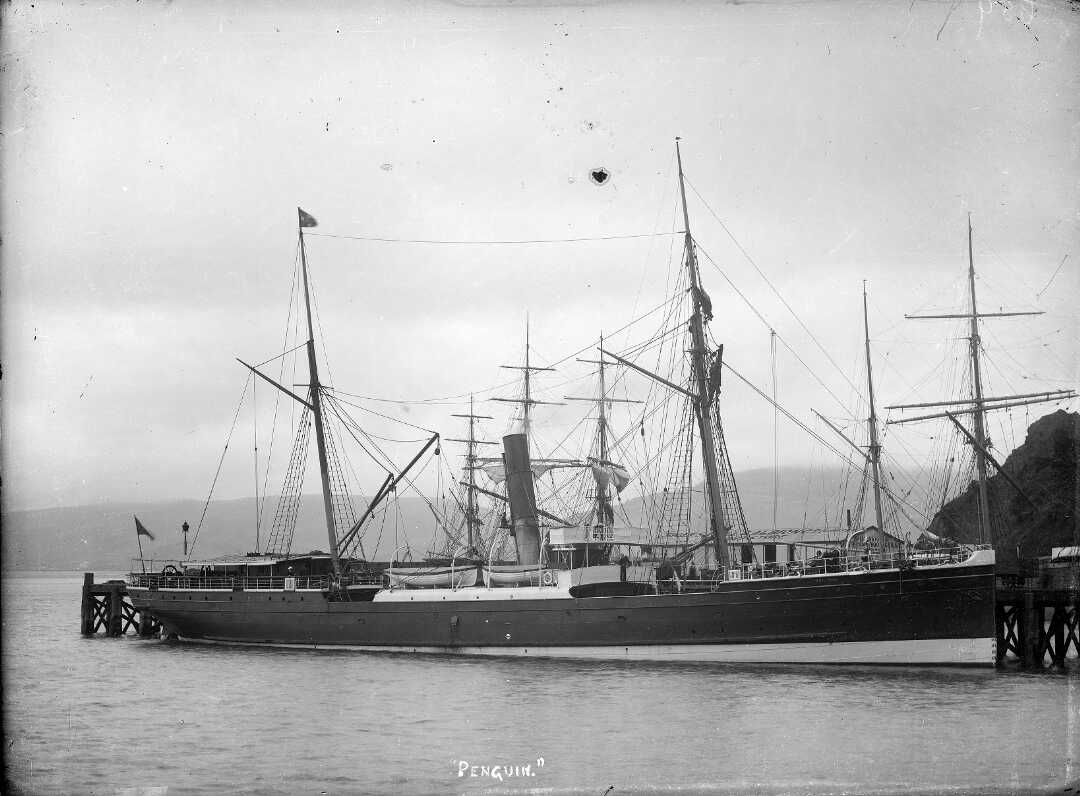
SS Penguin
On the evening of 12 February 1909, the inter-island steamer Penguin departed Picton under clear skies. By nightfall, Cook Strait had turned savage. Gale-force winds tore across the water, and visibility collapsed to almost nothing. What happened next would become New Zealand's deadliest maritime disaster of the twentieth century, killing 75 of the 105 people aboard and leaving a wound in Wellington that took decades to heal.
A Scottish Hull in Southern Waters
The Penguin began life far from the seas that would claim her. Built by Tod & McGregor of Glasgow and launched on 21 January 1864, she first sailed under the flag of G. & J. Burns before the Union Steamship Company purchased her in 1879. An extensive refit in 1882 prepared her for the demanding Cook Strait run between Picton and Wellington, a crossing notorious for violent weather and treacherous currents. By 1909, the Penguin was 45 years old -- ancient for a working vessel -- yet she continued to carry passengers and cargo across one of the most dangerous stretches of water in the Southern Hemisphere.
The Night the Sea Closed In
The weather turned around 8 pm. Captain Francis Naylor, facing howling winds and zero visibility, made the decision to head farther out to sea and wait for conditions to improve. It was a reasonable call from an experienced mariner. But at 10 pm, while turning the ship, the Penguin smashed into Thoms Rock near Sinclair Head, at the mouth of the Karori Stream. Water poured in immediately. The crew loaded women and children into lifeboats, but the mountainous seas swallowed them -- the boats were dragged under almost as soon as they hit the water. Only one woman survived. Every child aboard perished. Those who lived did so by clinging to makeshift rafts, drifting for hours through the dark and freezing strait. As the ship went down, seawater reached the boilers and triggered a massive steam explosion that fractured the hull, scattering wreckage across the seabed.
A City in Mourning
Wellington shut down. A half-day holiday was declared so that the city could bury its dead, and some 40 victims were laid to rest in Karori Cemetery in a procession that wound through streets lined with silent crowds. The disaster prompted a court of inquiry, which concluded the Penguin had struck Thoms Rock. Captain Naylor, who survived, contested the finding -- he maintained his ship had collided with the submerged hull of the Rio Loge, another vessel lost in the strait just a month earlier. The inquiry's conclusion stood, but the captain's theory was never definitively disproven. The ambiguity lingers, a small mystery nested inside a larger tragedy.
What the Water Remembers
A century later, on the 100th anniversary of the sinking, Wellington's mayor unveiled a memorial plaque at Tongue Point, near where the Penguin went down. The waters off Sinclair Head look unremarkable from above -- a stretch of grey-green chop where Cook Strait meets the Wellington coast. Nothing visible marks the grave. But the seabed holds the remains of a ship and the memory of a night when the sea took nearly everything. For the families of the 75 who died, many of whom still live in the Wellington region, the wreck site is not a historical curiosity. It is a place where the ocean demanded a price that the city has never forgotten.
From the Air
Located at 41.35S, 174.66E, off Sinclair Head on Wellington's southwest coast. The wreck site lies near Thoms Rock at the mouth of the Karori Stream in Cook Strait. From the air, look for the rugged coastline between Sinclair Head and Tongue Point. Nearest airport is Wellington International (NZWN), approximately 15 km northeast. Best viewed at 2,000-3,000 ft altitude. The Cook Strait waters here are frequently rough with strong tidal currents.