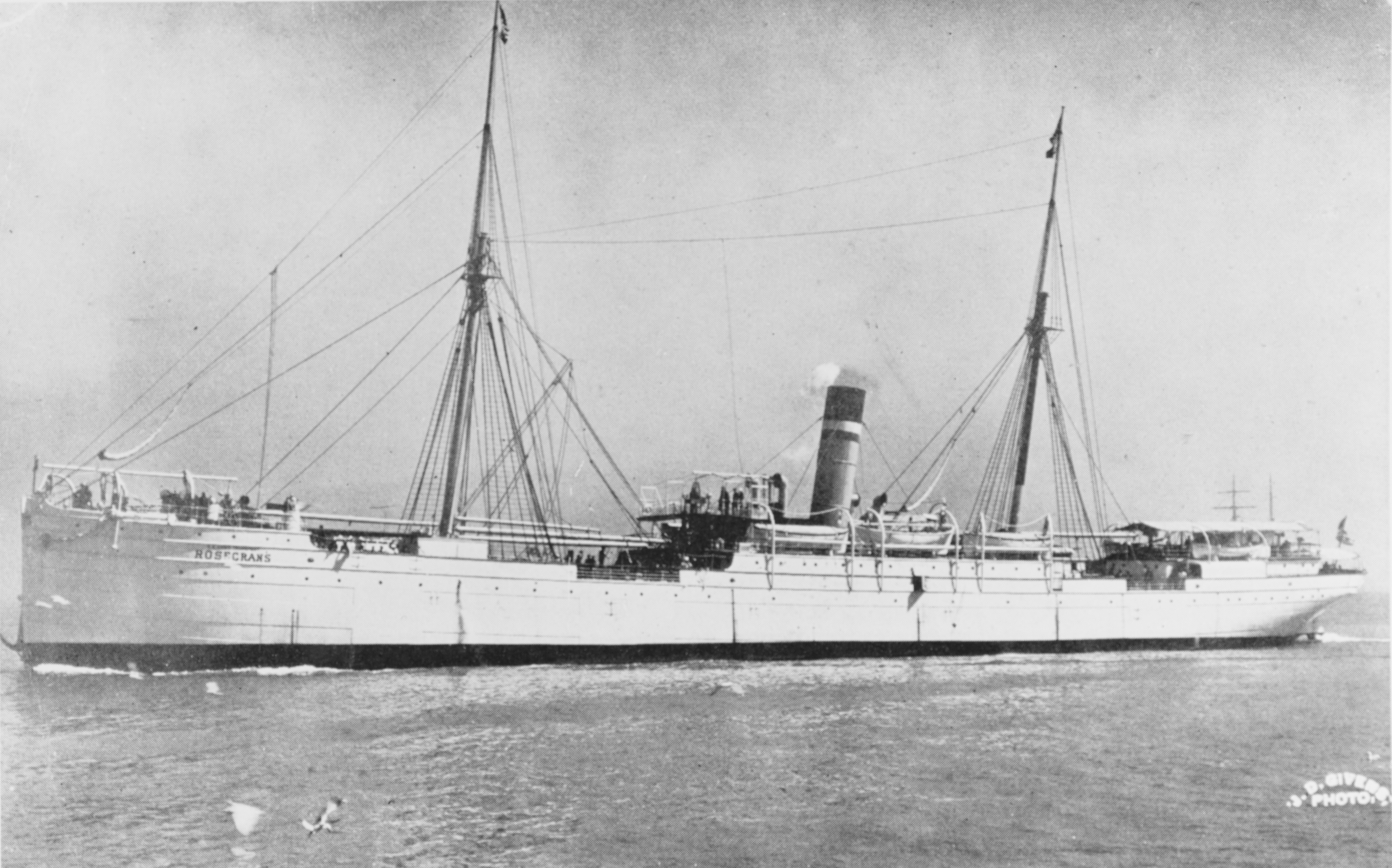
SS Rosecrans
She was built in Glasgow in 1883 as the Methven Castle, a passenger-cargo steamer for the South Africa mail route. By the time the Columbia River killed her thirty years later, she had been renamed twice, crossed every ocean, carried troops to the Philippines, hauled gold dust from Alaska, and been rebuilt after both a grounding and an explosion -- all under the same captain. The SS Rosecrans lived more lives than most ships dream of, and lost the last one on Peacock Spit in a January gale, taking thirty-three of her crew with her.
Three Names, Four Identities
Barclay, Curle & Company launched her at Whiteinch on September 19, 1883, a 335-foot iron steamer with three decks built strong enough to carry guns in case the Royal Navy ever called. As Methven Castle, she spent fourteen years hauling passengers and mail between London and Cape Town, with occasional runs to Madagascar and Mauritius. In 1897, her owners sold her to the Northern Pacific Line, who renamed her Columbia and sent her to the Orient trade -- silk, tea, and rice from Hong Kong to Victoria and Puget Sound. Two years later, the U.S. Army chartered her to transport troops to the Philippines during the insurrection there. The Army liked the ship well enough to buy her outright in 1900 for $147,200, renaming her Rosecrans after the Civil War general. She carried infantry to Alaska and Manila, ferried Philippine revolutionary leaders including Apolinario Mabini to exile on Guam, and ran aground on an Alaskan sandbar that took two days and a tugboat to escape. By 1902 the Army was done with her, and Matson Navigation bought the war-weary transport for $50,000 -- barely a third of what the government had paid.
Oil and Ice
Matson spent nearly a year converting Rosecrans from troop ship to oil tanker at Union Iron Works in San Francisco, fitting her with tanks capable of holding 23,000 barrels. She entered a new career hauling crude oil to Alaska and Hawaii, and on return trips she carried whatever paid: bananas, sugar, passengers, and at least once, in September 1905, more than $300,000 worth of gold dust and bullion from Alaska. When Associated Oil Company acquired Matson's oil operations in 1906, Rosecrans came with the deal, continuing her Pacific routes under new ownership. The work was steady but not gentle. Ice floes damaged her hull near Nome. Gales tore up her bridge and aerials en route to Alaska. In November 1911, she towed the disabled steamer M. F. Plant to safety after the ship lost her tail shaft off Point Arena. By then Rosecrans was nearly three decades old, her iron hull scarred by ice and salt, still making her runs up and down the coast under the command of Captain Lucien F. Johnson.
A Year of Catastrophes
The year 1912 tried to destroy Rosecrans twice. In March, a midnight gale at Gaviota tore her mooring lines and drove her onto rocks fifty feet from shore. The hull was breached, the engine flooded, and two crewmen -- a quartermaster and a carpenter -- drowned when a wave swept them from a lifeboat. Salvage crews spent weeks patching her battered bottom before she could be towed to San Francisco for $70,000 in repairs. Five months later, in August, she returned to Gaviota to load crude oil. While the crew sat at their evening meal, a tank near the engine room exploded. Fire engulfed the ship. The crew abandoned her, then Captain Johnson led them back aboard when the flames seemed to ebb -- and a second explosion threw many of them into the water. One seaman was badly injured. Remarkably, Associated Oil decided to rebuild again, at roughly the same cost. By December 1912, Rosecrans was back in service, carrying 18,000 barrels of crude to Portland on her first post-reconstruction voyage.
The Graveyard Takes Its Due
Three weeks into her rebuilt life, Rosecrans left Monterey on January 3, 1913, with 23,000 barrels of oil and a crew of thirty-six bound for Portland. Captain Johnson was still in command. On the morning of January 7, the tanker approached the mouth of the Columbia River in a gale -- rain, sixty-mile-per-hour winds, visibility near zero. Whether currents dragged the ship north of the entrance or Johnson mistook the North Head Lighthouse for the Cape Disappointment Lighthouse, Rosecrans struck the rocks of Peacock Spit between five and five-thirty in the morning. Two tugs rushed to help but could not get close. The waves hammered the grounded tanker for hours until, around ten-thirty, her hull split in two. Oil flooded the water, splashing the crew as they clung to whatever held. One quartermaster grabbed a thick plank and drifted for five and a half hours before washing ashore near Tioga Point. Three men held onto the main mast; one lost his grip and died. Lifesavers finally reached the other two that afternoon as the storm eased. Of thirty-six aboard, only three survived. The Columbia Bar -- the passage mariners call the Graveyard of the Pacific -- had claimed another ship, and this time, the old steamer that had survived everything else did not come back.
From the Air
The wreck site of SS Rosecrans lies at Peacock Spit, at the mouth of the Columbia River, approximately 46.283N, 124.087W. From the air, the Columbia Bar is unmistakable: a churning collision zone where the river's outgoing current meets the Pacific Ocean, producing visible white water and confused seas. Peacock Spit extends southwest from Cape Disappointment on the Washington side. The North Head Lighthouse and Cape Disappointment Lighthouse are prominent visual landmarks on either side of the headland. Nearest airports: Astoria Regional Airport (KAST) approximately 10nm south across the river in Oregon, Southwest Washington Regional (KELSO) approximately 50nm east. Best viewed at 1,500-3,000 feet to appreciate the bar's hazardous geography and the proximity of the spit to the river entrance.