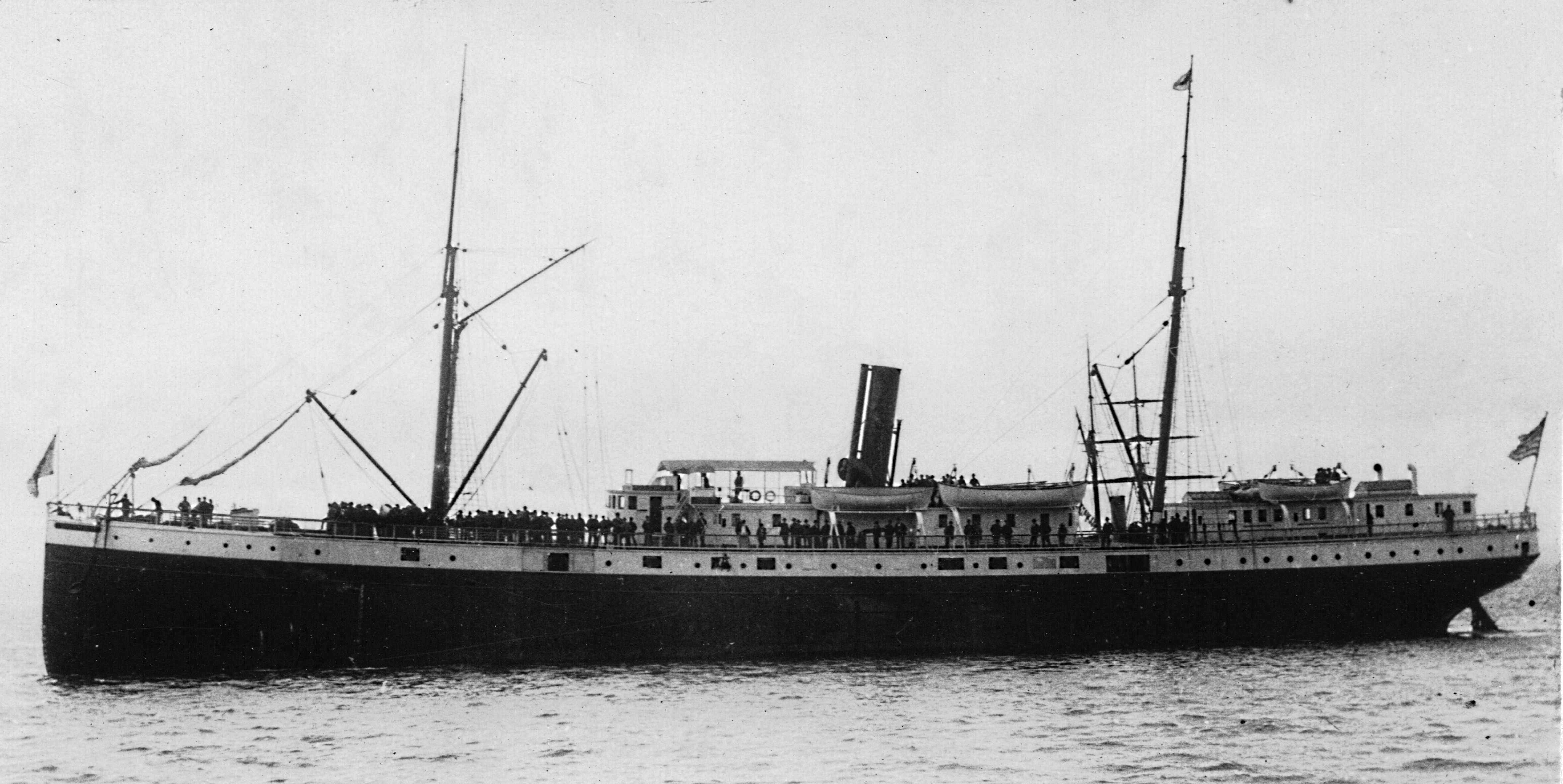
SS Valencia
Twenty-seven years after the SS Valencia broke apart off Vancouver Island, her lifeboat No. 5 was found floating in Barkley Sound. It was 1933. The boat was in remarkably good condition, much of its original paint still intact, drifting as if it had been launched that morning rather than lost in January 1906. The nameplate is now on display at the Maritime Museum of British Columbia. But the lifeboat was the least strange thing to come out of the Valencia disaster. Local fishermen reported seeing the ship's other boats being rowed by skeletons. And in 1910, the Seattle Times published accounts of sailors who claimed to have spotted a phantom ship resembling Valencia near Pachena Point, waves washing over her decks while human figures clung to the rigging.
Into the Graveyard
The Valencia was built in 1882 by William Cramp & Sons in Philadelphia, an iron-hulled steamship that spent her early years running passengers between New York and Venezuela for the Red D Line. She later served as a troop transport during the Spanish-American War before being transferred to the Pacific coastal trade. On January 20, 1906, Valencia departed San Francisco bound for Victoria and Seattle with passengers and crew aboard. Navigation errors in heavy weather sent her off course, and on the night of January 22, she struck a reef near Pachena Point on the southwest coast of Vancouver Island. The impact tore open her hull. She settled on the reef with her stern submerged, trapping passengers in a nightmare that would last two full days.
Screams Across the Surf
When word of the disaster reached Victoria, three ships were dispatched: the passenger liner SS Queen, the salvage steamer Salvor, and the tug Czar. A fourth vessel, City of Topeka, was sent from Seattle carrying a doctor, nurses, medical supplies, and experienced seamen. On the morning of January 24, Queen arrived at the wreck site but could not approach -- the weather was too severe and no reliable depth charts existed for the area. Salvor and Czar diverted to Bamfield to organize an overland rescue party, but the terrain was nearly impassable. Rescuers on the cliffs above could hear passengers screaming on the wreck below and could do nothing to reach them. Lifeboats launched from the ship capsized in the surf or were smashed against the rocks.
Every Woman and Child
The official federal report put the death toll at 136. Only 37 men survived. Every woman and child aboard the Valencia perished -- a detail that seared the disaster into the public consciousness. Some estimates place the total fatalities as high as 181. The disparity matters less than the fact that the loss was catastrophic and, in the view of many, preventable. The coast had no lifesaving infrastructure to speak of. No trail connected the isolated shoreline to settlements where help might be found. No shelters existed where survivors could wait for rescue. The Valencia disaster exposed a lethal gap in maritime safety along one of the most dangerous coastlines in the Pacific.
A Trail Built from Grief
Public outrage over the Valencia wreck drove the Canadian government to act on a scale that peacetime disasters rarely provoke. By 1907, the Dominion Lifesaving Trail had been carved through the old-growth forest lining the coast, with shelters positioned every eight kilometers, each equipped with a telegraph, survival provisions, and directions in multiple languages. The Bamfield Lifeboat Station was established and outfitted with the world's first purpose-built motor lifeboat. Telegraph lines connected lighthouses and patrol stations along the shore. The trail that was born from the Valencia's dead eventually became the West Coast Trail, now part of Pacific Rim National Park and one of the most celebrated hiking routes on the planet. Six thousand backpackers walk it each year. Few of them know that the path beneath their boots exists because rescuers once stood on cliffs above a dying ship and had no way down.
The Phantom on the Water
The Valencia never quite left. Lightkeeper Philip Daykin, who investigated the cave where lifeboat No. 5 was eventually found, speculated that survivors had been alive when the boat drifted inside but starved to death before anyone discovered them. The cave's entrance was blocked by a large boulder, the interior deep and dark. Whether that theory is true cannot be verified, but it added another layer of horror to a disaster already thick with it. The ghost sightings persisted for years after 1906 -- phantom steamers in the fog, figures in the rigging, lifeboats moving under no visible power. On a coast that takes ships and rarely gives them back, the Valencia became the Graveyard of the Pacific's most persistent haunting.
From the Air
The Valencia wreck site is near Pachena Point at approximately 48.71°N, 125.01°W on Vancouver Island's southwest coast. The reef where she struck is close to shore, in an area of rugged cliffs and dense forest. Best viewed from 1,500-2,500 feet altitude. The West Coast Trail runs along the clifftops above. Nearest airport: Port Alberni (CBS8). This stretch of coast is notorious for fog, rough seas, and poor visibility -- the conditions that sank the Valencia in 1906.