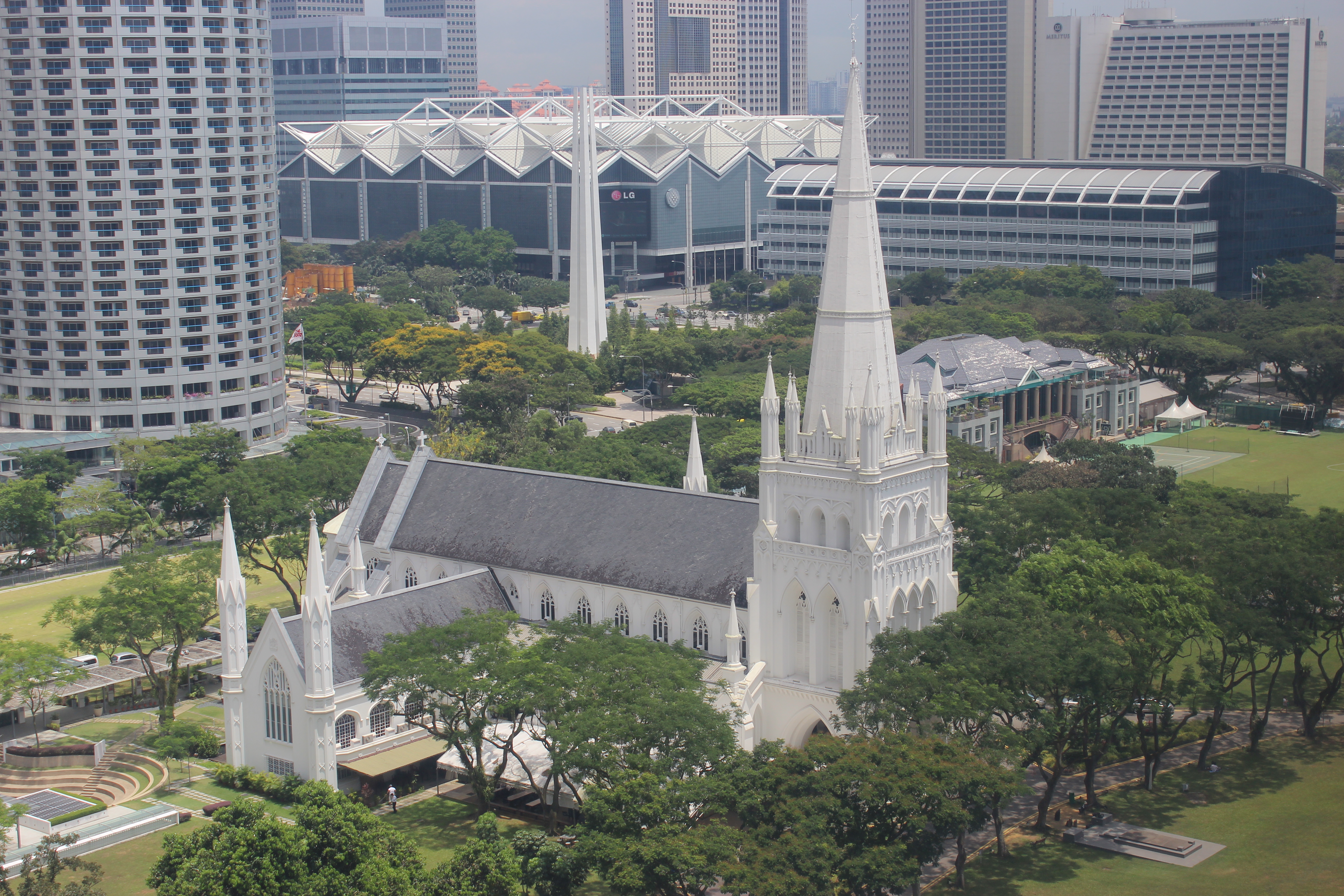
St Andrew's Cathedral, Singapore
The walls are white -- not painted, but coated in Madras chunam, a plaster made from egg white, shell lime, sugar, coconut husk, and water that gives the surface a luminous, almost porcelain smoothness. In the tropical humidity of Singapore, where mold claims most surfaces within months, this 19th-century Indian plastering technique has kept St Andrew's Cathedral gleaming for over 160 years. The Neo-Gothic spire rises near City Hall in the downtown core, an unlikely survivor in a city that has rebuilt itself many times over. The cathedral has occupied this piece of land between Hill Street and North Bridge Road since 1836, though the building standing today is technically the second church on the site, completed in 1861 and still serving as the mother church for 27 Anglican parishes across Singapore.
Two Churches, One Site
Stamford Raffles reserved this plot for an Anglican church in his Town Plan of 1822, but construction waited over a decade while the community raised funds. The first St Andrew's Church, designed by George Drumgoole Coleman in the neo-classical style, had its foundation stone laid on 9 November 1835. Services began on 18 June 1837, and the Bishop of Calcutta consecrated it the following year. Among its treasures was the Revere Bell, donated in 1843 by Maria Revere Balestier, wife of American Consul Joseph Balestier. But the first church did not last. Governor William Butterworth commissioned a replacement, and Colonel Ronald MacPherson designed a new building in the Gothic Revival style. MacPherson's original plans called for a tower twice the height of the previous one, but the foundations could not bear the weight. A lighter spire was substituted instead, and the plans were simplified so Indian convict laborers -- commonly used for construction in early Singapore -- could execute them. The result, completed in 1861, is the cathedral that stands today.
Nails from Coventry, Carpet from Westminster
Three objects inside the cathedral connect it physically to the Anglican world beyond Singapore. The Coventry Cross, mounted on the column supporting the pulpit, is fashioned from three silver-plated iron nails pulled from the ruins of the 14th-century Coventry Cathedral, destroyed by German bombing during the Second World War. In the Epiphany Chapel lies the Coronation Carpet, a section of the carpet walked upon during the 1953 Coronation of Queen Elizabeth II in Westminster Abbey. These are not replicas or symbols. They are fragments of distant history, transported across oceans and installed in a tropical cathedral as tangible proof of communion. The cathedral's own war story is equally direct: in 1942, just before Singapore fell to the Japanese, the building served as an emergency hospital, its nave filled with the wounded rather than worshippers.
The Organs That Refused to Die
Singapore's humidity has been the cathedral's most persistent adversary, and nowhere is that struggle more apparent than in the history of its organs. The first, installed in 1861 by John Walker of London at a cost of 600 pounds, survived sixty-six years before being replaced in 1928 by a Hill Norman and Beard instrument that incorporated some of the original Walker pipes. That newer organ, a three-manual instrument costing 30,000 pounds, eventually fell into disrepair in the tropical climate and sat disused for years, supplanted by an electronic substitute. But the pipes were not discarded. In 2008, some were restored and reinstalled in a new case in the west gallery, connected to the electronic console. A further expansion in 2017 brought back even more restored pipework, including components from the original 1861 Walker organ. Pieces of three different centuries of organ-building now sound together under one roof.
Bells Rung Wrong for 129 Years
The cathedral's bells have their own unlikely story. The original Revere Bell was replaced by a chime of eight bells in 1889, but for 129 years they were not hung for proper change ringing. A 2018 survey revealed that the tower could handle the forces involved, and a project was launched to rehang them correctly. The bells were removed in November 2018 for tuning and cleaning. John Taylor & Co, the Loughborough bell foundry, created a new arrangement: a peal of twelve in the key of D, retaining six of the original eight bells and adding new ones. On 7 August 2019, the first proper change ringing on twelve bells took place, and four days later the bells were formally dedicated. The original Revere Bell, meanwhile, found a quieter retirement at the National Museum of Singapore.
Building Down to Preserve What Stands
Gazetted as a national monument on 28 June 1973, the cathedral faced a modern problem: a growing congregation needing more space in a building that conservation guidelines forbade altering above ground. The solution was to dig. The Cathedral New Sanctuary, completed in November 2005, was built largely underground -- two new levels of floor space beneath the historic structure, housing a modern worship hall. From street level, the Neo-Gothic silhouette remains unchanged, its chunam walls still catching equatorial light the same way they did when MacPherson's convict laborers smoothed them into place. The north and south transepts, originally built as carriage porches, had already been extended in 1952 and 1983 to add halls and offices. But the underground expansion was something different: a declaration that the building's past and its future could coexist, one above the other, separated by a few meters of earth.
From the Air
Located at 1.2922N, 103.8522E near City Hall in Singapore's Downtown Core. The white Neo-Gothic spire is a distinctive landmark amid the surrounding high-rises and the green expanse of the Padang. Nearest airport is Singapore Changi Airport (WSSS), approximately 16 km east. Seletar Airport (WSSL) lies about 14 km north. Best viewed below 2,000 feet where the cathedral's white chunam walls contrast sharply with the modern skyline.