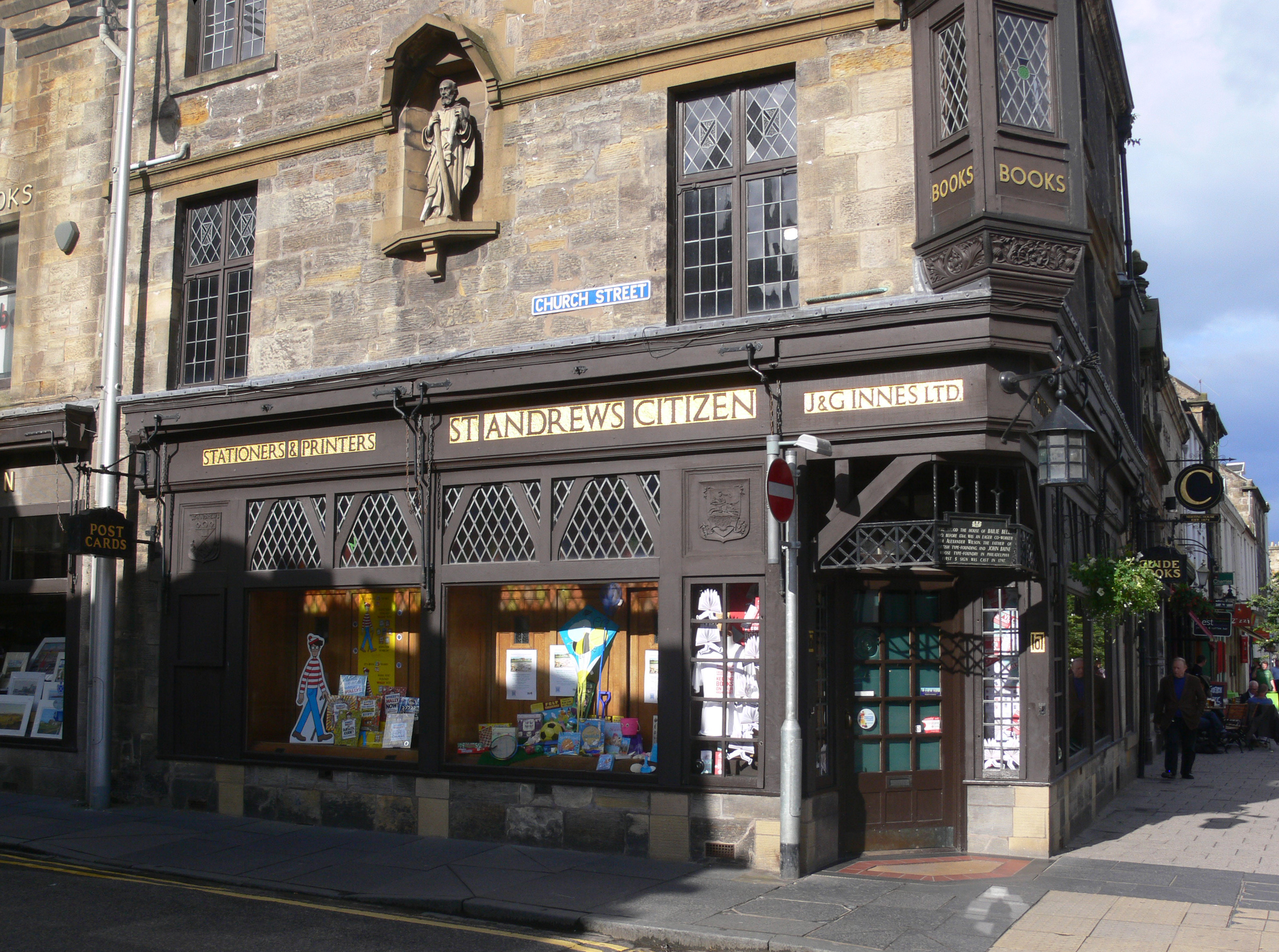
St Andrews
Golf was being played on the links at St Andrews before Columbus reached the Americas. The Old Course, stretching along the coast where the town meets the sea, has been in continuous use since at least the fifteenth century, and it was here that the Royal and Ancient Golf Club codified the eighteen-hole round that became the global standard. But golf is only the most famous layer of a town that has been accumulating significance for over a thousand years. Scotland's oldest university opened here in 1413. The cathedral, once the largest church in Scotland, drew pilgrims from across Europe before the Reformation reduced it to the elegant ruin that dominates the headland today.
Ecclesiastical Capital
St Andrews Cathedral was consecrated in 1318, in the presence of Robert the Bruce, after 158 years of construction. It was enormous - over 100 metres long, the largest building in Scotland - and it made St Andrews the undisputed religious centre of the nation. Pilgrims came to venerate the relics of St Andrew the Apostle, whose bones were said to have been brought here by St Rule in the fourth century. The cathedral's tower, still standing, offers views across the town and out to sea. Below it, the ruins spread across a grassy precinct that gives little sense of how overwhelming the building once was. The Reformation of 1559 ended its life as a place of worship; John Knox preached against it, and the townspeople stripped it of its furnishings. The stone was gradually quarried for other buildings, leaving the skeleton that stands today.
The Oldest University in Scotland
The University of St Andrews was founded in 1413, making it the third-oldest university in the English-speaking world after Oxford and Cambridge. Its colleges are woven into the fabric of the town - St Salvator's Chapel on North Street, St Mary's College with its medieval quadrangle, and the more recent buildings that have expanded along the western edge. The student population of around 10,000 gives this small town a disproportionate energy, especially during term time. Academic traditions here have their own peculiar character. First-year students acquire academic 'families' of older students, and the pier walk on Sunday mornings in red gowns is a tradition that has survived centuries. Prince William, later Duke of Cambridge, studied here from 2001 to 2005 and met Catherine Middleton in their first year.
Where Golf Became Golf
The Old Course is a links course in the original sense: it occupies the linksland, the sandy, wind-scoured strip between the town and the sea. Golf has been played here since at least 1552, though the tradition is almost certainly older. The course evolved naturally from the terrain, its bunkers formed by sheep sheltering from the wind, its greens worn smooth by centuries of play. What the Royal and Ancient Golf Club did in the eighteenth century was standardise the rules and establish the eighteen-hole format that the world adopted. The Old Course plays out along the coast and back, with enormous double greens shared between outgoing and incoming holes - a feature unique to links golf. Walking the fairways is free to residents, and on Sundays the course closes to golf entirely, becoming public parkland where families walk their dogs across the first and eighteenth fairways.
Ruins and Ramparts
St Andrews Castle, perched on a cliff edge above a rocky beach, saw some of the bloodiest episodes of the Scottish Reformation. In 1546, Cardinal Beaton was murdered here by Protestant reformers, his body hung from the castle walls. The ensuing siege produced the castle's most remarkable feature: a mine and counter-mine, tunnelled through solid rock by attackers and defenders respectively, that survive intact and can be walked through today. The bottle dungeon, carved deep into the rock beneath the castle tower, is a vertical pit from which escape was impossible. These are not sanitised heritage sites - they retain a rawness that more celebrated castles have lost to restoration. Below the castle, the harbour shelters a small fleet of lobster boats, and the cliff path running south offers views along the Fife coastline.
A Town Measured in Centuries
St Andrews is compact enough to walk end to end in twenty minutes, yet dense enough to absorb days of exploration. Three medieval streets - North Street, Market Street, and South Street - run parallel from the cathedral to the west, lined with buildings that span six centuries. The town's scale is human, its architecture unpretentious but handsome, its character shaped by students, golfers, and the constant presence of the North Sea. The wind off the water is bracing, the light sharp and clean, and the sky enormous. On a summer evening, with the ruins of the cathedral catching the last light and the Old Course empty and peaceful, St Andrews reveals what centuries of accumulated purpose look like: a place that has been important for so long that importance has become invisible, woven into the stonework and the turf.
From the Air
St Andrews sits on a headland on the east coast of Fife at approximately 56.339°N, 2.799°W. From the air, the Old Course is unmistakable - a broad green links stretching along the coast north of the town, with the distinctive R&A clubhouse at its southern end. The cathedral ruins and castle are visible on the headland. Nearest airport is Dundee Airport (EGPN), approximately 12 miles north. RAF Leuchars (EGQL), now an army base, is 5 miles to the northwest. The town is also accessible from Edinburgh Airport (EGPH) via the Forth Road Bridge.