St Anne's Cathedral, Belfast
They built the new cathedral around the old church, like a Russian doll made of stone. The parish church of St Anne, designed by Francis Hiorne in 1776, remained in use until the last day of 1903 while the new Romanesque cathedral rose around it. Then the old church was demolished from within. Only the Good Samaritan window in the sanctuary survived the transition. St Anne's Cathedral has been under construction, in one sense or another, for over a century. It was not until 2007 that it received its most dramatic element: a 40-metre stainless steel spire that pierces through a glass platform in the roof, glowing above Belfast's Cathedral Quarter after dark.
Century of Construction
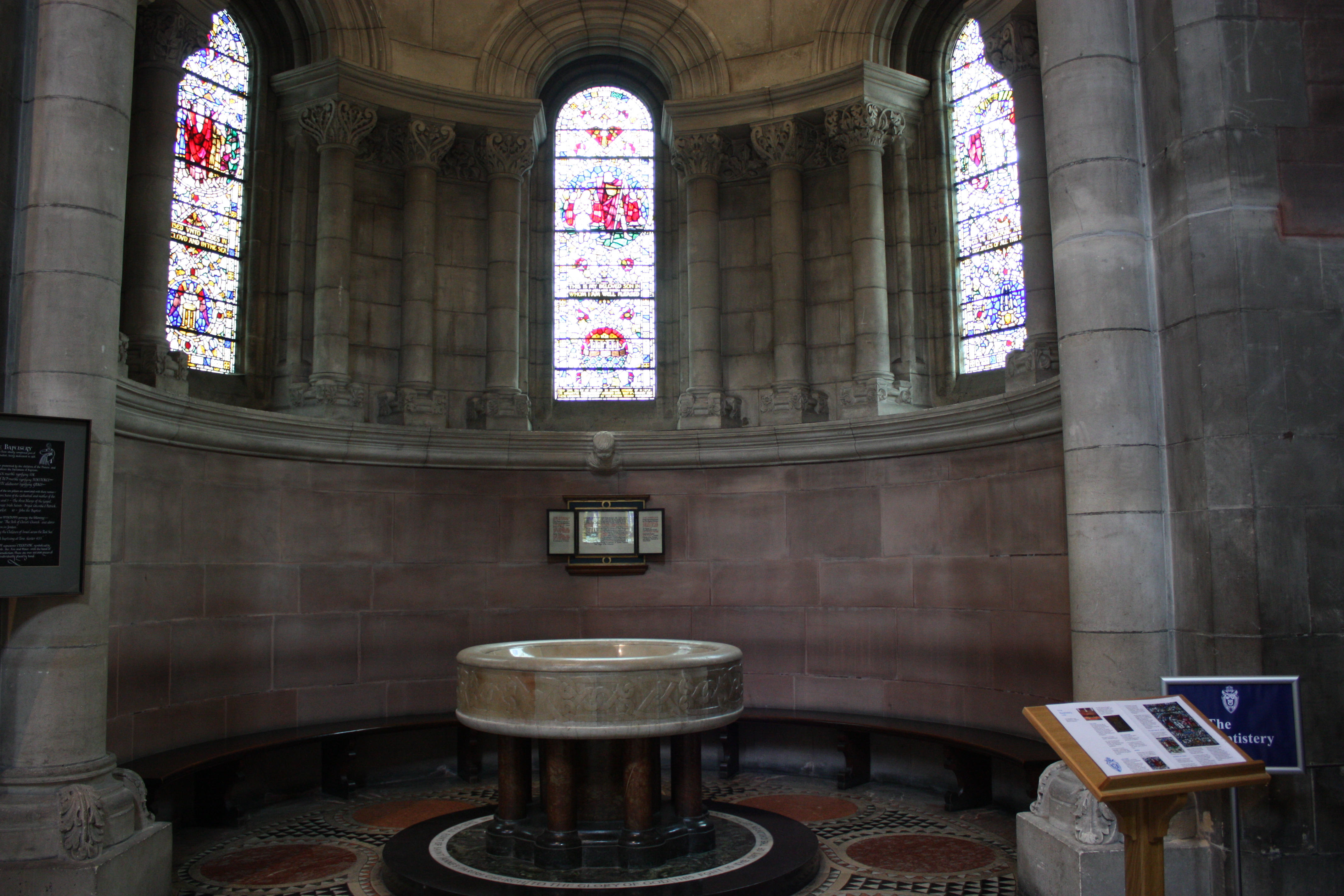
Sir Thomas Drew designed the cathedral, and the Countess of Shaftesbury laid the foundation stone on 6 September 1899. Only the nave was built initially, consecrated on 2 June 1904. The central crossing followed between 1922 and 1924. In that same period, the decision was made to rebuild the west front as a memorial to Ulstermen and women who had served and died in the Great War. The 3rd Duke of Abercorn, Governor of Northern Ireland, laid the memorial's foundation stone in 1925; the completed facade, redesigned by Sir Charles Nicholson, was dedicated in June 1927. The Baptistery came in 1928. The Chapel of the Holy Spirit, with its mosaics of Saint Patrick, was dedicated on 5 July 1932 -- the 1,500th anniversary of Patrick's arrival in Ireland.
Bombs, Burials, and Blue Benches
In 1935, Edward, Lord Carson -- the leader of the Unionist cause during the Home Rule Crisis -- received a state funeral and was buried in the south aisle. Six years later, a German bomb nearly destroyed the cathedral during the Belfast Blitz of 1941, devastating the surrounding neighbourhood. Reconstruction and expansion continued through the decades, but the Troubles and inflation created long delays. The south transept, housing the Chapel of Unity and the organ loft, was not dedicated until 1974. The north transept, bearing a large Celtic cross by John MacGeagh on its exterior and housing the Chapel of the Royal Irish Rifles, was completed in 1981. The cathedral serves two dioceses simultaneously -- Connor and Down and Dromore -- an arrangement unusual among Anglican cathedrals anywhere.
The Spire of Hope
In April 2007, the cathedral received its most visible addition. The Spire of Hope, a 40-metre stainless steel needle, was installed atop the building. It is illuminated at night, transforming the cathedral's profile against Belfast's skyline. Below, the spire's base protrudes through a glass platform directly above the choir stalls, so visitors standing in the nave can look up and see the steel column ascending through the opening in the roof. The spire anchors a wider regeneration of the Cathedral Quarter, the neighbourhood of narrow streets surrounding St Anne's that has become Belfast's cultural and nightlife district. What began as a Victorian replacement for a Georgian parish church now anchors an entirely different kind of community.
The Black Santa
In 1976, Dean Samuel B. Crooks invented a tradition that has outlasted him by decades. He spent the week before Christmas sitting on the cathedral steps, wrapped in dark clothing against the cold, collecting donations for local charities. Passersby dubbed him the "Black Santa" for his appearance, and the name stuck. Every December since, the Dean and members of the cathedral chapter have continued the sit-out, from nine in the morning to half past five each evening. The tradition has raised several million pounds. In a city that spent decades defined by division, the image of a clergyman shivering on stone steps to collect money for anyone who needed it became something unexpectedly unifying. The cathedral's four-manual organ, built by Harrison and Harrison in 1907 and rebuilt between 1969 and 1975, is the second largest pipe organ in Northern Ireland -- but it is the Black Santa, not the organ, that most Belfastians associate with St Anne's.
From the Air
Located at 54.60°N, 5.93°W in Belfast's Cathedral Quarter, on Donegall Street. The Spire of Hope is visible from the air, particularly when illuminated at night. Belfast City Airport (EGAC) is approximately 4 km to the east. The cathedral sits in the city centre, near Belfast's commercial core, with the River Lagan visible to the east.