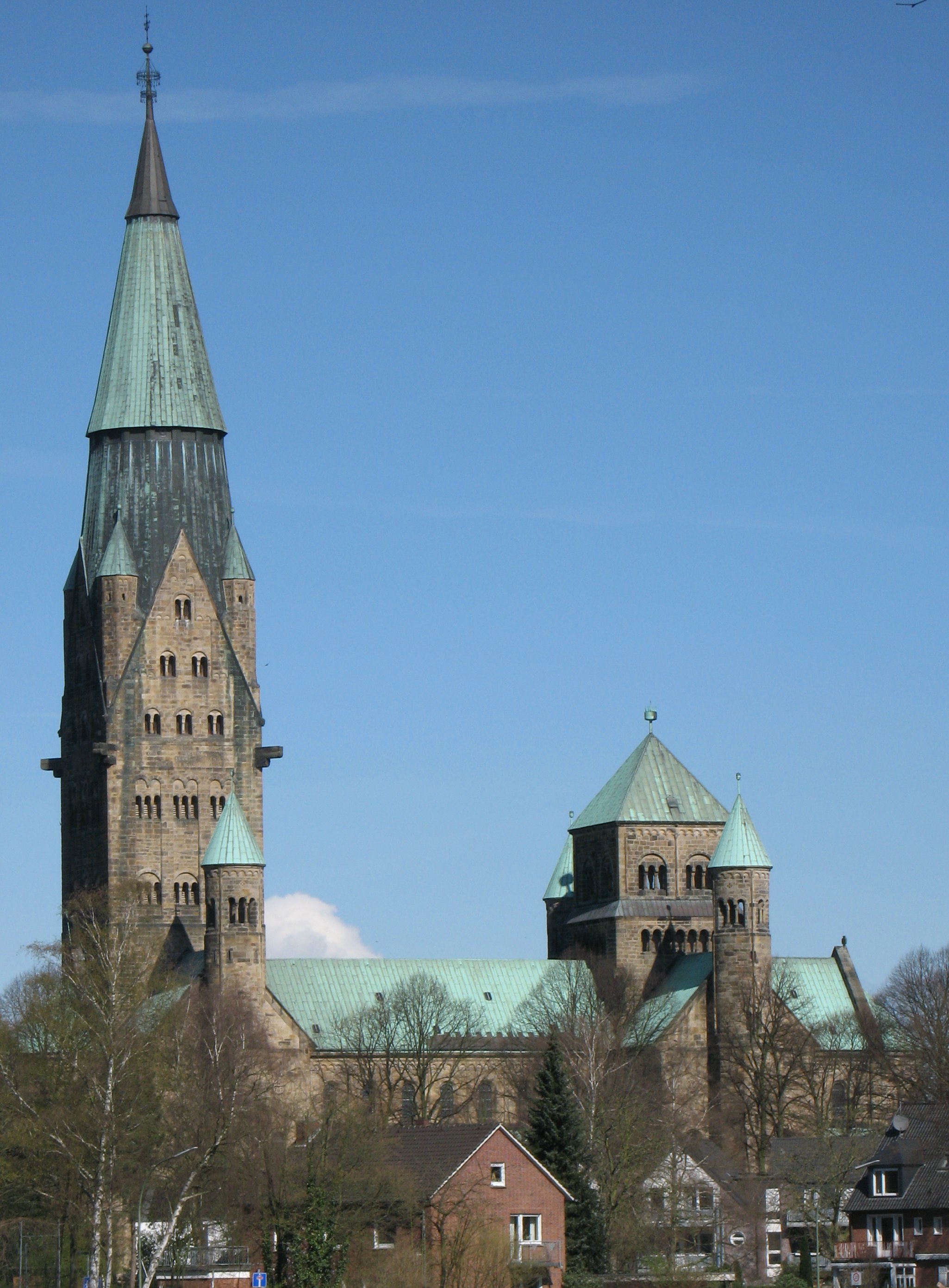
St Anthony's Basilica, Rheine
Dean Bernhard Pietz had a motto, and it has been carefully handed down: 'Hoch die Schlote - höher die Kirchtürme!' - 'High the chimneys, higher the church towers!' His church, he insisted, would rise at least twice as high as the surrounding chimneys of Rheine's textile factories. The dean was building in a moment when northern Münsterland was changing faster than its parishioners could quite absorb. Farms were turning into mill towns; the old parish church of St Dionysius could no longer hold the congregation. Between 1899 and 1905, the German-Dutch architect Franz Klomp gave Dean Pietz exactly what he wanted: a three-aisled neo-Romanesque basilica modelled on imperial cathedrals, with two transepts, two choirs, six towers, and one extraordinarily insistent statement about who, in this corner of Westphalia, would still own the skyline.
An Imperial Cathedral in a Mill Town
Klomp leaned heavily on Hildesheim's medieval churches - St Michael's from the 11th century and St Godehard from the 12th - for the body of the basilica. For its tallest tower he reached toward Paderborn Cathedral. The result rises 102.5 metres above Eschendorf, making it the highest church tower in the Münsterland - higher than St Lamberti in Münster (90.5 m), than St Nicomedes in Borghorst (99 m), and even than the Propsteikirche in Billerbeck (100 m). At ninety metres long and thirty-nine wide, with 650 seats, it dominates the right bank of the Ems with the kind of presence usually reserved for medieval bishoprics. At the four corners of the crossing tower, sculpted figures from Rheine's own history stand guard: Charlemagne, Bishop Ludwig II, the warrior-bishop Christoph Bernhard von Galen, and Johannes von Grüter, once Gograf of Rheine.
Awkward Altars, Honest Pictures
Inside, the basilica is mostly white, ribbed and ordered by alternating red and grey arches over the columns. The high altar in the east choir was built between 1925 and 1929 in Ferdinand Langenberg's Goch workshop to a design by Joseph Windhosen; it survived post-Vatican II reform thanks to congregational protest. The side altars are arranged in an oddly inverted pattern - the altar of Mary stands on the eastern end of the southern aisle (the men's side, traditionally), while the Joseph altar sits in the northern, women's aisle. The Christ the King image in the apse was originally meant to be a mosaic. When the costs proved impossible, the Cologne painter Peter Hecker took the commission instead, and added a few small mosaic fragments to his painting almost as a wink at what it had been meant to be. The crypt, modelled on Roman catacombs, was designed by Friedrich Stummel; the painted baptistery is the work of his student Karl Wenzel.
The Steel Bells That Survived Two Wars
For fifteen years after consecration, the basilica had no bells worthy of its scale - three small bronze loaners from the Petit & Edelbrock foundry hung in the unfinished tower. The real ringing came in 1919, when seven huge bells designed by Heinrich Humpert of Brilon were cast at the Buderus iron foundry in Wetzlar. They were made of steel, not the usual bell bronze - a cost-driven decision, with bronze clappers added to keep the tone full. The bells were named for their wealthy donors, mostly Rheine's textile dynasties: Aloysius, Agnes, Maria, Antonius, Franziskus, Heinrich, and Georg Franz-August. The First World War had already swallowed two of the original three bronze loaners for armament. In the Second World War, bronze church bells across Germany were melted down for weapons - but steel was useless for that purpose. The basilica's bells stayed in the tower. They are now the only fully preserved pre-war bells in Rheine.
Organ, Crypt and Crib
The original 1908 organ by Eggert & Feith had 44 registers and was tucked, acoustically buried, above the west gallery. By 1979 it could no longer be repaired economically, and the organ builder G. Christian Lobback of Neuendeich was commissioned to replace it. The new instrument, completed in 1984, has 54 registers, loop windchests, mechanical key action and electric stop action. Down in the catacomb-style crypt, beside the tomb of the basilica's builder Dean Pietz - secretly prepared by craftsmen against his explicit wishes - the parish has staged a Christmas crib every year since 1981. More than a hundred figures fill several scenes: the Annunciation, John the Baptist in the wilderness, the Magi en route to Bethlehem, even a few sheep that visiting children may pet. The 2020 edition was cancelled, the first break in thirty-nine years, when the COVID-19 epidemic made the gathering impossible. The chimneys are mostly silent now. The church tower is still very much there.
From the Air
St Anthony's Basilica stands at 52.28°N, 7.45°E in the Eschendorf district of Rheine, on the right (east) bank of the Ems. Its 102.5-metre west tower is the highest church tower in the Münsterland and visible from a wide arc - useful as a long-range visual reference when navigating along the Ems valley. The basilica lies about 30 km southeast of Münster Osnabrück Airport (FMO/EDDG) and a short distance from the former Rheine-Bentlage airbase. Best photographed in early morning or late afternoon light, when the sandstone-coloured neo-Romanesque facade glows.