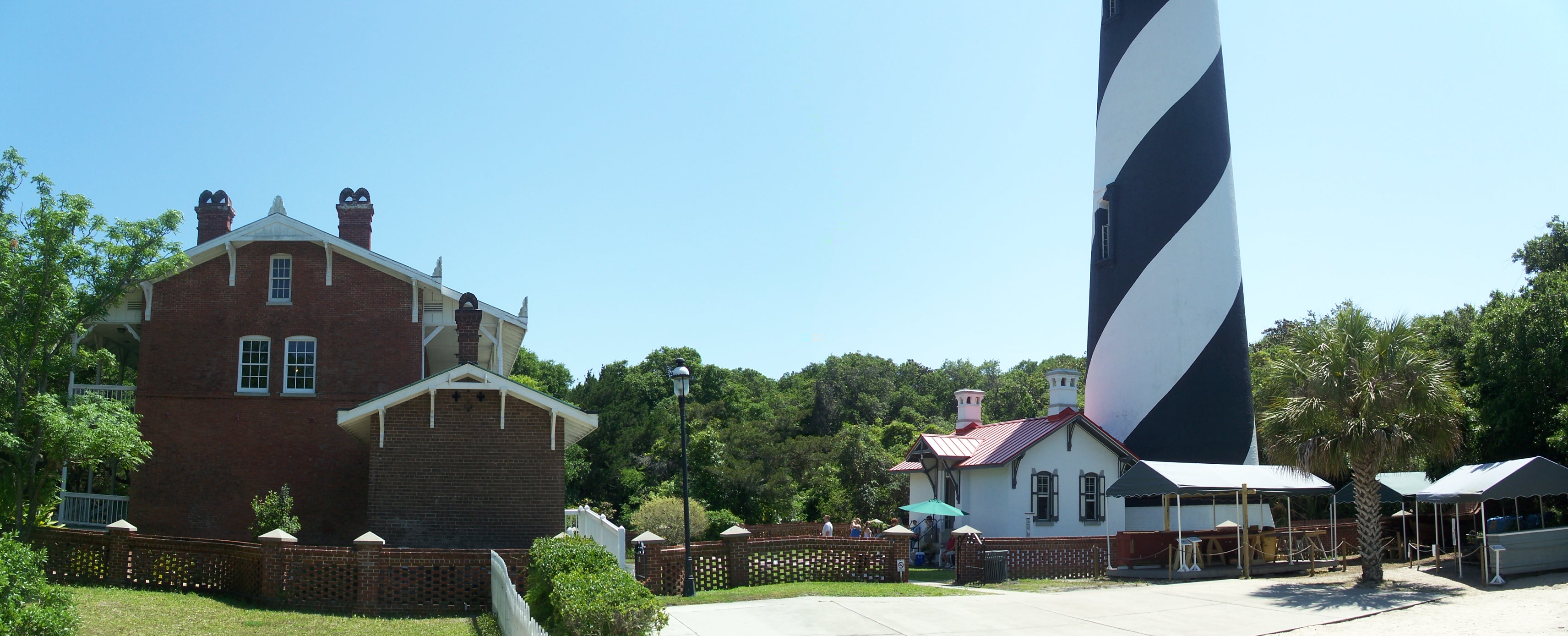
St. Augustine Light
Maria Mestre de los Dolores Andreu climbed the lighthouse tower in the dark and removed the Fresnel lens with her own hands. It was 1861, the Civil War had just begun, and the Menorcan lightkeeper -- the first Hispanic-American woman to serve in what would become the Coast Guard -- was helping the local harbor master hide the optic to blind Union ships navigating the treacherous St. Augustine inlet. The harbor master, Paul Arnau, would later be captured and forced to reveal the lens's hiding place. But for a time, the oldest lighthouse site in Florida went dark by an act of defiance, not neglect. That tension between destruction and preservation defines the St. Augustine Light, where beacons have burned in one form or another since 1565.
Four Centuries of Fire on the Shore
The Spanish built their first wooden watchtower here in the late 16th century, visible on a 1589 map drawn during Sir Francis Drake's attack on the city. By 1737, they replaced it with a more permanent tower quarried from coquina, the compressed shellstone native to Anastasia Island. The British took control in 1763 and regularly referred to the structure as a lighthouse in ship's logs and nautical charts. When the United States acquired Florida, the territorial government officially lit the tower in May 1824, making it Florida's first lighthouse. Early lamps burned lard oil, their multiple flames reflected by silver mirrors until a fourth-order Fresnel lens replaced them in 1855. But the coastline was shifting. Beach erosion ate steadily at the bluff, and by 1870 the old tower was in danger of falling into the sea. Construction on the current tower began in 1871, with coquina and building supplies ferried to the site by trolley track. The new light was first lit in October 1874 by keeper William Russell, the only person to have tended both towers. The old coquina tower crashed into the ocean in 1880 and is now a submerged archaeological site.
A Gettysburg Hero Serving Lemonade
For twenty years the station was run by Major William A. Harn, a Union war hero who had commanded his own artillery battery at the Battle of Gettysburg. Harn moved his wife Kate and their six daughters into the keeper's house, a Victorian duplex built during his tenure, and the family became known for serving lemonade from the wrap-around porches. The station weathered the 1886 Charleston earthquake, which made the tower sway violently according to the keeper's log, though no damage was recorded. In 1885 the lamp converted from lard oil to kerosene. Indoor plumbing arrived in 1907, electricity in the keeper's quarters in 1925, and the light itself was electrified in 1936. When the beacon was automated in 1955, the era of resident keepers slowly ended. By the 1960s, the house was rented to locals. In 1970, an arsonist set a devastating fire. The light station seemed destined for ruin.
Fifteen Women and a 99-Year Lease
In 1980, fifteen women from the Junior Service League of St. Augustine signed a 99-year lease for the burned keeper's house and began a massive restoration. They then secured a 30-year lease with the Coast Guard for the tower itself. The lighthouse landed on the National Register of Historic Places in 1981 through the efforts of local preservationist Karen Harvey. But the antique first-order Fresnel lens was damaged by rifle fire in 1986, shattering 19 prisms. The Coast Guard proposed replacing the historic optic with a modern airport beacon. The Junior Service League fought back, and retired Coast Guardsmen Joe Cocking and Nick Johnston restored the lens -- the first restoration of its kind in the nation. In 2002, ownership of the tower and lens was transferred from the Coast Guard to the St. Augustine Lighthouse and Museum, the first such transfer of a U.S. lighthouse to a nonprofit organization. Today the museum keeps the light burning as a private aid to navigation, visited annually by over 200,000 people.
Shipwrecks Beneath the Inlet
The museum's Lighthouse Archaeological Maritime Program, known as LAMP, employs full-time marine archaeologists who have pulled centuries of maritime history from St. Augustine's waters. The oldest identified wreck is the British sloop Industry, lost on May 6, 1764, while carrying munitions and tools for the colonial garrison. Eight cast-iron cannon, an iron swivel gun, millstones, and crates of tools were recovered in remarkable condition. In 2009, archaeologists discovered the Storm Wreck, an 18th-century vessel believed to have been part of the final British fleet evacuating Loyalist refugees from Charleston in December 1782. Among the artifacts: a flintlock Queen Anne pistol, three Brown Bess muskets (two still loaded), a bronze ship's bell, and a 9-pounder carronade believed to be the second oldest in the world. As many as sixteen ships were lost on the sandbar that winter. LAMP continues to investigate these wrecks and others, including plantation landings, colonial wharves, and the site of Fort Mose, America's first free African American settlement.
From the Air
The St. Augustine Light stands at the north end of Anastasia Island at approximately 29.885N, 81.289W. The black-and-white spiral-striped tower is a distinctive landmark visible from altitude, rising above the tree canopy near the mouth of the Matanzas River. The St. Augustine Inlet lies to the northeast, with the Bridge of Lions and downtown St. Augustine across the waterway to the west. Nearest airport: St. Augustine Airport (KSGJ) approximately 4nm northwest. Jacksonville International (KJAX) is about 35nm north. The lighthouse and adjacent keeper's house complex are best spotted at moderate altitude; the spiral paint pattern becomes identifiable above 1,000 feet AGL.