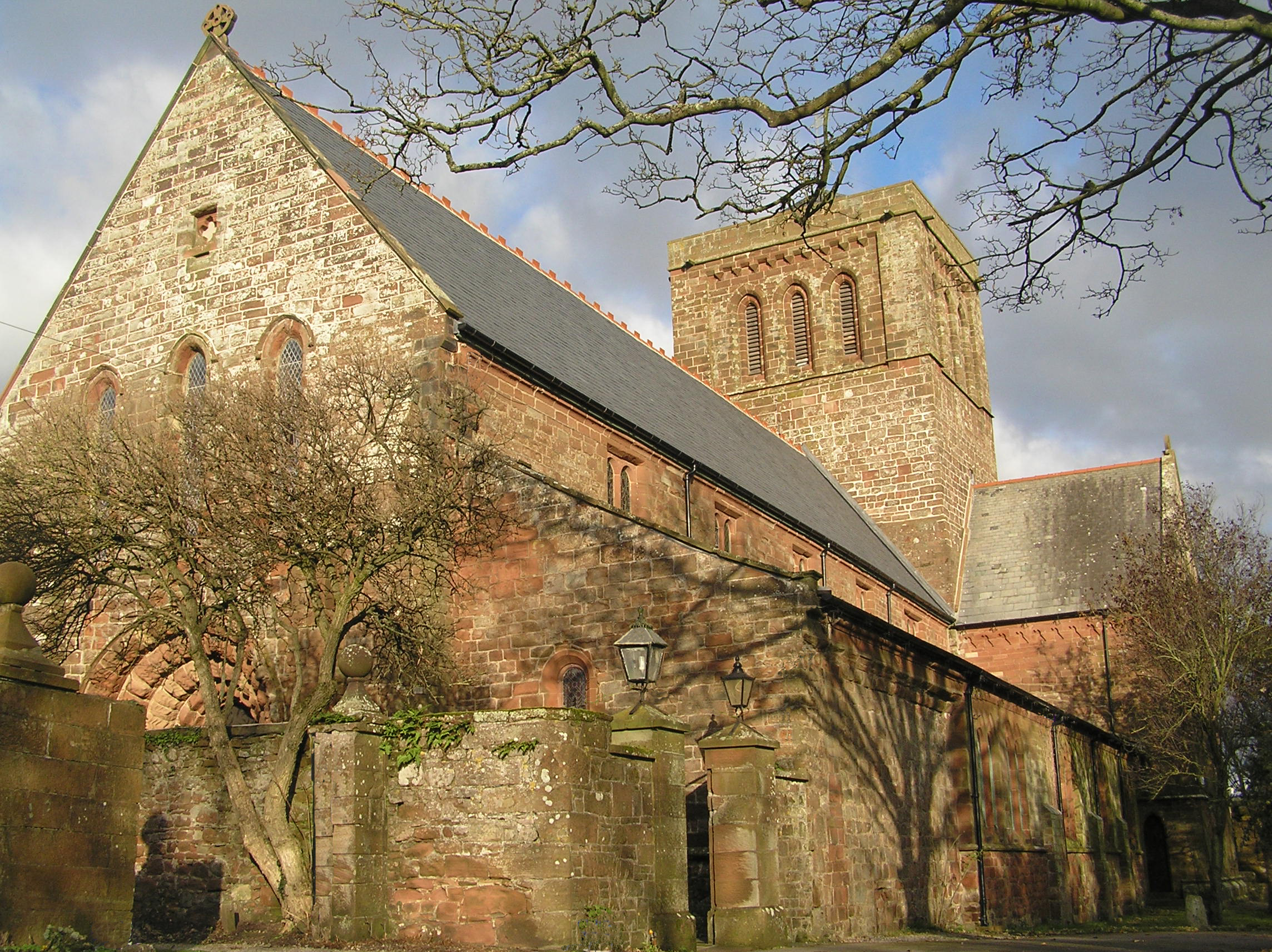
St Bees Priory
When archaeologists opened a lead-lined vault beneath the chancel of St Bees Priory in 1981, they found a body wrapped in a shroud. The man had died in 1368, more than six hundred years earlier. He was almost certainly Anthony de Lucy, a knight who had fought in the Northern Crusades in Lithuania. His skin, fingernails, and stomach contents were in near-perfect condition -- the anaerobic environment of the sealed vault had preserved him as completely as any Egyptian mummy. The discovery made headlines around the world, but the knight's remarkable preservation was only the latest chapter in a story that stretches back more than a thousand years on this windswept stretch of the Cumbrian coast.
The Bracelet of St Bega
The place-name St Bees derives from Kirkeby Becok -- the Church Town of Bega. According to legend, St Bega was an Irish princess who fled an arranged marriage and sailed across the Irish Sea, landing on this coast sometime in the decades after 850 AD. She lived a life of piety here, and her cult persisted long after her death. When the Normans arrived, oaths were sworn on the 'Bracelet of St Bega,' a relic kept at the priory. Sculptural evidence -- including fragments of a 10th-century cross still visible in the graveyard -- confirms that a significant religious community existed on this site well before the Norman Conquest.
Norman Ambitions on the Irish Sea
The Normans did not reach this corner of Cumbria until 1092, late even by the standards of the gradual Norman advance northward. William Meschin, the first Norman Lord of Egremont, founded a Benedictine priory here with the support of Archbishop Thurstan of York, sometime between 1120 and 1135. The priory grew into a substantial institution with extensive parish boundaries covering much of the western Lake District. In its most prosperous period, the 14th and 15th centuries, the complex included not only the church but a full range of monastic domestic buildings. The monks ran a mill in the village and farmed the surrounding land, though they never rose to the national prominence of the great abbeys further south.
Dissolution, College, and Revival
The priory was dissolved on 16 October 1539, but the church survived because the village had no other place of worship. The monastic chancel, roofless since the dissolution, found new purpose when St Bees Theological College was established in the 19th century. The chancel was re-roofed to serve as the college's lecture room and library, and students lodged in the village while the college principal doubled as the Vicar of St Bees. The college trained over 2,600 clergy before closing in 1895, unable to compete with larger institutions that could award degrees. Its model of affordable clerical training, however, inspired the creation of similar colleges across England.
Stone, Light, and a Dragon
The priory's greatest architectural treasure is its Norman west doorway, dating from 1150 to 1160 and the most richly decorated in Cumbria. Three orders of columns support arches carved with chevron ornaments and beak-head decorations -- stylized animal heads that bite down on the mouldings. In the west courtyard, a Romanesque lintel from about 1120 shows St Michael fighting a dragon, a scene rendered in the muscular, compact style of early Norman sculpture. Inside, the nave sits on original Norman pillars topped by Early English arches -- a layering of architectural periods visible in a single glance. The north transept houses Josefina de Vasconcellos's 1950 sculpture 'Vision of St Bega,' flanking the altar where Norman windows still admit the grey Cumbrian light.
From the Air
St Bees Priory is at 54.49N, 3.59W in the village of St Bees on the Cumbrian coast, just south of Whitehaven. The village sits at the start of Alfred Wainwright's Coast to Coast Walk. The priory church is visible among the village buildings near the shoreline. St Bees Head, a dramatic sandstone headland and RSPB reserve, lies just to the north. Nearest airports: Carlisle (EGNC, 35nm northeast) and Barrow/Walney (EGNL, 25nm south). The red sandstone cliffs of St Bees Head are a prominent coastal landmark.