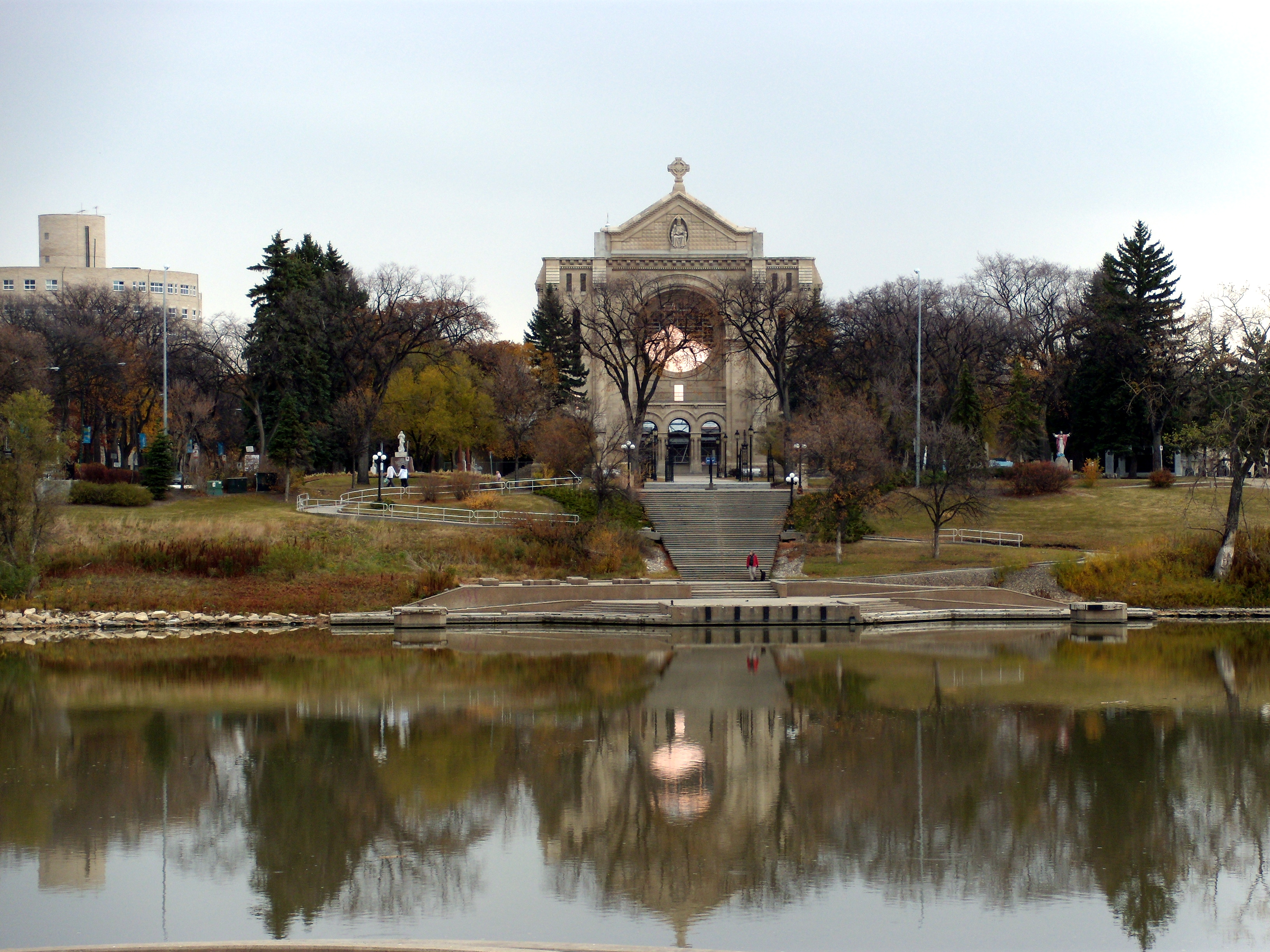
St. Boniface Cathedral
The facade stands alone. Walk toward St. Boniface Cathedral from the east bank of the Red River and the first thing you see is a wall of pale stone pierced by arched windows and a rose window opening -- except there is no glass behind it, and no roof above it. The 1906 facade is a ruin, open to the Manitoba sky, and nestled behind it sits an entirely different building: a modern cathedral designed by Etienne Gaboury and Denis Lussier in 1972. This strange architectural marriage -- old stone shell sheltering new worship space -- is the result of a devastating fire on July 22, 1968, that gutted one of Western Canada's most imposing churches and left only the front wall standing. Rather than demolish the remains or attempt a replica, the architects chose to build something new within the bones of something old, creating one of Winnipeg's most haunting and memorable landmarks.
A Log Chapel on the Red River
The story begins in 1818, when Reverend Norbert Provencher and two colleagues arrived at the confluence of the Red and Assiniboine Rivers and built a small log structure measuring fifty feet by thirty feet on land donated by the Hudson's Bay Company's Thomas Douglas, 5th Earl of Selkirk. That modest building served triple duty as chapel, residence, and school for the nascent Franco-Manitoban settlement. By 1832, Provencher -- now elevated to bishop -- had built the first proper cathedral. The bells of that church became famous enough to inspire American poet John Greenleaf Whittier, who immortalized them in his 1859 poem "The Red River Voyageur." On December 17, 1891 -- Whittier's 84th birthday -- Archbishop Tache had the cathedral bells rung across the frozen prairie in the poet's honor.
Fires and Resurrections
Destruction by fire is woven into the cathedral's DNA. The first major blaze struck on December 14, 1860, reducing Provencher's cathedral to ashes. Bishop Tache traveled to Quebec to raise reconstruction funds, and a smaller stone replacement rose in its place, the bell tower completed eight years later. By 1900, the Catholic population of St. Boniface had more than doubled -- from 2,154 in 1888 to 4,615 by 1906, nearly all of French heritage -- and the fifth-largest city in the Canadian West demanded a grander house of worship. Montreal architect Jean-Omer Marchand designed an imposing new cathedral, dedicated on August 15, 1906, by Monsignor Adelard Langevin. It became one of the most striking churches west of Ontario. Then, on a July night in 1968, fire returned. The rose window shattered. The 1860 bells melted. Parish records, vestments, and the building's interior were consumed. Only the sacristy, outer walls, and that magnificent stone facade survived.
The Graveyard of Founders
Behind the cathedral, the cemetery reads like a roll call of Manitoba's founding generation. Louis Riel, the Metis leader who led the Red River Resistance and was executed in 1885, rests here beneath a simple headstone that draws visitors year-round. Jean-Baptiste Lagimodiere, the fur trader and voyageur who made an epic midwinter journey from the Red River to Montreal in 1815, lies beside his wife Marie-Anne Gaboury, widely regarded as the first European woman to settle in the Canadian West. Norbert Provencher himself is buried in the ground he consecrated. Until 2007, the cemetery also held the remains of Chief One Arrow, a Cree leader who died in 1886 and whose body was eventually exhumed and returned to the One Arrow First Nation in Saskatchewan -- a quiet act of repatriation more than a century overdue.
Stone and Sky
Today the cathedral sits at 190 avenue de la Cathedrale, facing the Red River with The Forks and downtown Winnipeg directly across the water. The ruined facade has become more than an architectural curiosity; it functions as a memorial wall, a threshold between the open air and the enclosed sanctuary behind it. Visitors pass through the old stone arches to enter Gaboury's modern interior, a transition that feels like moving between centuries. In nearby Verendrye Park, a statue of Pierre La Verendrye by sculptor Joseph-Emile Brunet faces the river that brought the first French explorers to this place. The cathedral, the cemetery, the park, and the river together form the spiritual and cultural heart of Franco-Manitoban Winnipeg -- a neighborhood where French is still spoken on the street, and where the layered history of fire, faith, and rebuilding is written directly into the architecture.
From the Air
Located at 49.8893N, 97.122W on the east bank of the Red River in Winnipeg's St. Boniface neighborhood. The ruined stone facade is visible from low altitude, positioned directly across the river from The Forks. Nearest major airport is Winnipeg James Armstrong Richardson International (CYWG), approximately 7 km west. Best viewed from 1,500-2,500 ft AGL approaching from the south along the Red River. The cathedral grounds, cemetery, and adjacent Verendrye Park form a distinctive cluster on the riverbank.