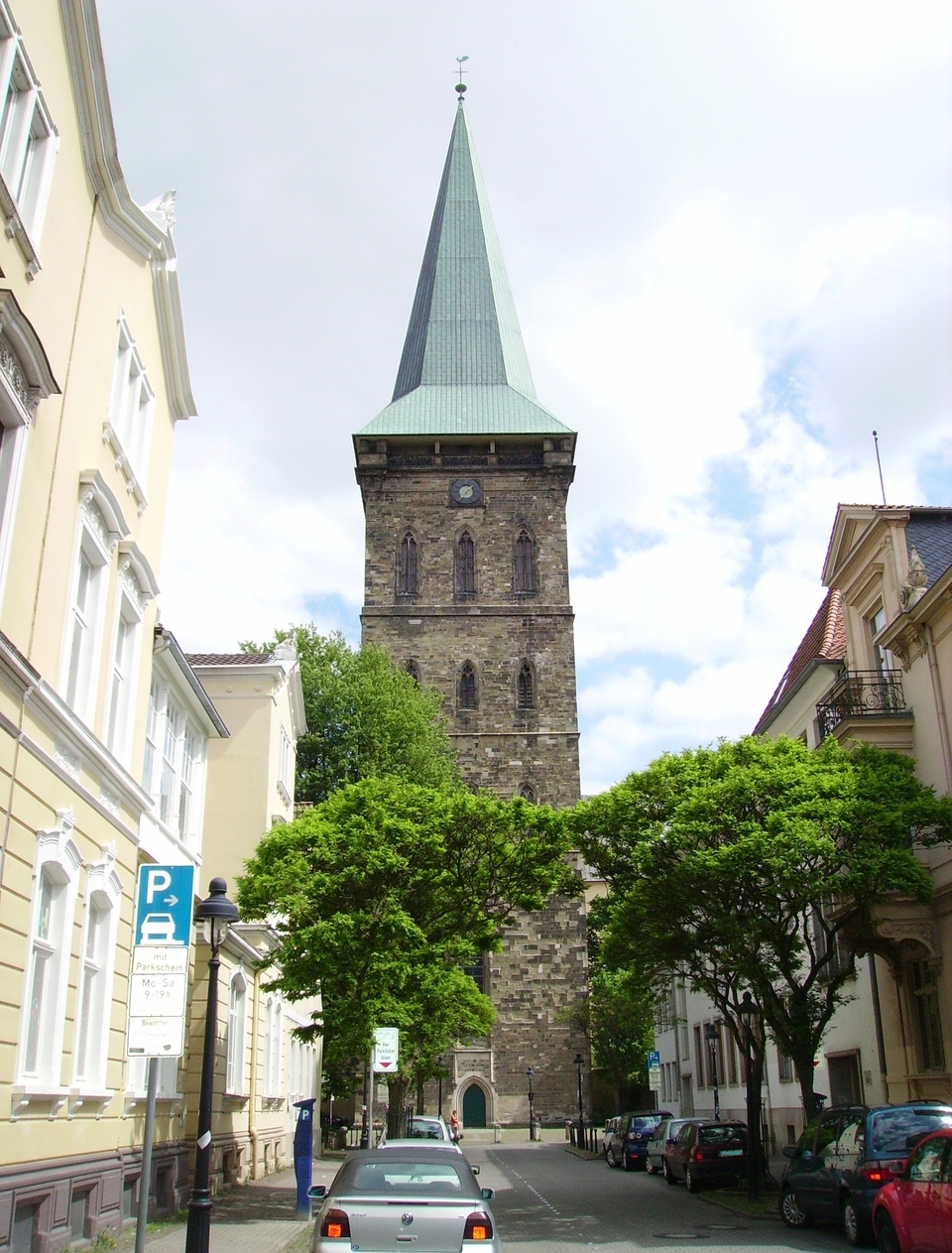
St. Catherine's Church, Osnabrück
On Palm Sunday 1945, the bombs found St. Catherine's. The last Allied air raids on Osnabrück fell on March 25 of that year, and the late Gothic hall church that had shaped the cityscape for seven centuries went up in flames. By then the Katharinenkirche had already burned once before, in 1868, when its baroque steeple caught fire during renovation work. Twice the city watched its tallest medieval building burn. Twice the city rebuilt it. The 103-meter tower still rises over the old town, and the church remains the tallest medieval structure in western Lower Saxony.
Pilgrims and a Patron Saint
The first small church on this spot went up in the early 13th century, just outside the walls of the Osnabrück inland castle in the precinct where the city nobility held court. The choice of Catherine of Alexandria as patron was almost certainly carried back from the Holy Land by pilgrims; her cult traveled with returning crusaders. According to the legend that gave her the name, Catherine was the learned daughter of an Alexandrian prince who converted to Christianity in the early 4th century, debated fifty of the Roman emperor's most famous scholars into accepting the faith, told the emperor Maximus to his face that his gods were empty delusions, and was killed for it. The Osnabrück church inherited her name and her image. The current Gothic building rose from around 1300 and was largely complete by 1500.
When the Swedes Came to Worship
By 1543 the Reformation had reached the Katharinenkirche, and the parish became Protestant. A century later, the church found itself with an unusual congregation. During the peace negotiations from 1643 to 1648 that ended the Thirty Years' War, the Swedish legation was in Osnabrück, hammering out the Protestant side of what would become the Peace of Westphalia. St. Catherine's offered them space to hold services and meetings. Swedish diplomats prayed beneath these Gothic vaults while the future shape of Europe was being negotiated in the town hall a few blocks away. Later still, from 1673, the Protestant prince-bishops of Osnabrück used the church as their court chapel, the castle that served as their residence rising just beside it from 1669 onward.
Rebuilding, Again
After the 1945 fire, the church was patched up and reopened in 1950. By 1990 the interior needed comprehensive work, and St. Catherine's closed for two years. When it reopened in November 1992, the redesign favored simple, clear lines - a restrained modern interior set against the medieval Gothic shell. Around the church stands one of Osnabrück's most evocative architectural clusters: the castle, the Poggenburg, the Ledenhof, the surviving monastery walls of the old barefoot friary, and the old rectory. Together they form an ensemble that remembers what the rest of the Altstadt also was, before the bombs.
The Peace Organ
The current organ project carries a deliberate name: Friedensorgel - the Peace Organ. The previous instrument, built in 1961 by the Paul Ott workshop, was no longer economically worth restoring. In 2022 it was dismantled and sold to a town in Lithuania. The new instrument is being built in stages by Metzler Orgelbau, the Swiss firm from Dietikon, and was originally scheduled for completion in 2018; financing delays pushed back the start. The first phase was inaugurated on Easter Sunday, April 9, 2023, in the presence of one of the project's patrons: former Federal President Christian Wulff, an Osnabrück native. The other patron is Regional Bishop Ralf Meister. In a city that calls itself the Friedensstadt - the city of peace - the organ's name was not a casual choice.
Bells Like Big Ben
In the tower hangs a four-bell set cast in 1955 by the Bochumer Verein cast steel works - the second largest peal of bells in Osnabrück. They were first rung on December 11 of that year. Local lore says they ring as beautifully as the bells of Big Ben. The parish has around 7,000 members today, served by four pastors, a full-time deaconess, a sexton, and a cantor. The church runs its own day-care center, where two pedagogical specialists look after 25 children in four groups, and a community garden project where Osnabrückers grow vegetables in raised beds beside the medieval walls. Art exhibitions and concerts fill the nave between services. The church that has burned twice now keeps on functioning, with all the small everyday weight of a working parish.
From the Air
St. Catherine's stands at 52.27°N, 8.04°E in the Altstadt of Osnabrück. Recommended viewing altitude: 2,000-3,500 ft AGL. The 103-meter Gothic tower is the most prominent vertical landmark in the old city, visible from kilometers away in clear weather. Look for it just south of the Schloss (palace). Nearest airport: Münster Osnabrück International (EDDG / FMO), about 31 km south.