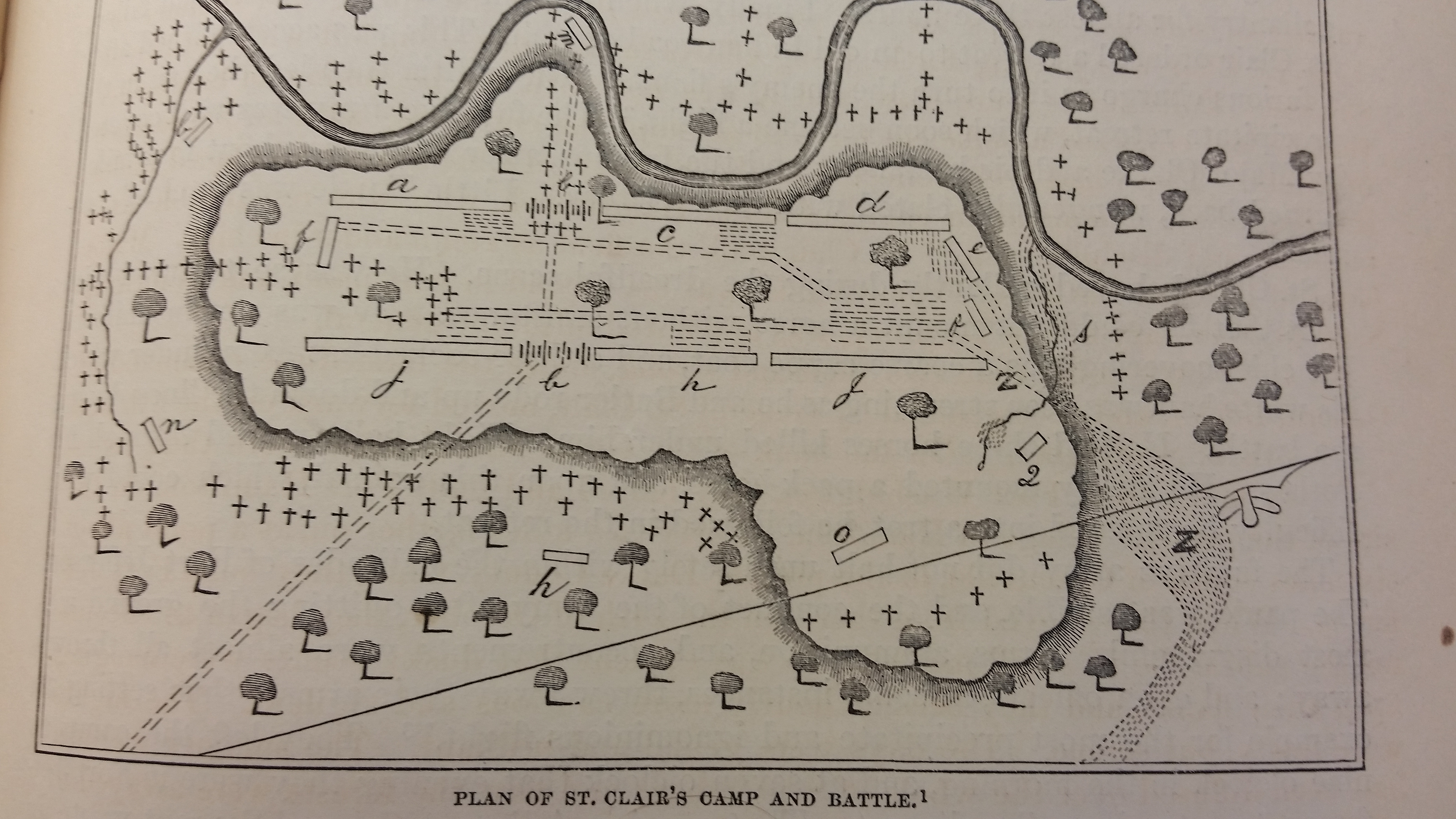
St. Clair's Defeat
Only 24 men walked away unharmed. On the morning of November 4, 1791, near the headwaters of the Wabash River in what is now western Ohio, more than 1,000 warriors of the Northwestern Confederacy fell upon a sleeping American camp and delivered the most devastating defeat the United States Army would ever suffer at the hands of Native Americans. The casualty rate among soldiers reached 97 percent. A total of 832 Americans were killed, more than three times the toll at Little Bighorn 85 years later. When 300 soldiers arrived two years afterward to build an outpost on the site, they found the ground so thick with human remains they had to clear bones before they could lay their bedrolls.
A Campaign Doomed Before It Began
President George Washington ordered Arthur St. Clair, governor of the Northwest Territory, to march north and crush the Miami and their allies at their capital of Kekionga. But everything went wrong before the first shot was fired. Recruits were poorly trained, food supplies were rancid, horses were scarce and sickly, and St. Clair himself suffered from gout so severe he could barely mount a horse. The force that finally left Fort Washington, near present-day Cincinnati, in October 1791 numbered about 2,000, but by the time it reached the upper Wabash, desertion, illness, and insubordination had whittled it down to roughly 1,120, including some 200 camp followers. Meanwhile, the great war leaders Little Turtle of the Miami, Blue Jacket of the Shawnee, and Buckongahelas of the Lenape had united more than 1,000 warriors from a dozen nations into a crescent-shaped battle formation surrounding the American camp.
Thirty Minutes to Encirclement
The Americans camped on a high meadow on the evening of November 3, splitting their force across the Wabash with the militia on one side and regulars on the other, a fatal mistake that prevented quick reinforcement. No defensive works were built despite reports of Native scouts in the forest. At dawn, as soldiers prepared breakfast and stacked their muskets, the center of the confederacy's crescent, the Miami, Shawnee, and Lenape, overran the militia, who fled weaponless across the river. The regulars broke their musket stacks and fired a volley, pushing back the attack, but within thirty minutes the wings of the Native formation flanked the camp and closed a complete circle. Native marksmen picked off artillery crews as they tried to load their guns, and the survivors were forced to spike the cannons. St. Clair, awakened half-dressed, had two horses shot from under him. His lack of proper uniform may have saved his life, since a group of warriors was specifically targeting officers. Of 52 officers engaged, 39 were killed and 7 wounded.
A Flight Through the Snow
After three hours of carnage, St. Clair gathered his remaining officers and ordered a desperate breakout. The decision meant abandoning the supply wagons, the wounded, and the women and children who had followed the army. Bayonet charges punched through the Native line, and the survivors threw away their muskets and ran. The retreat became a rout. St. Clair later wrote that the road was littered with discarded firelocks, cartridge boxes, and uniforms. In their desperation, a cook known as Red-headed Nance abandoned her baby in the snow; another fleeing mother did the same, and pursuing warriors found and adopted the child. Private Stephen Littell, lost in the woods, stumbled back to the abandoned camp and reported that the wounded begged him to kill them before the warriors returned. The head of the retreat reached Fort Jefferson that evening, having covered nearly the full distance in a single desperate day.
Washington's Fury and a New Army
When Major Ebenezer Denny brought the official report to Philadelphia in December, President Washington erupted in a fury recorded for posterity. He forced St. Clair to resign, though he then reappointed him governor of the Northwest Territory. Congress launched the first-ever investigation of the executive branch, an inquiry that produced the earliest assertion of executive privilege in American history. More consequentially, Washington demanded a military capable of winning, and Congress responded by creating the Legion of the United States, raising enlistment terms to three years, increasing pay, and passing two Militia Acts that empowered the president to federalize state forces. Approximately one-quarter of the entire U.S. Army had been destroyed in a single morning, and the nation would rebuild from the ashes.
The High-Water Mark
In December 1793, the Legion of the United States built Fort Recovery on the battlefield itself, clearing the mass of bones that still covered the ground. In the summer of 1794, General Anthony Wayne led this new professional force to a decisive victory at the Battle of Fallen Timbers, and the Treaty of Greenville the following year used Fort Recovery as a reference point for the new boundary. Historian William Hogeland called the 1791 victory "the high-water mark in resistance to white expansion. No comparable Indian victory would follow." Today the small village of Fort Recovery, Ohio, sits near the battlefield, and a state museum preserves the memory of the morning when the Northwestern Confederacy won its greatest triumph and the young republic confronted the cost of underestimating the people whose land it was trying to take.
From the Air
Located at 40.41N, 84.78W, near the village of Fort Recovery in Mercer County, western Ohio. The battlefield sits on rolling agricultural land near the headwaters of the Wabash River. From altitude the terrain is flat Midwestern farmland with scattered woodlots. Best viewed at 2,000-4,000 feet AGL. Nearby airports: Neil Armstrong Airport (KAOH) in Sidney 25nm southeast, Mercer County Regional (GMER) 15nm southwest. Fort Recovery State Museum marks the approximate site of the battle.