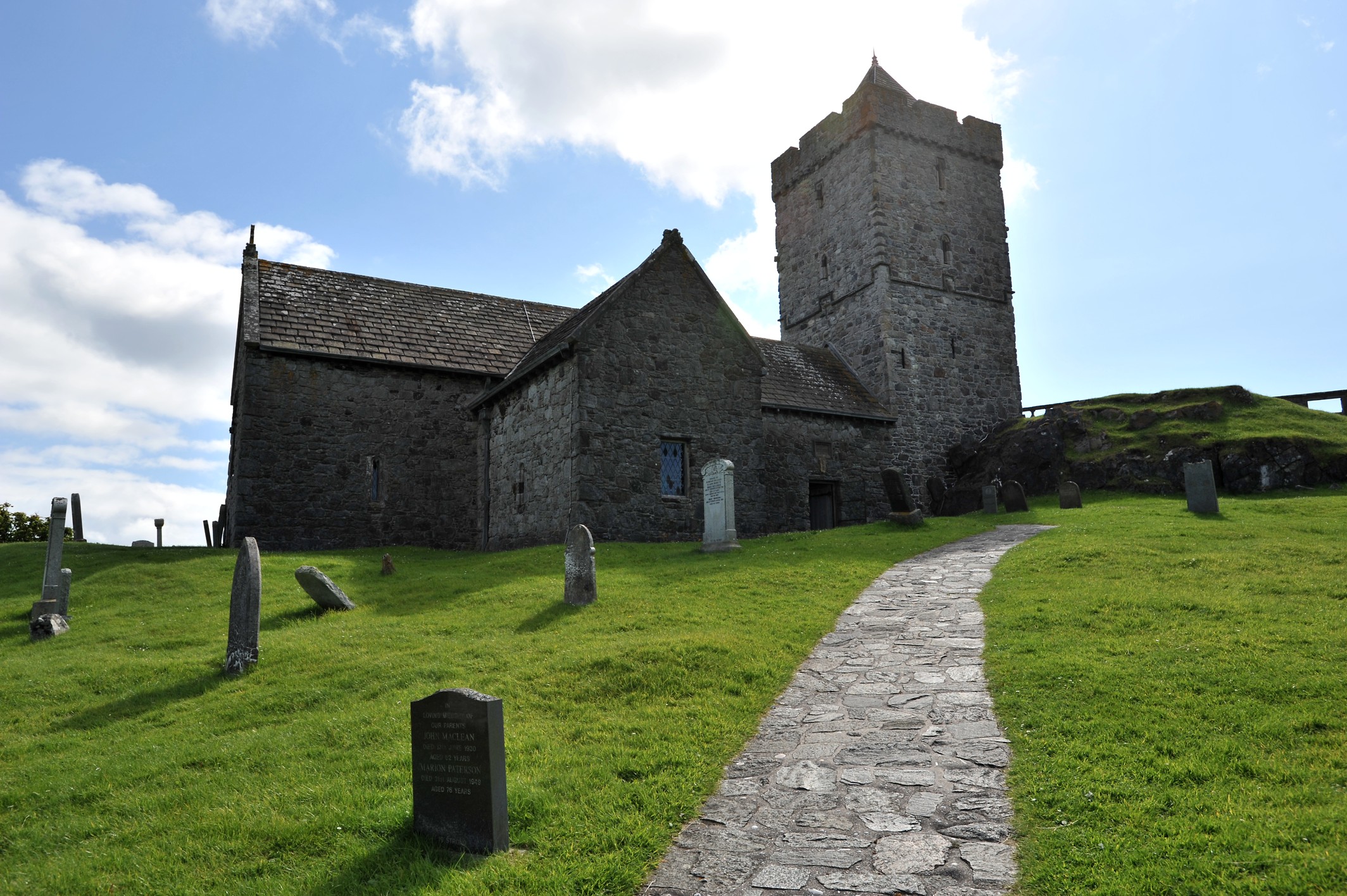
St Clement's Church, Rodel
Alasdair Crotach MacLeod, the 8th Chief, prepared his own tomb in 1528 -- nineteen years before he died. The wall tomb on the south side of the choir at St Clement's Church in Rodel is crowned by a carved arch and decorated with biblical scenes of such intricacy that scholars have called it possibly the finest medieval wall tomb in Scotland. That a clan chief on the remote southern tip of Harris commissioned his own memorial with such care and so far in advance tells you something about the MacLeods, about their church, and about the kind of confidence that builds in stone on the edge of the Atlantic.
Gneiss and God
The church was built from local Lewisian gneiss -- rock formed nearly three billion years ago, among the oldest on Earth -- shaped into a cruciform ground plan with a tower at the west end. The architectural style dates to 1520-1550, placing its construction during the chieftainship of Alasdair Crotach himself. A door at the west end of the nave leads to stone staircases and wooden ladders that ascend the tower. The choir and sanctuary with the high altar occupy the east end, once separated from the nave by a wooden screen. Transepts lead off both sides to additional chapels. Dean Donald Munro, writing in 1549, described the building as a monastery, though there is no evidence of a monastic community; historians believe he meant it as a parish church of unusual importance. The MacLeod chiefs who built it lived not on Harris but at Dunvegan Castle on Skye, yet they chose this spot at Rodel as their spiritual seat.
Three Chiefs, Three Tombs
The church is as much mausoleum as house of worship. After Alasdair Crotach's elaborate tomb in the choir, his son William, the 9th Chief, had his own grave prepared in the south wall of the nave in 1539. A third tomb in the south transept probably belongs to John MacLeod of Minginish, the 10th Chief. Five more grave slabs lean against the wall of the north transept, and the surrounding graveyard contains additional MacLeod burials. Among those said to be interred here is the seventeenth-century poet Mary MacLeod -- Mairi Nighean Alasdair Ruaidh -- whose Gaelic verse celebrated and sometimes criticized the MacLeod chiefs with equal vigor. The church was dedicated to Pope Clement I, giving it the Gaelic name Tur Chliamainn, or Clement's Tower.
Reformation, Ruin, and Restoration
St Clement's was a Catholic church, and it fell into disuse shortly after its completion around 1560, a casualty of the Scottish Reformation. The churchyard continued to serve as a MacLeod burial ground, but the building itself decayed. Captain Alexander MacLeod of Berneray renewed the roof in 1784, only to see it burn down shortly after; it was rebuilt again in 1787. By the nineteenth century, the church had been reduced to use as a cow byre -- a fate common to many Scottish medieval churches, where theological revolutions met agricultural pragmatism. In 1873, Catherine Herbert, Countess of Dunmore, undertook a proper restoration. In 1907, a lightning strike damaged the tower, which was rebuilt in 1913. Today the church is under the care of Historic Scotland, its Lewisian gneiss walls as solid as they were five centuries ago, the carvings on Alasdair Crotach's tomb still sharp enough to read.
At the End of Harris
Rodel sits at the southernmost point of Harris, where the road runs out and the landscape opens to the sea. The church stands on a slight rise, commanding views across the Sound of Harris to the islands beyond. To reach it is to understand why the MacLeods chose this place: it is both an ending and a beginning, the last point of land before the water takes over, a threshold between the known world and whatever lies beyond. The church's position -- built by island chiefs who lived on another island, dedicated to a pope by men whose descendants would become Protestant, occupied by cattle before being rescued by a countess -- captures the particular Scottish talent for layering centuries of contradiction into a single building. The gneiss absorbs it all, as it has absorbed three billion years of everything else.
From the Air
Located at 57.74N, 6.96W at the southern tip of Harris in the Outer Hebrides. The church tower is visible from the air as a prominent structure at Rodel. Nearest airport is Stornoway (EGPO) on Lewis, approximately 55 miles north. Best viewed at 2,000-3,000 feet. The Sound of Harris and the islands of North Uist are visible to the south.