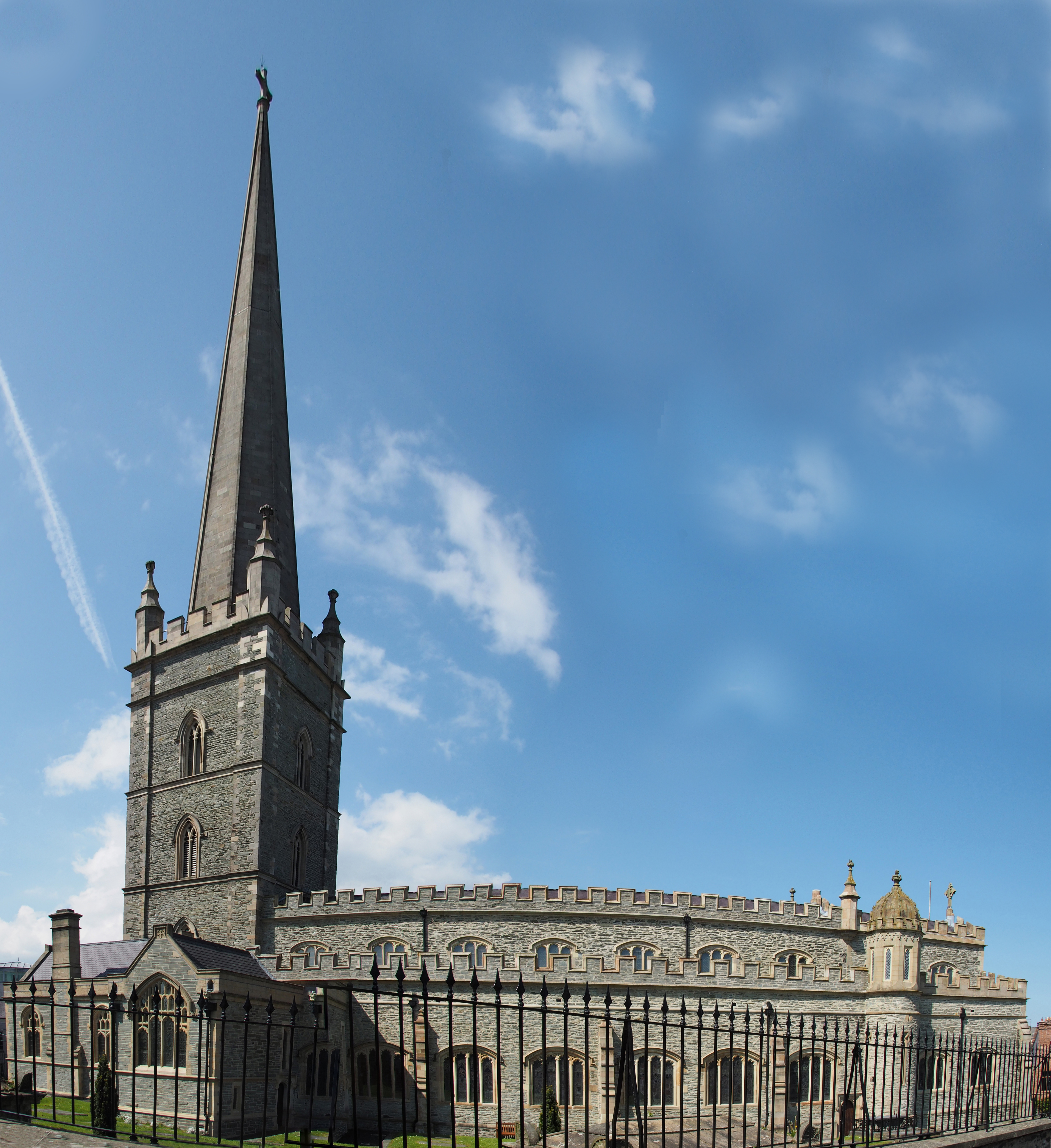
St Columb's Cathedral
Set into the porch of St Columb's Cathedral is a small square stone tablet, easy to miss. Its Latin inscription reads: "In Templo Verus Deus Est Vere Colendus" -- "The True God is in His Temple and is to be truly worshipped." The stone was rescued from An Teampall Mor, the Big Church, a medieval cathedral that stood on this site before Sir Henry Docwra arrived in 1600 with 4,000 soldiers, demolished the ruins, and used them as raw material for the walls and ramparts of the newly fortified city. The present cathedral rose in its place, consecrated in 1633, and holds a distinction no other church in Western Europe can claim: it was the first non-Roman Catholic cathedral built after the Reformation.
A Church Built From Its Own Ruins
The original diocesan cathedral of Templemore had already suffered before Docwra leveled it. An accidental gunpowder explosion damaged it in 1568 -- the church having been commandeered for storing ammunition during the Nine Years' War. The violence of that conflict finished the job. When London builder William Parratt raised the present church on ground close to the original site, he created a fine example of what historians call "Gothic survival" -- seventeenth-century architecture still speaking the language of medieval Gothic. The cathedral is contemporary with the chapel of Peterhouse, Cambridge, and shares its commitment to the pointed arch and timber ceiling at a time when classical forms were becoming fashionable elsewhere. Foundations for a chancel extension were laid in 1633, but the building work never advanced beyond that point.
The Saint Who Left Ireland
The cathedral takes its name from Saint Columba, the Irish monk who established a Christian settlement in the area before his exile from Ireland in the sixth century. That exile carried Christianity to Scotland and northern England, making Columba one of the most consequential figures in the Christianization of Britain. His association with Derry predates the walls, the plantation, and the religious divisions that would come to define the city. As the cathedral church of the Church of Ireland's Diocese of Derry and Raphoe, and also the parish church of Templemore, St Columb's stands at the intersection of Derry's layered identities -- a Protestant cathedral named for a Catholic saint, built inside walls that became symbols of sectarian division, in a city that is still learning to hold all its histories at once.
Behind the Walls
The cathedral sits within the walled city of Derry, the most complete set of city walls anywhere in Ireland and among the finest in Europe. Those walls have made the cathedral a witness to the siege of 1689, the political upheavals of the twentieth century, and the Troubles that reshaped Northern Ireland. Inside, the building holds a remarkable collection of artifacts and memorials spanning four centuries. The nave stretches east under a timber ceiling. Perpendicular Gothic tracery fills the windows. A nineteenth-century tower and spire were added to the exterior, along with a chancel and chapter house. One of the cathedral's most unusual objects is the Bomb Font -- a cannonball from the siege, now repurposed as a baptismal ornament. It is the kind of artifact that could only exist in Derry: violence transformed into ritual, destruction absorbed into worship.
Still Standing
Nearly four centuries after its consecration, St Columb's continues to serve as a place of active worship. The organ has been played by a succession of musicians since at least 1873, the role passing from one hand to another across generations. Dean Raymond Stewart, appointed in 2016, served for nearly nine years before announcing his retirement after forty-seven years of active ministry in the Diocese of Derry and Raphoe. The cathedral remains the episcopal see of the diocese, its congregation smaller than in centuries past but its significance undiminished. In a city where even the name -- Derry or Londonderry -- carries political weight, the cathedral endures as a place where the deep past presses close against the present, where a stone tablet from a demolished medieval church reminds worshippers that the ground beneath them has been holy for longer than any wall has stood.
From the Air
Located at 54.99N, 7.32W within the walled city of Derry/Londonderry, Northern Ireland. The cathedral's spire is visible from the air within the distinctive oval of Derry's city walls, which are themselves a prominent landmark. City of Derry Airport (EGAE) lies approximately 10 km northeast. The River Foyle, Craigavon Bridge, and Peace Bridge are all nearby landmarks for orientation. The walled city sits on the west bank of the Foyle.