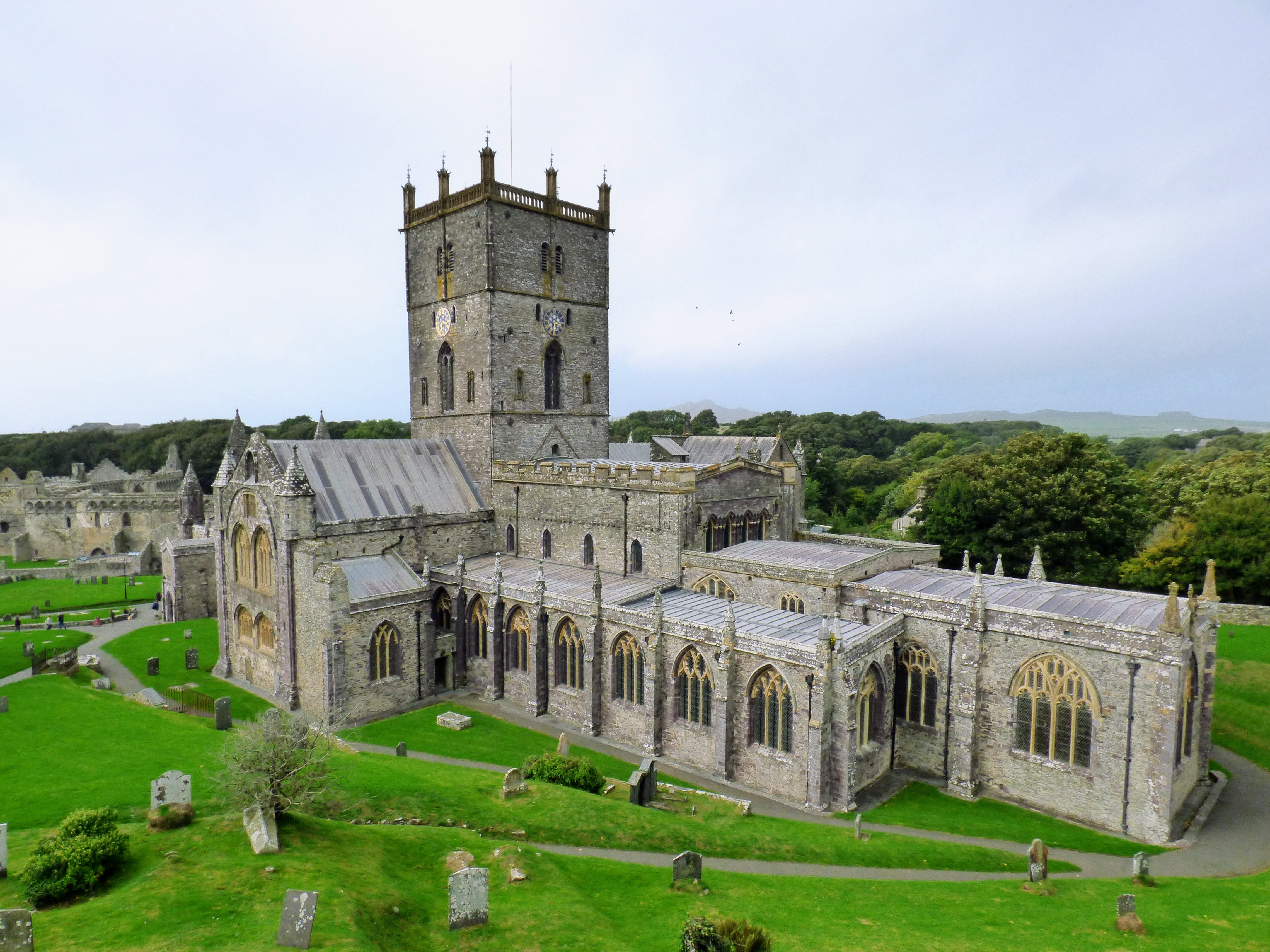
St Davids Cathedral
You approach St Davids Cathedral by walking downhill. This is unusual -- most cathedrals sit on the highest ground in town, asserting their dominance over the surrounding landscape. St Davids does the opposite. It nestles in the valley of the River Alun, hidden from view until you are practically at its door. The reason is defensive: Viking raiders attacked the monastic community here at least a dozen times between 645 and 1097, and a building that could not be seen from the sea stood a better chance of surviving the next assault. The strategy of concealment gives the cathedral its most distinctive quality. You descend the thirty-nine steps from the gatehouse, and there it is -- one of the oldest and most significant Christian sites in Britain, tucked away like a secret.
The Bishops Who Were Murdered
Saint David, Abbot of Menevia, founded a monastic community here before his death in 589 AD. Over the next five centuries, the community endured relentless violence. Vikings raided repeatedly, but they were not the only threat. Bishop Moregenau was murdered in 999. Bishop Abraham was killed in 1080, and the intricately carved 'Abraham Stone' that marked his grave -- bearing early Celtic symbols -- is now displayed in the cathedral's Porth-y-Twr exhibition. Despite the bloodshed, St Davids grew in intellectual and spiritual significance. King Alfred summoned scholars from the community to help rebuild the intellectual life of Wessex. William the Conqueror visited in 1081 to pray, recognizing it as a holy place. In 1090, the Welsh scholar Rhigyfarch wrote his Latin Life of David, elevating David to near-cult status. And in 1123, Pope Calixtus II granted a papal privilege that transformed the site: he decreed that two pilgrimages to St Davids equaled one to Rome, and three equaled one to Jerusalem.
A Cathedral That Slopes
The present cathedral was begun in 1181 and completed shortly after. Problems arrived almost immediately: the tower collapsed in 1220 and an earthquake caused damage in 1247. Bishop Henry de Gower, who served from 1328 to 1347, added the elaborate rood screen and built the Bishop's Palace, now a picturesque ruin. In 1365, Bishop Adam Houghton and John of Gaunt began constructing St Mary's College and its cloister. The Holy Trinity Chapel, built under Bishop Edward Vaughan between 1509 and 1522, features fan vaulting that some claim inspired the ceiling of King's College, Cambridge. One of the cathedral's most striking physical characteristics is the pronounced slope of its floor -- nearly four meters of height difference between the east and west ends. The building is still shifting minutely. The Irish oak ceiling of the nave, constructed between 1530 and 1540, remains one of its finest features. In 1538, Bishop Barlow stripped the shrine of its jewels and confiscated the relics of St David and St Justinian. Cromwell's forces later reduced the cathedral to near-ruin and stripped the lead from the Bishop's Palace roof.
Restoration and Revival
The Welsh architect John Nash was commissioned to restore the west front in 1793. His work proved substandard -- not for the last time in Nash's career -- and within a century the facade had become unstable. George Gilbert Scott undertook a thorough restoration between 1862 and 1870. The twentieth century brought both setbacks and renewal. Disestablishment in 1920 separated the Church in Wales from the Church of England, and the diocese shrank when the Archdeaconry of Brecon was transferred to form a new diocese. But the Welsh Youth Pilgrimages to St Davids, known as Cymry'r Groes, brought young people back to the cathedral and supplied the Church in Wales with inspired clergy for a generation. In 1982, Queen Elizabeth II became the first monarch to distribute the Royal Maundy outside England, choosing St Davids for the ceremony. The British Government reinstated the city title in 1995, making St Davids officially the smallest city in Britain. A major restoration program followed: the west front was rebuilt using stone from the original quarry at Caerbwdi Bay, a new organ was built by Harrison and Harrison of Durham, two treble bells were cast by the Whitechapel Bell Foundry, and the cloisters were reconstructed between 2003 and 2007.
The Talking Stone and the Tomb of a King's Father
Gerald of Wales, the twelfth-century chronicler, recorded a curious legend about a marble footbridge called Llechllafar -- 'the talking stone' -- that spanned the River Alun near the cathedral. According to Gerald, the stone once spoke aloud when a corpse was being carried over it to the cemetery, and the effort of speech split it in two. The superstition became so powerful that corpses were no longer carried across the bridge. More tangibly, the cathedral holds the tomb of Edmund Tudor, 1st Earl of Richmond and father of Henry VII. His body was brought from the dissolved Greyfriars' Priory in Carmarthen in 1540 and entombed before the high altar. Gerald of Wales himself is buried here, as is the Welsh prince Rhys ap Gruffydd. The bells -- ten in total, the heaviest weighing over a ton -- ring not from the central tower but from the old gatehouse of Porth-y-Twr. On St David's Day 2012, the restored shrine of St David was unveiled and rededicated, bringing the cathedral full circle to the saint whose community began this place nearly fifteen centuries ago.
From the Air
Located at 51.88N, 5.27W near the westernmost point of Wales, in St Davids, Britain's smallest city. The cathedral sits in a depression in the landscape and is not visible from a distance -- approach at low altitude from the south or west to spot it. The ruins of the Bishop's Palace sit adjacent. Nearest airports: Haverfordwest (EGFE) 12 miles southeast, St Athan (EGDX). Best viewed at 1,000-2,000 feet to appreciate the cathedral's hidden position in the valley.