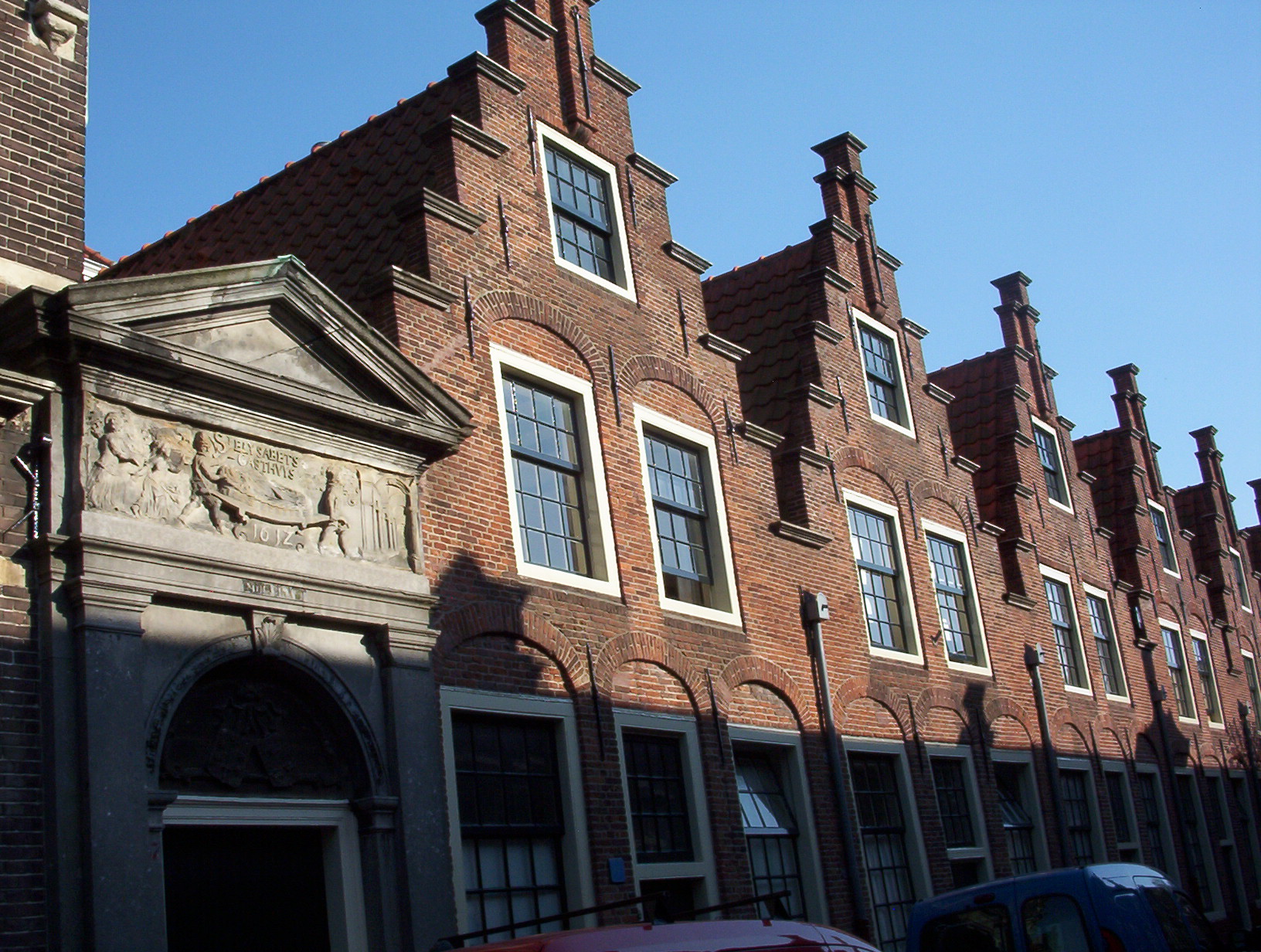
St. Elisabeth Gasthuis, Haarlem
Above a side door on the Groot Heiligland, set high enough that most pedestrians never look up, a 1612 gable stone shows a sick person being carried in a wicker basket on a stretcher. The Dutch word is lappenmand, a basket of rags, and it is the older Haarlem name for the moment when a body becomes too weak to manage on its own. The stone marks the doorway of the St. Elisabeth Gasthuis, a hospital that ran for four centuries on this spot and whose successor still functions today, twenty minutes' walk away on the Boerhaavelaan. The same three crowns of St. Elisabeth still mark the modern buildings. The patients in the basket have changed; the institution has not.
A Hospital Born of Fire
The fire of 1572 destroyed a large part of central Haarlem, including the original Gangolf Gasthuis on the Verwulft. Nine years later, in 1581, with the Protestant Reformation rolling over the city, the hospital society petitioned the town for permission to rebuild. The town awarded them the buildings of the Minnebroers monastery on the Gasthuisvest. The remaining Franciscan monks were ordered to leave. A community that had cared for souls was replaced by one that would care for bodies, and for four hundred years it did, in the same set of walls, through every plague, war, and renovation Haarlem could throw at it. The main facade you see today dates from 1871, the most ambitious of many rebuildings, but the hospital function persisted under its skin until 1970.
A Princess and Three Crowns
The hospital's patron was Elisabeth of Hungary, the 13th-century landgravine of Thuringia who, the legend goes, smuggled bread to the poor under her cloak; when her husband stopped her on a forest path and demanded to see what she carried, the bread had turned to roses. The three crowns of her arms - representing her royal birth in Hungary, her marriage into Thuringia, and her heavenly crown as a saint - became the hospital's symbol. They still appear, carved into baroque shields, above doorways on the Kleine Houtstraat, on the gate of the Hofje van Loo, on the Gasthuisvest, and around the corner on the Groot Heiligland. The miracle of the roses became a sculpture by Mari Andriessen in 1971, placed in a rose garden behind the new hospital. The bread is gone, but the crowns remain everywhere in this city, like watermarks left by an institution that no one any longer notices but everyone has, at some point, depended on.
Painted Regents, Painted Care
Every generation of the hospital's board commissioned its portrait. In 1641, Frans Hals painted five male regents in dark robes and white collars; the same year, his contemporary Johannes Cornelisz Verspronck painted the four regentesses who managed the women's wards. The doorway into the regentesses' room still survives, framed by the Haarlem city arms on one side and the three crowns of Elisabeth on the other. The Hals painting once hung inside that room, on a wall the regents looked at while they worked. Today it has moved around the corner to the Frans Hals Museum. Almost forty other paintings from the hospital's walls now hang there too - works by Maarten van Heemskerck, Cornelis Cornelisz van Haarlem, Adriaen Backer, Dirck Hals, a follower of Joachim Patenier. Most were privately funded by the regents themselves, not paid for from hospital coffers, which is why no one could argue they should have been sold to fund medicine. The tradition continues: every modern hospital building in the Netherlands sets aside one percent of construction cost for art.
Four Centuries of Patients
Imagine the number of people who lay in beds inside these walls. Children with smallpox. Women in labour. Sailors brought up the Spaarne with broken bones from rigging accidents. Soldiers from the Eighty Years' War. Old men dying of consumption. Plague victims in the bad years. The institution's records run back into the Dutch Republic, through the French period when most things in Haarlem changed names, through the German occupation, through the rise of antibiotics. A back room of the complex once held the Zanderzaal, a chamber full of machines invented by Gustav Zander, the Swedish physician who founded modern physical therapy. Patients lay on his contraptions and were stretched, bent, and rolled back into mobility. The room is still there, still on the same floor, but it now displays an overview of Haarlem's history.
What the Old Building Holds Now
In 1970 the hospital moved southeast to the Boerhaavelaan, in 1991 it merged with two other Haarlem hospitals, and in time the merged Spaarne Gasthuis built its main complex on Vondelweg. The Gasthuisvest buildings were repurposed. The grand 1871 facade now opens onto music lessons, dance classes, and a fitness studio - a cultural centre called the Egelantier. The wings have become apartments. Two museums occupy the early 19th-century wing on the Groot Heiligland: the Historisch Museum Haarlem and the ABC Architectuurcentrum. Walk past on a winter evening and you can hear a tango class on the first floor, see the lit windows of the museums, and know - if you know to look - that this is the building where Haarlem, for four hundred years, brought its sick.
From the Air
St. Elisabeth Gasthuis sits at 52.376 N, 4.634 E, in central Haarlem about 15 km west of Amsterdam. The old complex is on the Gasthuisvest in the southern part of the historic city centre, easy to pick out from the air as a rectangular block of red roofs immediately south of the St. Bavokerk. The modern Spaarne Gasthuis is several kilometres north, near Vondelweg 999. Nearest airport is Amsterdam Schiphol (EHAM), about 12 km southeast; Rotterdam The Hague (EHRD) is 55 km south. Recommended viewing altitude 1,500-3,000 feet; Haarlem passes under the Polderbaan and Kaagbaan approach corridors and is overflown frequently in calm conditions.