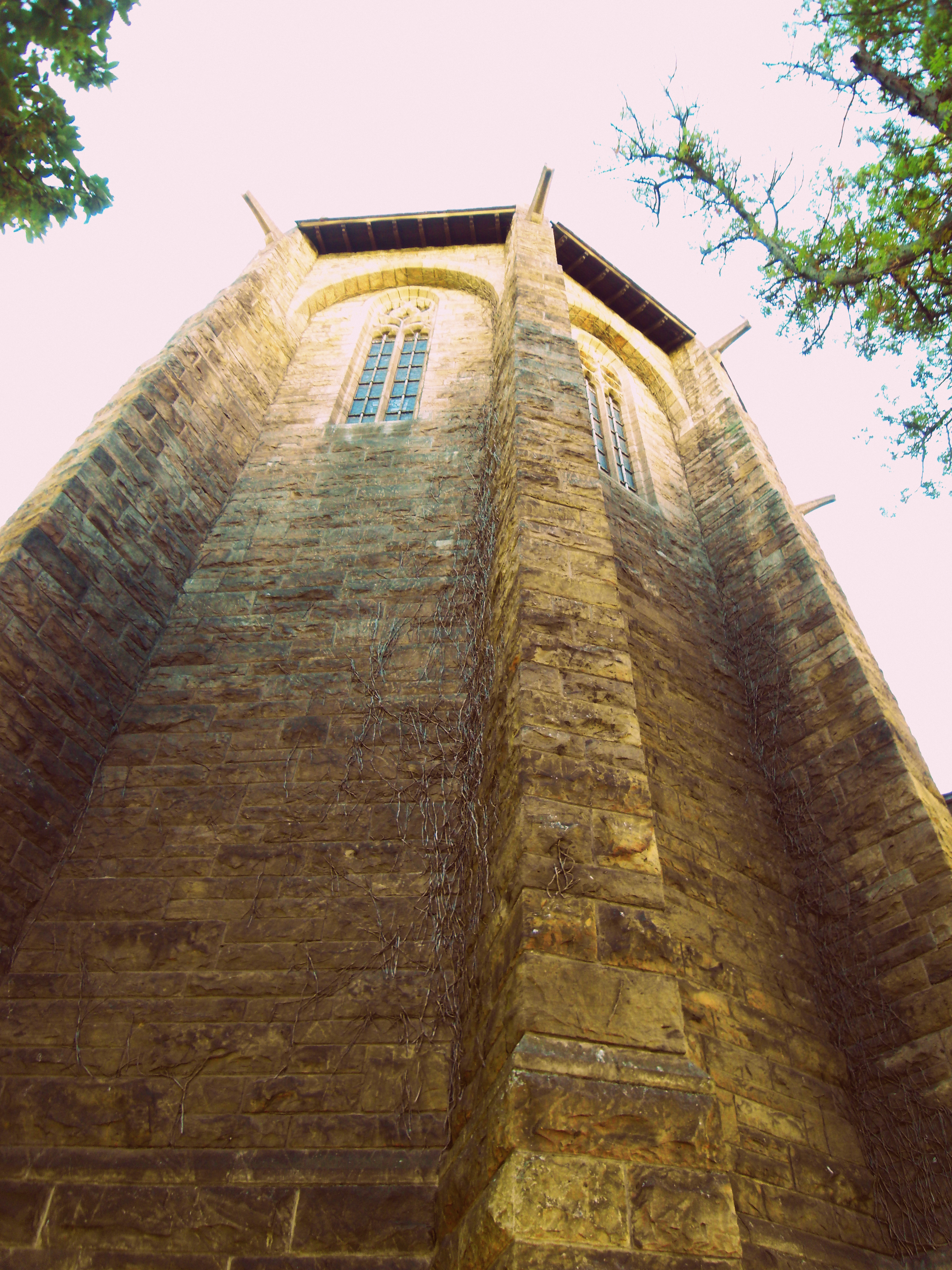
St. George's Cathedral, Cape Town
In the great west window of St. George's Cathedral, the central figure is a triumphant Black Christ. To his right, in stained glass, stands Mahatma Gandhi. The window was created by French artist Gabriel Loire and installed in 1982 -- eight years before Nelson Mandela walked free, twelve years before the first democratic election. It was a declaration of faith rendered in glass: that justice would prevail, that the oppressed would triumph, that the church would not be neutral. From this cathedral, Archbishop Desmond Tutu preached against apartheid with a moral clarity that shook a nation. The building Sir Herbert Baker designed in 1901 had become something its Edwardian-era patrons never imagined -- the spiritual headquarters of South Africa's struggle for freedom.
Borrowed Space, Borrowed Faith
Cape Town's Anglican community spent its early decades without a proper building. In October 1827, the Bishop of Calcutta -- visiting what was then a distant outpost of his diocese -- discussed the idea of building a church. Until then, Anglicans had worshipped in the Castle of Good Hope and later accepted hospitality from the Dutch Reformed Groote Kerk. The colonial government donated a site at the lower end of the Dutch East India Company's gardens, at the corner of Government Avenue and Wale Street. Governor Sir Lowry Cole laid the foundation stone on St. George's Day, 23 April 1830. The church was modeled on the Neo-Greek St. Pancras' Church in London, and it opened for services on 21 December 1834, with a capacity of 1,000 people -- 300 of those seats reserved for the poor.
A Cathedral Built in Stages
In 1847, Robert Gray was ordained as the first Bishop of Cape Town and installed his cathedra -- his bishop's throne -- in what was still a modest parish church. That act made it a cathedral, even if the building did not match the title. Gray dreamed of something grander but died in 1872 without seeing it realized. It was not until 22 August 1901 that the Duke of Cornwall and York -- later King George V -- laid the foundation stone for Herbert Baker's new design. The South African War delayed construction until 1904. The north transept was not completed until 1936. Baker's letters AMDG (Ad Majorem Dei Gloriam -- "For the Greater Glory of God") are chiselled into the inward-facing surface of every stone in the cathedral, invisible from outside, present in every wall.
Light Through Colored Glass
The cathedral's stained glass tells a story of evolving faith and conscience. The oldest windows, from 1886 by Mayer of Munich, depict the Ascension and the Last Supper -- the latter showing only eleven disciples, with Judas Iscariot visible clutching his bag of silver. The great north window, dedicated in 1951 and executed by Francis Skeat, is reportedly the largest stained glass window in the Southern Hemisphere, depicting saints and pioneers of the church in Africa. But it is Loire's west window that arrests visitors. The Black Christ at its center, arms raised in triumph, was commissioned in memory of Earl Mountbatten but speaks to a far larger liberation. The rose window over the south transept took Frank Spears two years to complete, its Christ in Majesty surrounded by seraphim and cherubim in petals of red and blue.
The People's Cathedral
St. George's earned its moral authority during apartheid. Desmond Tutu, who served as Archbishop of Cape Town from 1986 to 1996, used the cathedral as a platform for nonviolent resistance. The building became a gathering point for marches, vigils, and prayer services that challenged the apartheid state. Tutu's ashes were interred here after his death in December 2021. The cathedral was declared a provincial heritage site in 2014 by Heritage Western Cape. Today, its crypt houses a jazz restaurant called The Crypt -- a detail that captures something essential about the building's character. This is not a cathedral preserved in amber. Its bells, originally cast in 1834 by Mears and Stainbank of Whitechapel, were recast in 1963 into a ring of ten and finally hung for proper change ringing in 1979. The pulpit and lectern come from the original church, donated in memory of the wreck of the mail ship SS Drummond Castle, which sank off Ushant in 1896. Every surface carries a story, every window a witness.
From the Air
Located at 33.93S, 18.42E at the corner of Wale Street and Government Avenue in central Cape Town, adjacent to the Company's Garden and near Parliament. The cathedral is part of the cluster of historic buildings in the governmental precinct. Cape Town International (FACT) is 18 km southeast. Table Mountain rises dramatically behind the city center. The bell tower is visible from low altitude. Best viewed at 2,000-3,000 ft AGL for the urban context among the parliamentary and garden precinct.