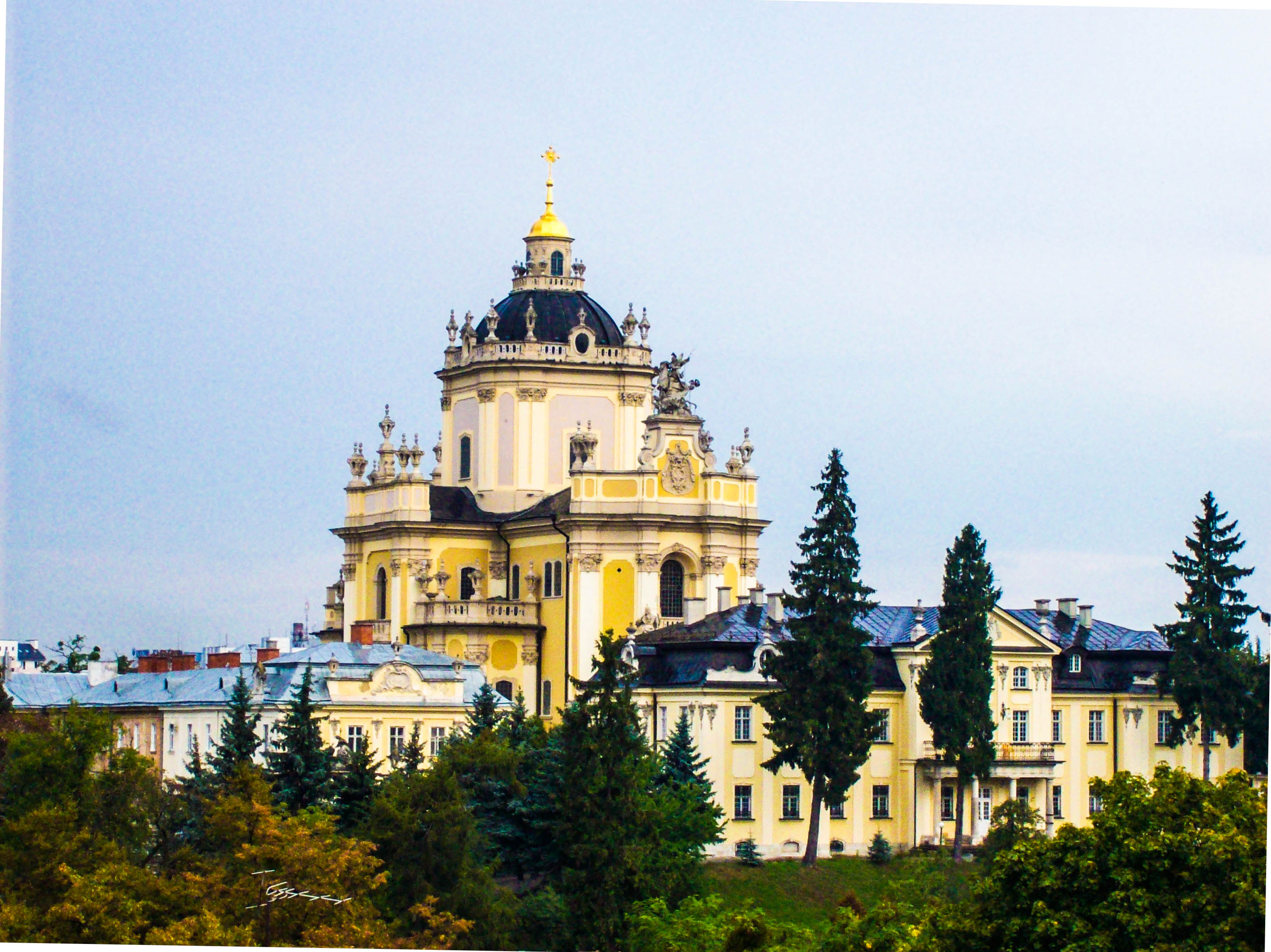
St. George's Cathedral, Lviv
A young priest named Volodymyr Sterniuk hid in the cathedral loft in March 1946 and watched as the Synod of Lviv below him voted to dissolve the Ukrainian Greek Catholic Church and hand its parishes to the Russian Orthodox Church. The vote was coerced. The church hierarchy was already in prison. Sterniuk would spend the next four decades leading the banned church underground, and this building -- St. George's Cathedral, perched on its hill above Lviv -- would remain the symbol of what was taken and what was never truly surrendered.
Three Churches, One Hill
A church has occupied St. George's Hill since around 1280, when the area belonged to the Principality of Halych-Volhynia. That first wooden structure, along with the fortress surrounding it, was destroyed by King Casimir III of Poland in 1340. A Byzantine basilica replaced it, serving the local Eastern Orthodox community. In 1642, Orthodox bishop Arseniy Zheliborskyi established a printing workshop at the cathedral -- an early recognition that words could defend a faith as effectively as walls. Then came a pivotal moment: in July 1700, bishop Joseph Shumlanskyi proclaimed the unification of the Lviv archeparchy with the Holy See, embracing the Union of Brest. The hill's church was no longer just Orthodox. It had become the seed of the Ukrainian Greek Catholic Church, a community of eastern rite and western allegiance that would define the spiritual identity of western Ukraine for the next three centuries.
Baroque Ambition on a Hilltop
The current cathedral was built between 1746 and 1762, commissioned by Metropolitan Athanasius Szeptycki and completed by his successor Leo Szeptycki. Its architect, Bernard Meretyn, designed a building that blends western baroque and rococo exuberance with Ukrainian ecclesiastical tradition. The sculptor Johann Georg Pinsel gave it some of its most striking features: an expressive statue of St. George slaying the dragon perched in the church attic, and stern stone figures of Pope Leo I and St. Athanasius flanking the portal. Inside, icons by Luka Dolynskyi range from the dramatic -- a depiction of merchants being driven from the Temple -- to the devotionally intense. The cathedral's most treasured relic is a 17th-century icon of the Virgin Mary, brought from Terebovlia in 1674 and considered wonder-working. As the seat of the metropolitan transferred to Lviv in the 1800s, St. George's became the mother church of the entire Ukrainian Greek Catholic Church.
The Underground Church
After World War II, the Soviet state set about destroying the Ukrainian Greek Catholic Church. In 1945, the newly ordained Archbishop of Lviv, Josyf Slipyj, was arrested along with the rest of the hierarchy. The 1946 Synod of Lviv -- held under duress and with no legitimate Catholic leadership -- nullified the Union of Brest and transferred all Greek Catholic parishes to the Russian Orthodox Church. The cathedral was reconsecrated as Saint Yury's. For 45 years, the UGCC existed only in secret, its priests ordained clandestinely, its sacraments administered in private homes. Slipyj spent eighteen years in Soviet labor camps before being released to Rome. Sterniuk, the young priest who had watched from the loft, led the underground church in Ukraine. The faith persisted in kitchens and basements across western Ukraine, kept alive by people who risked imprisonment to practice it.
Reclaimed in a Changed World
In 1989, amid perestroika, the Soviet government recognized the Ukrainian Greek Catholic Church. The reclamation of St. George's followed swiftly. On August 12, 1990, members of the People's Movement of Ukraine occupied the cathedral. Two days later, the Lviv Oblast council upheld the UGCC's claim. The cathedral was theirs again. Restoration in 1996 commemorated the 400th anniversary of the Union of Brest. In 2005, the seat of the Major Archbishop was transferred to Kyiv, but St. George's remains the central church of the Ukrainian Catholic Archeparchy of Lviv and one of the most important religious buildings in the country. Its tombs hold some of the most significant figures in Greek Catholic history: Cardinal Sylvester Sembratovych, Metropolitan Andrei Sheptytsky, Josyf Slipyj himself, Volodymyr Sterniuk, and Cardinal Myroslav Ivan Lubachivsky. The hill endures as it has for seven centuries -- a place where faith proved more durable than the regimes that tried to abolish it.
From the Air
Located at 49.839N, 24.013E on St. George's Hill in the western part of Lviv, overlooking the city. The cathedral's baroque-rococo profile, belfry, and the adjacent Metropolitan Palace are visible from low altitude on the hill's western slope. The nearest major airport was Lviv Danylo Halytskyi International (UKLL), approximately 6 km southwest, though Ukrainian airspace is currently closed to civil aviation. The hilltop position makes the cathedral one of the more prominent landmarks in Lviv's skyline when viewed from the west or south.