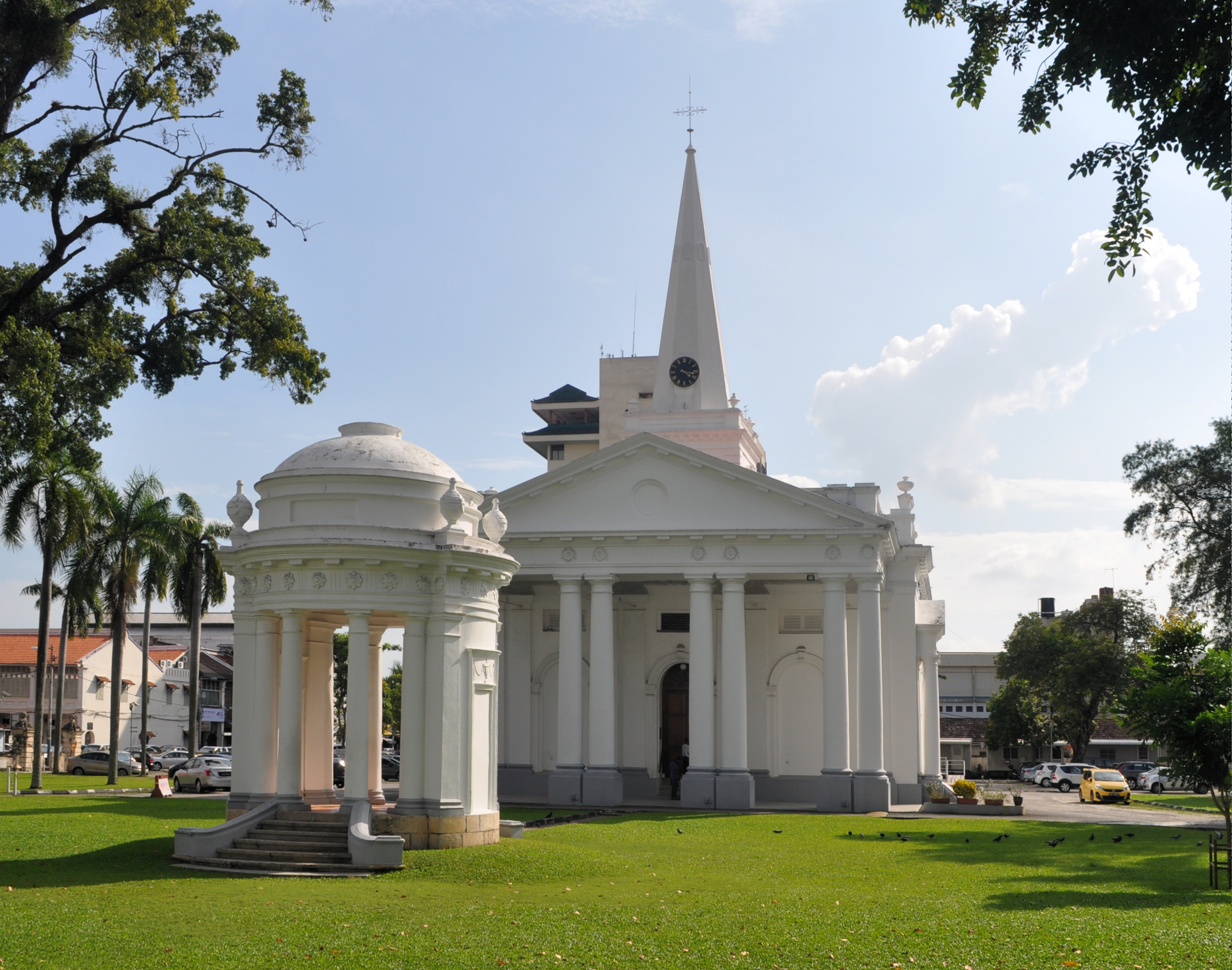
St. George's Church, Penang
It took Indian convict laborers, a governor's architectural sketches, and the East India Company's reluctant blessing to raise the oldest purpose-built Anglican church in Southeast Asia. St. George's Church has stood on its plot in George Town since 1818, its white Doric columns and octagonal steeple a quiet assertion of British order in a port city that was, even then, anything but orderly. Penang in the early nineteenth century was a tangle of languages, religions, and commercial ambitions, and the church was less a monument to spiritual conviction than to imperial self-image: a piece of England reassembled in the tropics, brick by brick, on the backs of men who had no choice in the matter.
From Fort Chapel to Cornerstone
When the British East India Company took possession of Penang Island in 1786, its colonists made do with the chapel inside Fort Cornwallis for their Church of England services. Later they moved across the street to the Court House. Proposals for a permanent church surfaced as early as 1810, but the Company, perpetually weighing expense against prestige, did not act until the East India Company Act of 1813 extended its charter by twenty years and loosened the purse strings. Approval came in 1815. Major Thomas Anburey drew the original plans, but the church was ultimately built to designs by William Petrie, then Governor of Prince of Wales Island, as Penang was formally known. Lieutenant Robert N. Smith of the Madras Engineers modified Petrie's vision, drawing on his colleague Colonel James Lillyman Caldwell's work on St. George's Cathedral in Madras. The architectural lineage is unmistakable: Penang's church is, in essence, a smaller sibling of the Chennai cathedral, transplanted across the Bay of Bengal.
Convict Hands, Colonial Ambitions
The church was built entirely by Indian convict laborers, a fact noted plainly in historical records and worth pausing over. These were men transported from the Indian subcontinent to serve colonial construction projects across the Straits Settlements, and their labor produced one of Southeast Asia's most celebrated churches. The building rose in brick on a solid plastered stone base, blending Neo-Classical, Georgian, and English Palladian styles into a structure that looked as if it had been lifted from a county town in England and set down in the equatorial heat. Among those consulted during construction was the Reverend Robert Sparke Hutchings, the Colonial Chaplain of Prince of Wales Island, who would go on to found the Penang Free School. Hutchings was in Bengal when the building was completed in 1818, so a Reverend Henderson officiated early services. The formal consecration came on 11 May 1819, performed by the Bishop of Calcutta, Thomas Fanshawe Middleton.
A Roof for the Tropics
Even the best-laid colonial plans had to reckon with the climate. The church's original flat roof, a design choice that worked well enough in English parishes, proved disastrously unsuitable for Penang's monsoon rains. In 1864, nearly half a century after construction, the roof was converted to a gable, and an octagonal steeple was added at its apex. The modification gave the church its present silhouette, a profile that has defined this stretch of George Town's streetscape ever since. In 1886, a memorial pavilion was erected on the grounds in honor of Captain Francis Light, the trader and adventurer who had claimed Penang for the British a century earlier. The pavilion marked the centenary of the island's founding as a colonial settlement, linking the church's grounds to Penang's origin story.
National Treasure, Living Church
In 2007, the Malaysian federal government declared St. George's Church one of the country's 50 National Treasures, a distinction that recognized both its architectural significance and its layered history. A major restoration followed in 2009, shoring up the structure and refreshing its white facade. Then, in 2023, the church received an ecclesiastical elevation: it was designated a pro-cathedral, giving it a formal status within the Anglican Diocese of West Malaysia that matches its historical weight. The church sits within George Town's UNESCO World Heritage Site, surrounded by mosques, Chinese clan houses, and Hindu temples, a reminder that the British were only one thread in the city's cultural fabric. Visitors entering today walk past those Doric columns into a space where the air is cooler and the light softer, where the plaques on the walls record two centuries of baptisms, marriages, and memorial services conducted in a language that the builders of the church never spoke.
From the Air
Located at 5.420°N, 100.339°E in the core of George Town's UNESCO World Heritage zone, Penang, Malaysia. The church sits along Lebuh Farquhar, identifiable from lower altitudes by its white facade and octagonal steeple amid the heritage district's dense low-rise buildings. Nearest airport is Penang International Airport (WMKP), approximately 10 nm south. The Penang Bridge and Penang Strait provide clear visual references when approaching from the mainland.