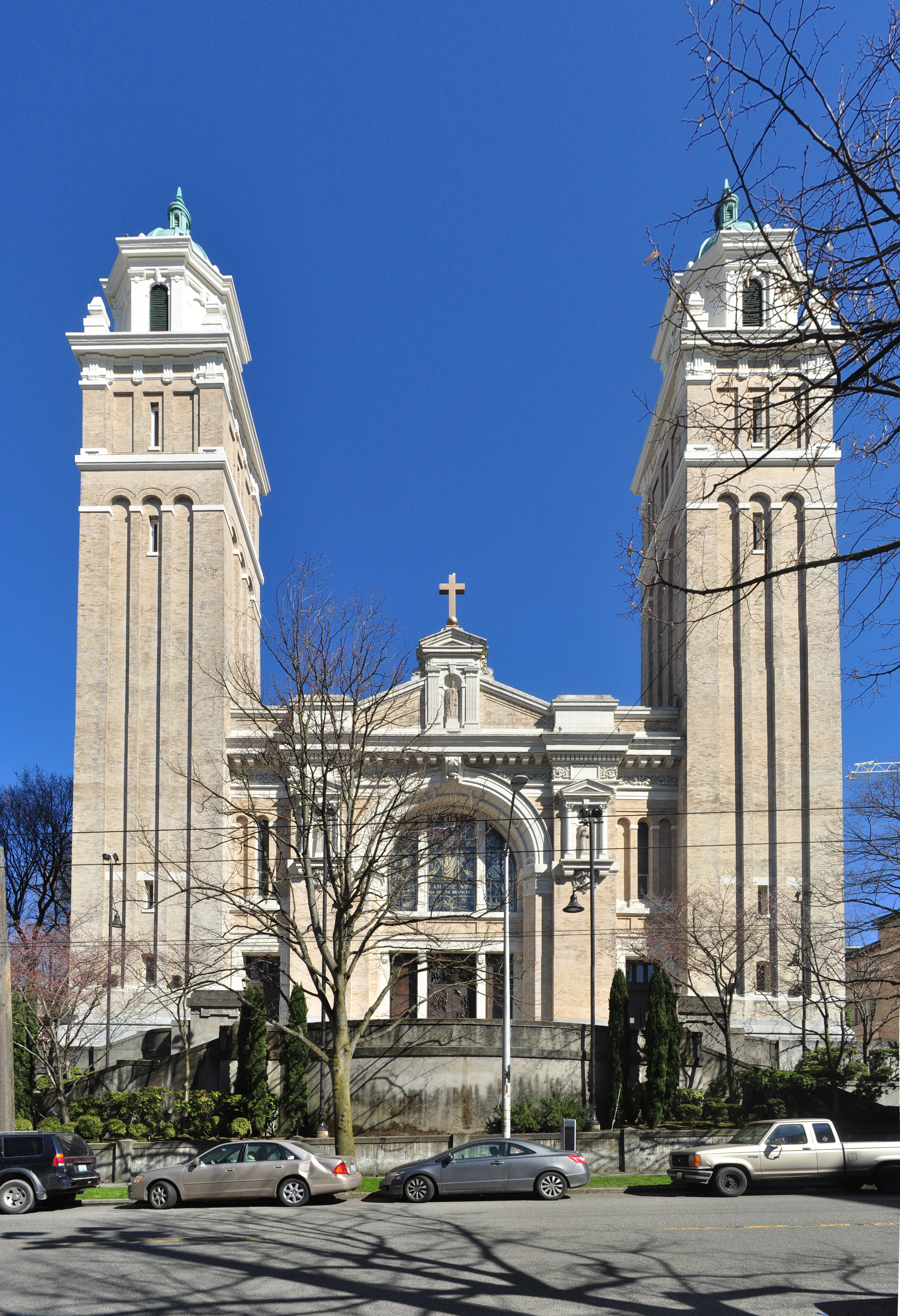
St. James Cathedral
On February 2, 1916, the dome of St. James Cathedral gave way. Heavy snow had been accumulating on the structure, and the weight proved too much. The collapse changed the building forever, not by destroying it, but by creating an absence that architects would spend the next century filling with light. Where the dome once stood, a skylight and oculus now pour daylight onto the central altar, and the cathedral's story has become one of reinvention after loss. Perched on First Hill at 804 Ninth Avenue, St. James is the mother church of the Archdiocese of Seattle, a building that has been dedicated, damaged, stripped down, and rebuilt more beautifully each time across its more than a century of service.
From Fort Vancouver to First Hill
The roots of Seattle's Catholic cathedral reach back to 1850, when Pope Pius IX established the Diocese of Nesqually in Vancouver, Washington. The first bishop, Augustin-Magloire Blanchet, dedicated a modest cathedral honoring Saints James and Augustine inside Fort Vancouver on January 23, 1851. A second St. James Cathedral was built in Vancouver in 1885. But as Seattle's population surged, Bishop Edward O'Dea recognized that Vancouver was fading as the region's center of gravity. At the urging of Father Francis X. Prefontaine, a priest in the booming city to the north, O'Dea relocated the episcopal see to Seattle in 1903 and immediately began planning a cathedral worthy of the move. He purchased the current site on First Hill that same year. Construction began in early 1905, and on November 12, 1905, more than five thousand people gathered for the laying of the cornerstone, the largest religious gathering Seattle had yet seen.
The Dome That Vanished
The cathedral was dedicated on December 22, 1907, the same year the Diocese of Nisqually was formally renamed the Diocese of Seattle. For nine years, a grand dome crowned the building. Then came the winter of 1916. The dome's collapse on February 2 was dramatic but not fatal; the cathedral reopened on March 18, 1917, with a drastically altered interior. The dome was never reconstructed. Instead, the space it left became the cathedral's most distinctive architectural feature. During the major 1994 renovation, liturgical consultant Father Richard S. Vosko guided the installation of an oculus and skylight directly above a new central altar, positioned at the crossing where the dome had been. Relics of St. Frances Xavier Cabrini, who had worshiped at St. James during her missionary work in Seattle from 1903 to 1916, were sealed beneath this altar. Cabrini, the first American citizen to be canonized, had walked these aisles when the dome was still overhead.
Bronze, Glass, and Sacred Conversation
The art collected within St. James spans continents and centuries. Charles Connick's stained glass windows, installed between 1917 and 1920 during the post-dome rebuilding, fill the nave with filtered color. In 1994, three new windows by German artist Hans Gottfried von Stockhausen were added in the east apse, incorporating fragments of Connick's 1918 glass as backgrounds for six roundels depicting the works of mercy from the Gospel of Matthew. The ceremonial bronze doors, installed in 1999, are the work of German sculptor Ulrich Henn, whose only other American commission is the bronze gates at the National Cathedral in Washington, D.C. The doors trace a biblical pilgrimage from the expulsion from Eden to the heavenly Jerusalem. In the cathedral chapel hangs a 1456 altarpiece by Florentine painter Neri di Bicci, a sacra conversazione showing the Madonna and Child surrounded by six saints. How this Renaissance masterpiece arrived in Seattle remains a mystery.
Stars Above the Shrine
The cathedral's interior rewards slow observation. The west vestibule floor declares in mosaic: DOMUS DEI PORTA COELI, "House of God, Gate of Heaven." Inside the west doors, the baptismal font is inscribed with the Chi Rho, an ancient Greek abbreviation for Christ, and its classical quatrefoil shape echoes the floor plan of the cathedral itself. Along the north wall, a shrine honoring Saint John XXIII, dedicated in 2012 by Seattle artist John Sisko, makes St. James the only cathedral in the United States with such a devotion. The Shrine of the Blessed Virgin Mary, designed by parishioner Susan Jones, is perhaps the most intimate space: its ceiling replicates the night sky as it appeared over Seattle on December 22, the date of the cathedral's dedication. The Virgin and Child statue within is modeled on a fifteenth-century sculpture from the German monastery of Blaubeuren.
The Living Cathedral
St. James has never been content as a monument. The red interlocking clay roof tiles, manufactured by the Celadon Roofing Tile Company, still cap a building that houses active social ministries: the Cathedral Kitchen, Homeless Ministry and Nightwatch, a housing advocacy program, and the St. James Immigrant Assistance Program, all operated from Cathedral Hall and the Pastoral Outreach Center. The center itself was once the convent of the Sisters of the Holy Names of Jesus and Mary, who run nearby Holy Names Academy. Above the west door, a 1950 black and gilt window shows Christ with outstretched hands, framed by images of the Pacific Northwest's industries of that era: fishing, shipping, lumber, and manufacturing, with a sketch of Mount Rainier. The window reads, "I am the vine, you are the branches." The cathedral was designated a Seattle city landmark in 1984, but the designation merely acknowledged what parishioners had known for decades: this building belongs to the city as much as to the church.
From the Air
St. James Cathedral sits at 47.608N, 122.326W on First Hill, the ridge immediately east of downtown Seattle. From the air, look for the distinctive red clay tile roof and the twin-towered west facade facing Ninth Avenue. The cathedral is roughly equidistant between the Space Needle to the northwest and the stadiums to the south. First Hill rises prominently above the I-5 corridor. Nearest airports: Boeing Field/King County International (KBFI) 4nm south, Seattle-Tacoma International (KSEA) 11nm south. Renton Municipal (KRNT) 10nm southeast.