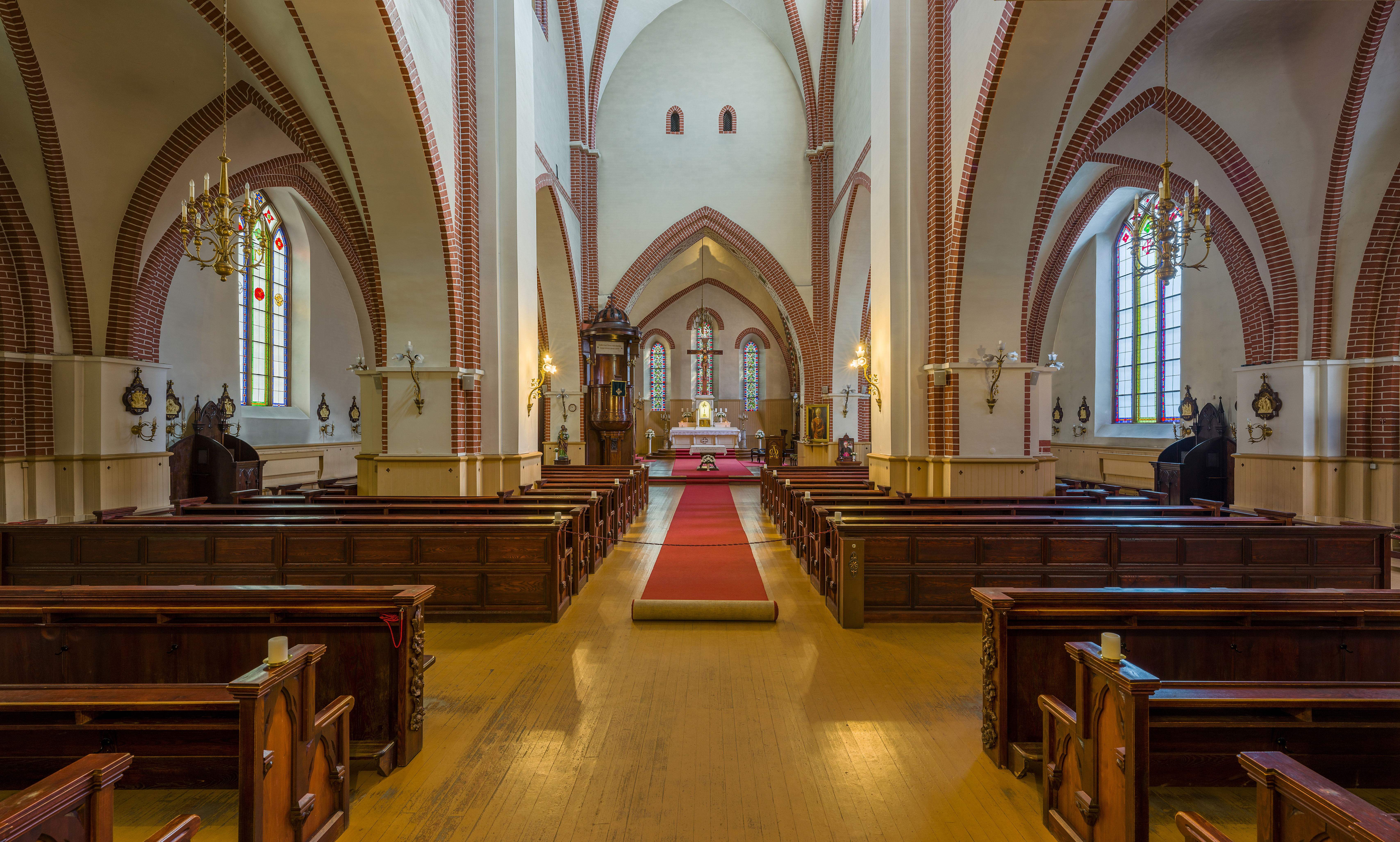
St. James's Cathedral, Riga
The same brick walls have heard prayers in Latin, German, Latvian, Swedish, Estonian, and back to Latin again. St. James's Cathedral in Old Riga was dedicated in 1225, just as Crusaders were finishing their conquest of the eastern Baltic, and over the following 800 years the building changed religion almost every time the city changed rulers. Catholic, then the second German-speaking Lutheran church in town, then the first Latvian-speaking Lutheran church, then Jesuit, then Lutheran again, then a French-occupier flour warehouse, then finally Catholic once more in 1923 when newly-independent Latvia handed it back. Few buildings carry that much theological mileage in their stones.
A Crusader's Church
When the foundation stones were laid in the early 13th century, Riga was barely a generation old as a Christian city. The Northern Crusades had reached the eastern Baltic, the Bishop of Riga had a cathedral of his own (the Dom across the river side of Old Town), and St. James's was built as a parish church for the rough new merchant settlement growing up between the Daugava and the bishop's keep. The early Gothic shape it still wears dates from that founding generation. In the 15th century the Holy Cross Chapel was added at the southern end and parts of the church were reworked into a basilica plan, the modest brick tower beside it climbing higher into the Riga skyline. By then St. James's stood opposite what would later become the House of the Livonian Noble Corporation, the building that today houses the Saeima, Latvia's parliament. The two structures still face each other across a narrow cobbled square, sacred and secular sharing the same address.
Five Centuries of Changing Hands
In 1522 the Reformation arrived and St. James's became the second German-language Lutheran church in Riga. A year later, in 1523, it became the first Latvian-language Lutheran church, a quietly radical choice that put scripture into the parishioners' own tongue at a moment when most Latvians were still treated as a peasant underclass by the German-speaking town elite. In 1582 the Polish king Stephen Bathory took the city for the Polish-Lithuanian Commonwealth and gave the church to the Jesuits as part of the Counter-Reformation. In 1621 the Swedish king Gustavus Adolphus marched in and gave it back to the Lutherans. Over the next century services here were held in German, Swedish, and Estonian by turns, depending which garrison or congregation held the upper hand. After Russia took Riga in 1710 the building was renamed The Crown Church, and German-language services were tolerated as a courtesy to the Baltic German nobility who actually ran the place for the Tsars.
Napoleon's Flour Warehouse
From June to November of 1812, with Napoleon's Grande Armee threatening Riga during the Russian campaign, French troops requisitioned the church and filled the nave with sacks of flour and other military supplies. The Lutheran congregation walked across town to St. Peter's Church for services. Riga was never actually captured, the suburbs were burned in a panicked Russian defense that proved entirely unnecessary, and by November the French had withdrawn and the bags of flour came out. In 1901 the oldest Baroque altar in Riga, a 1680 piece that had survived all these changes, was finally replaced by a new one. Then came 1918, Latvian independence, and the question of who actually owned all the church real estate that had been bouncing between confessions for four centuries.
Returned to Rome
The 1923 Latvian church property referendum sorted things out by handing St. James's to the Catholic minority, who needed a cathedral and now had one. The first Catholic mass in nearly four centuries was celebrated on 3 May 1924 by Archbishop Antonijs Springovics. In 1947, under early Soviet occupation, Springovics formally created the Catholic parish of St James as a national congregation without territorial bounds, gathering Latvian Catholics from across Riga along with the small French and English Catholic communities still in the city. Pope John Paul II visited in 1993, just two years after Latvia escaped the USSR. Pope Francis came in 2018 to mark the centennial of Latvian independence. Today the cathedral is part of the UNESCO-listed Old Riga, its medieval brick still patched with eight centuries of repairs, the same building visible in 16th-century engravings of the city skyline.
Old Riga from the Air
From above, Old Riga reveals itself as a tight cluster of red-tiled roofs and three church spires rising along the right bank of the Daugava. St. Peter's needle is the tallest and most famous, the squat black tower of the Dom Cathedral squats nearby, and St. James's slimmer green spire stands a little inland near the parliament. The whole medieval core fits inside what was once the city's defensive ring, now traced by parks and a canal. The Daugava broadens into a delta just west, the modern bridges thread across it, and the Hanseatic geometry of the old town remains startlingly intact eight centuries on.
From the Air
St. James's Cathedral sits in Old Riga at 56.95 N, 24.10 E, on the right bank of the Daugava River. View from 4,000-6,000 feet to take in the medieval old town's three spires together. Riga International Airport (EVRA) lies 9 km southwest. Best in clear weather; Baltic coast can produce low cloud and fog, especially in autumn and winter.