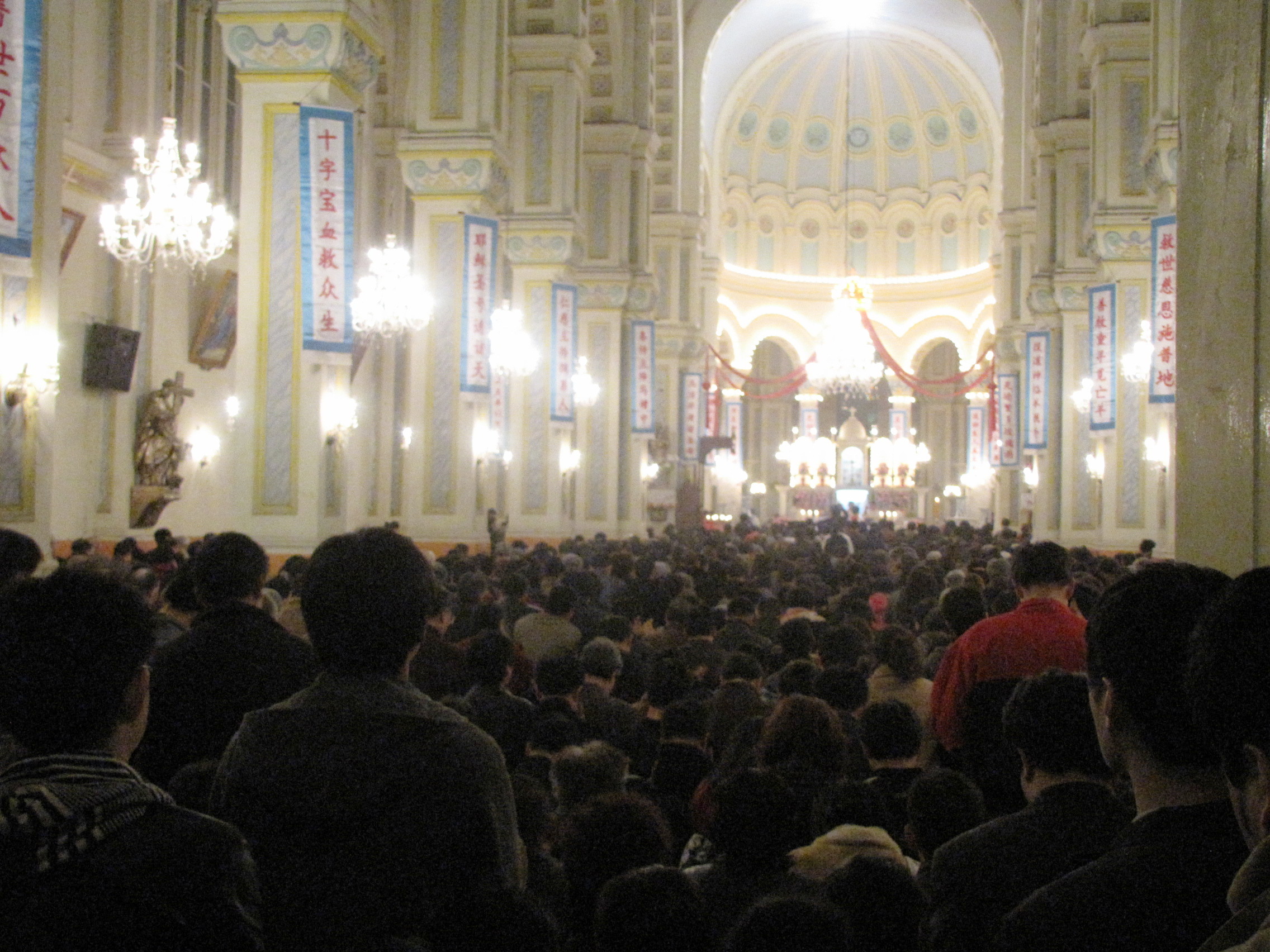
St. Joseph Cathedral (Tianjin)
Every brick came from France. When Bishop Paul-Marie Dumond of the Congregation of the Mission began construction of St. Joseph Cathedral in August 1913, he insisted on materials shipped from the other side of the world, as if the building's legitimacy depended on the authenticity of its clay. The result, completed in June 1916 in the heart of Tianjin's French concession, is northern China's largest Romanesque church -- a 1,892-square-meter sanctuary that can hold 1,500 worshippers beneath a green copper dome topped with a bronze cross. Known locally as Xikai Church, it is still the largest Catholic church in the Tianjin metropolitan area.
A Dome Without a Lightning Rod
The cathedral's design blends French and Roman architectural traditions. Fourteen large columns -- two rows of seven -- line the main hall, leading to a gallery-style transept. The central dome sits atop an octagonal drum roof that echoes the octagonal windows found throughout the building. Stained glass windows with inlay paintings filter light into a space covered with painted murals depicting Biblical scenes. When the cathedral was completed, the bishop refused to install a lightning rod on the dome, trusting divine protection over engineering. Fifty years later, pragmatism won and one was added. But by the time eighty years had passed, the commercial center that grew around the cathedral had produced taller buildings, and the rod became unnecessary -- a small parable about the relationship between faith, technology, and the passage of time.
Red and Yellow on the Skyline
From the outside, the cathedral announces itself through a distinctive pattern of red and yellow tiles on checkered walls, framed with white water masonry. Circular windows, columns, and semi-circular arches create a visual rhythm that is unmistakably European yet somehow at home in this northern Chinese city. The entrance was designed with two doors at the rear, originally intended to allow men and women to enter separately -- a convention that has long since been abandoned. The building's exterior, with its green copper dome and flanking towers, has become one of Tianjin's most recognizable landmarks, surviving in a commercial district where modern high-rises have transformed the skyline around it.
Attacks and Aftershocks
The cathedral's history tracks the violent upheavals of twentieth-century China. On October 20, 1916, shortly after the church's completion, French police in the concession were forced to disarm by local Chinese officers, sparking massive protests. The building survived that confrontation but not the Cultural Revolution: on August 23, 1966, Red Guards stormed the area and destroyed three of the cathedral's towers. They were not rebuilt until the 1980s. Then, on July 28, 1976, the Tangshan earthquake severely damaged the dome's base and front towers. Repairs began in 1979 and were completed by autumn 1980, when the cathedral reopened with a celebration that marked both physical restoration and the beginning of a more tolerant era for religious practice.
Two Parishes, One Cathedral
Today, St. Joseph Cathedral serves two distinct congregations. The Chinese parish holds daily morning Mass with additional weekend services, maintaining a tradition of worship that has continued through persecution and natural disaster. Since 2007, an English-speaking parish founded by Joseph Loftus has celebrated Mass at 11:30 each Sunday, drawing expatriates and English-speaking Catholics from across Tianjin. The English parish has built a full community infrastructure -- music ministry, youth group, rosary group, charity partnerships with local organizations including the Huiling Orphanage. In August 1991, Xikai was listed on Tianjin's cultural relics protection list, giving it formal recognition as a historical monument. It remains a working church, a French colonial artifact, and a survivor.
From the Air
Located at 39.12°N, 117.19°E in Tianjin's Heping District, at the southern end of Binjiang Dao, the city's main commercial pedestrian street. The cathedral's distinctive green copper dome and twin towers make it identifiable from lower altitudes amid the surrounding commercial buildings. Nearest airport: Tianjin Binhai International (ZBTJ), approximately 15 km east. Beijing Capital International (ZBAA) is about 120 km northwest. The building sits at a key intersection in the former French concession district.