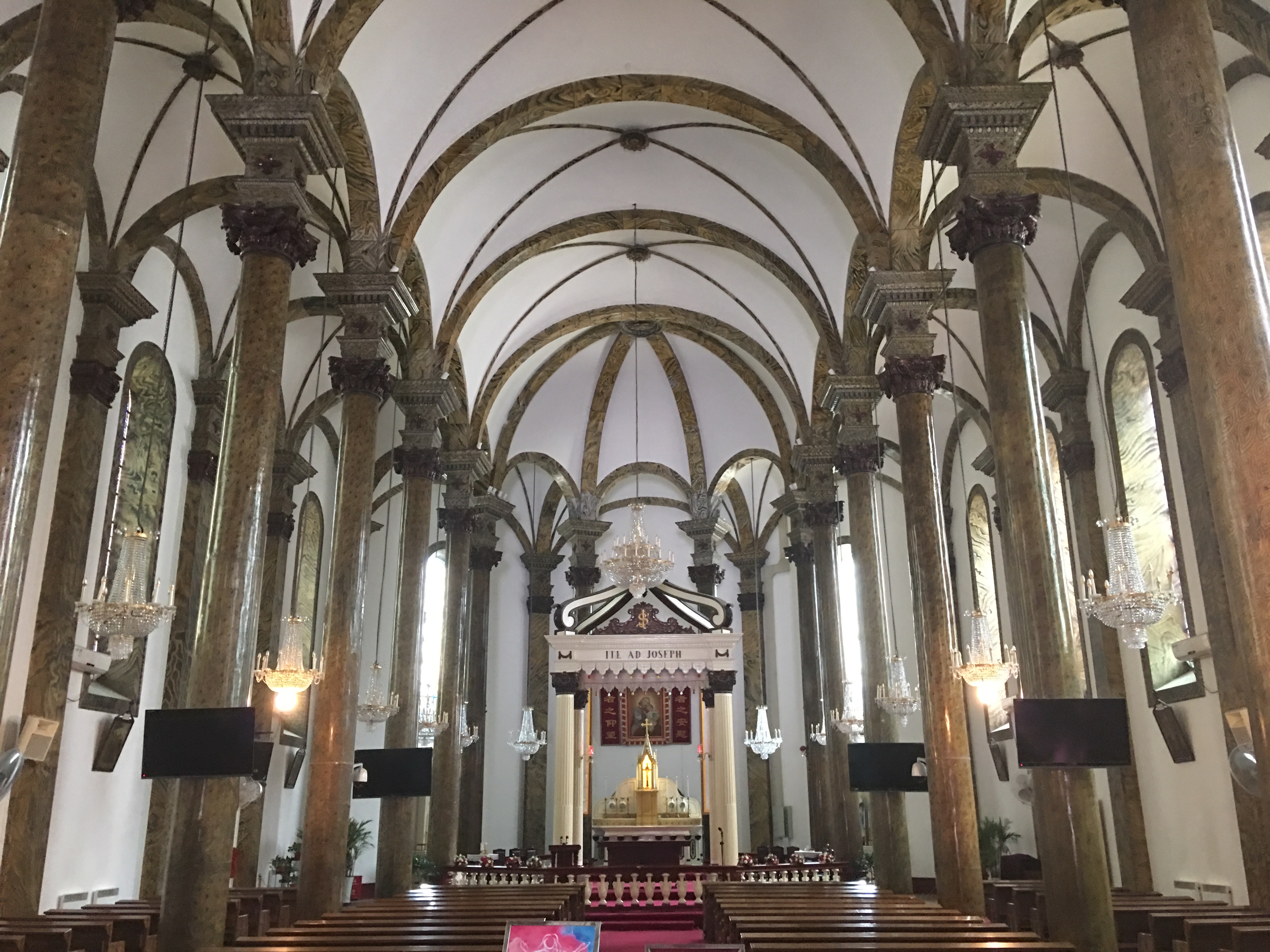
St. Joseph's Church, Beijing
The Jesuits came to Beijing because they understood the stars. In 1653, Father Lodovico Buglio, an Italian astronomer and theologian, and Father Gabriel de Magalhaes, a Portuguese priest, established a small congregation on land gifted by the Shunzhi Emperor. The emperor had granted the Jesuits -- and only the Jesuits -- the rare privilege of residing in the imperial capital, not out of religious sympathy, but because their astronomical expertise proved useful to the court. The church they built served double duty as a house of worship and a residence, a quiet foothold for European Catholicism in the heart of China.
An Emperor's Gift, a Century of Ruin
The original St. Joseph's was completed in 1655, making it the second oldest Catholic church in Beijing after the Cathedral of the Immaculate Conception. But the building's history reads like a catalog of destruction. Wars, political upheavals, and natural disasters took their toll across the centuries, and the church was rebuilt multiple times. The structure that visitors see today on Wangfujing Street dates from 1904, its Romanesque Revival facade a deliberate echo of European ecclesiastical architecture transplanted to a shopping district in eastern Beijing. The arched windows and twin bell towers stand in striking contrast to the commercial bustle of Wangfujing around it.
Between Two Authorities
The founding of the People's Republic in 1949 placed St. Joseph's in an impossible position. The new government severed diplomatic ties with the Vatican and moved to bring all religious institutions under state control through the Chinese Patriotic Catholic Association. St. Joseph's parish priests have since operated without Vatican recognition, their appointments a product of negotiation between two authorities whose relationship remains one of the most delicate in modern diplomacy. The church was shuttered entirely in 1966, the first year of the Cultural Revolution, and suffered significant damage during the decade of political upheaval that followed.
Survival on Wangfujing
Today, St. Joseph's stands as something of an anomaly: a functioning Catholic church at the northern end of one of Beijing's most famous shopping streets. Wangfujing pulses with commercial energy -- department stores, snack vendors, neon signage -- and yet the church persists, its gray stone facade and devotional quiet occupying a space that real estate logic alone cannot explain. Services are held regularly, and the church draws both worshippers and curious tourists. In a city that has torn down and rebuilt itself countless times, St. Joseph's endurance is itself a kind of testimony -- not to any single faith, but to the stubborn persistence of things that are old enough to outlast the forces that would destroy them.
A Rare Bridge
Pope Benedict XVI's reported approval of at least one bishop's appointment at St. Joseph's marked a quiet diplomatic milestone, making the appointee one of the few Chinese bishops recognized by both the Vatican and the Chinese government. In a country where the relationship between church and state remains fraught, such dual recognition is extraordinary. St. Joseph's, commonly known as Dongtang -- the East Church -- occupies its place among Beijing's four historic Catholic churches not through architectural grandeur or political power, but through the simple, improbable fact of having survived.
From the Air
Located at 39.92°N, 116.41°E on Wangfujing Street in Beijing's Dongcheng District. The church is visible from low altitude as a gray stone structure amid the commercial buildings of Wangfujing. Beijing Capital International Airport (ZBAA/PEK) lies 25 km to the northeast. Best viewed at 2,000-4,000 feet when approaching from the east.