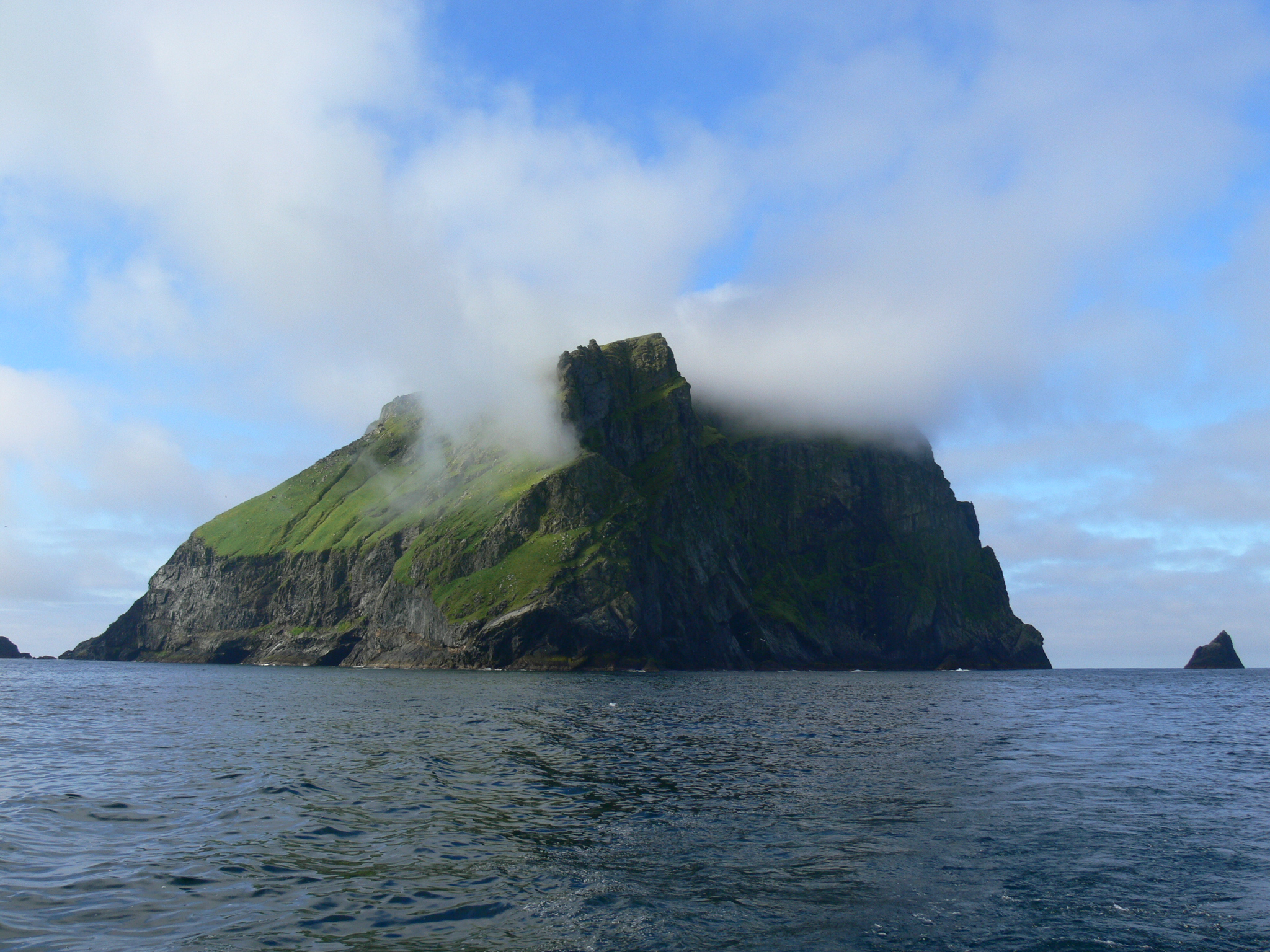
St Kilda, Scotland
When British soldiers arrived on Hirta in 1746 searching for Bonnie Prince Charlie, the islanders fled to caves, convinced they were pirates. Coaxed out eventually, the St Kildans had never heard of the prince. They had never heard of King George II either. That level of isolation defined life on this archipelago 35 nautical miles west-northwest of North Uist -- the remotest inhabited place in the British Isles, where news arrived by bonfire signal or sheepskin-bladder mailboat, and where a community sustained itself for two thousand years on seabirds, sheep, and stubborn resilience before the modern world finally overwhelmed it.
Cliffs at the Edge of the World
St Kilda is the remnant of a long-extinct ring volcano, its islands composed of Tertiary granites and gabbro sculpted by Atlantic gales into some of the most dramatic sea cliffs in Europe. Conachair, the highest point on the main island of Hirta, rises 430 metres above sea level -- and its north face drops 427 metres sheer into the ocean, forming the tallest sea cliff in the United Kingdom. The archipelago comprises four main islands: Hirta, the largest at 670 hectares; Soay and Boreray; and the island of Dun, which shelters Village Bay from the prevailing southwesterlies. Wind speeds of 209 km/h have been recorded near sea level. Gales batter the islands roughly 75 days a year. Two ancient breeds of sheep survive here in the wild -- the Neolithic-era Soay and the Iron Age Boreray -- while the St Kilda wren and St Kilda field mouse are found nowhere else on Earth.
The Fowlers' Republic
For centuries, the St Kildans lived on birds. Gannets, fulmars, and puffins were the staple diet -- harvested as eggs, chicks, and adults from the vertiginous cliffs and sea stacks. A 1764 census recorded the 90 inhabitants consuming 36 wildfowl eggs and 18 seabirds daily. Young men proved their worth at the Mistress Stone, a door-shaped opening in the rocks overhanging a gully northwest of Ruival, where they demonstrated the cliff-climbing skills necessary for survival and marriage. The community stored their harvest in cleitean -- distinctive stone storage huts unique to St Kilda, of which 1,260 survive on Hirta alone. When Henry Brougham visited in 1799, he found the air thick with 'a stench almost insupportable -- a compound of rotten fish, filth of all sorts and stinking seafowl.' The smell was the price of survival.
Mailboats and Ministers
Communication with the outside world was precarious at best. In 1877, journalist John Sands improvised when nine shipwrecked Austrian sailors were stranded on the island and supplies ran low. He attached a message to a lifebuoy from the wreck and cast it into the Atlantic. Nine days later, it washed ashore in Birsay, Orkney, and a rescue followed. The St Kildans refined the idea, fashioning miniature wooden boats with sheepskin bladders and bottled messages. Launched on northwest winds, two-thirds were eventually found on the Scottish coast or in Norway. But isolation had its spiritual costs too. When the Free Church minister John Mackay arrived in 1865, he imposed three services every Sunday, each lasting two to three hours. Attendance was effectively compulsory. Children were forbidden to play and required to carry Bibles everywhere. When a supply ship arrived on a Saturday during a food shortage, Mackay insisted the islanders spend the day preparing for church. Supplies were not landed until Monday.
The Last Summer
The population, which may never have exceeded 180, had been declining since the 19th century. Visiting ships brought cholera and smallpox. The upheaval of the First World War drew young men away. Tourism, ironically, introduced diseases against which the isolated community had no immunity. By 1930, only 36 people remained. On 29 August that year, at their own request, the remaining islanders were evacuated to the Scottish mainland aboard HMS Harebell. The men set open their Bibles on the tables, locked their doors, and left. Some never recovered from the transplantation. Today the only year-round residents are military personnel at a radar tracking station. The National Trust for Scotland, which owns the entire archipelago, sends conservation workers and volunteers in summer. In 1986, St Kilda became one of the few places in the world to receive dual UNESCO World Heritage status -- recognized for both its natural and cultural significance.
A Stone Library
Recent archaeology has pushed the story of human presence on St Kilda much deeper than previously known. In 2015, Neolithic pottery sherds made from local materials emerged near the village, suggesting settlement as early as the 4th millennium BC. Stone tool quarries on Mullach Sgar yielded hoe-blades and Skaill knives that may be thousands of years old. Remarkably, when similar tools were unearthed from the 2,000-year-old Taigh an t-Sithiche -- the 'house of the faeries' -- in 1877, the St Kildans recognized them immediately and could name each one, because identical implements were still in daily use. That continuity, stretching across millennia of unbroken habitation on this storm-lashed fragment of volcanic rock, is perhaps St Kilda's most astonishing legacy.
From the Air
St Kilda lies at 57.815N, 8.5875W, roughly 35 nautical miles west-northwest of North Uist in the Outer Hebrides. The archipelago is visible from the Skye Cuillin ridges on clear days, some 129 km distant. Approach from the east for best views of Village Bay and the dramatic north face of Conachair. Nearest airfield is Benbecula Airport (EGPL), approximately 70 nm east. Weather is frequently severe with high winds and low visibility; clear days offer spectacular aerial views of the sea stacks and cliff formations.