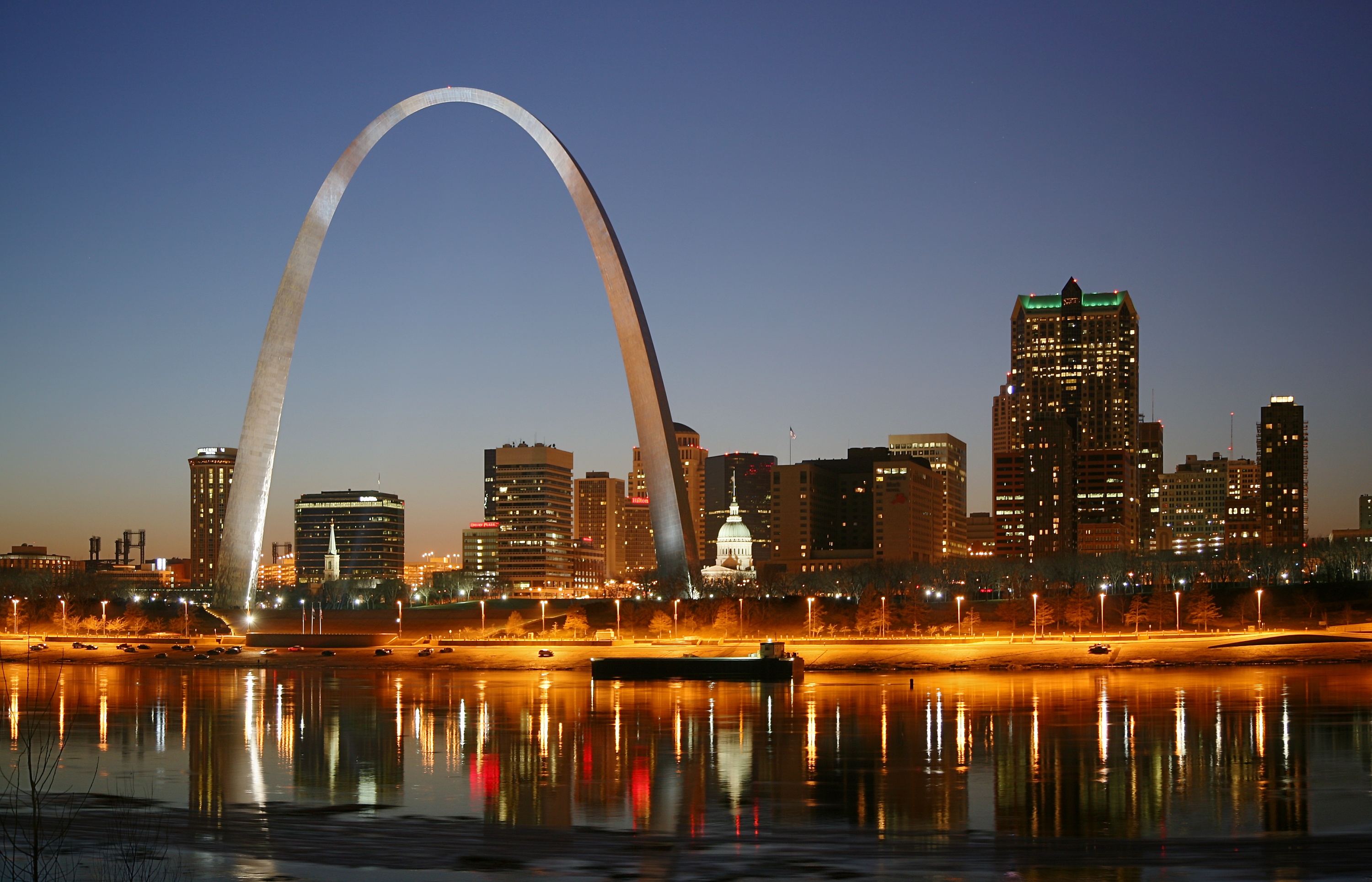
Gateway Arch: The Monument That Pointed West
The Gateway Arch is America's tallest monument and also its most mathematically elegant. Eero Saarinen designed it as a weighted catenary curve - the shape a chain assumes when hanging freely, inverted and executed in stainless steel at a scale that dominates the St. Louis skyline. At 630 feet tall and 630 feet wide at the base, the proportions are perfect; the arch sways up to 18 inches in high winds but remains stable through engineering as graceful as the form. The monument commemorates westward expansion, the Louisiana Purchase, and St. Louis's role as 'Gateway to the West.' That history is complicated: expansion for some meant displacement for others. The arch celebrates what it cannot fully contain.
The Design
Eero Saarinen won the design competition in 1947, though construction didn't begin until 1963. He died in 1961, never seeing his masterpiece completed. The weighted catenary shape - slightly thicker at the base than a pure catenary - ensures stability while achieving the form's apparent weightlessness. The stainless steel cladding, unique among major monuments, reflects sky and city, changing appearance with light. The legs are equilateral triangles at the base, transitioning to smaller triangles at the apex where they meet. Interior tram cars, running at odd angles through the structure's curves, carry visitors to an observation deck with views reaching 30 miles. The engineering that achieved the form is invisible; only the form remains.
The Construction
Building the arch required precision unprecedented in large-scale construction. Each leg rose independently, creeping upward in sections, the two sides meeting at the apex where a final keystone section locked them together. Tolerances were measured in fractions of inches over 630 feet. Workers climbed inside the structure as it rose, trusting calculations they couldn't verify. On October 28, 1965, the final section was placed, the two legs meeting within 1/64 of an inch of projection. The crowd that gathered expected dramatic completion; the placement was almost anticlimactic in its precision. The arch stood, the mathematics vindicated, Saarinen's vision realized four years after his death.
The History
The arch commemorates the Louisiana Purchase of 1803 and the westward expansion that followed. St. Louis was the launching point for Lewis and Clark, the outfitting center for pioneers, the last Eastern city before the frontier. The Old Courthouse, preserved within the park, hosted the Dred Scott trial - the Supreme Court case that denied citizenship to enslaved people and helped precipitate the Civil War. The expansion the arch celebrates included the displacement of Indigenous peoples across the continent; the Old Courthouse interprets this history alongside the pioneers. The monument is both celebration and complication, pointing west toward lands that were already home to others.
The Park
Gateway Arch National Park encompasses the riverfront below the arch, the underground museum, and the Old Courthouse. The grounds underwent extensive renovation completing in 2018, reconnecting the park to downtown and creating greenspace from former highway. The Museum at the Gateway Arch, beneath the north leg, interprets westward expansion through multiple perspectives. Riverboat cruises depart from the levee. The Old Courthouse offers restored courtrooms and exhibits. The arch itself provides the destination: tram cars load in the underground visitor center, ascending through the legs in capsules designed specifically for the structure's curves. The observation deck's windows offer views of St. Louis, the Mississippi, and the Illinois plains beyond.
Visiting Gateway Arch
Gateway Arch National Park is located on the Mississippi riverfront in downtown St. Louis. Tram rides to the observation deck require timed tickets; reserve online during busy periods. Security screening precedes entry. The tram ride takes four minutes each way; the observation deck accommodates about 160 visitors at a time. The museum is free; plan at least an hour. Riverboat cruises offer different perspectives. The Old Courthouse provides historical context. The grounds are pleasant for walking, especially since the 2018 renovation. The experience is best in clear weather; haze limits observation deck views. The arch is visible from throughout St. Louis, but the experience of standing beneath it - understanding the scale, watching the curves rise and meet - justifies the journey.
From the Air
Located at 38.62°N, 90.19°W on the west bank of the Mississippi River in downtown St. Louis, Missouri. From altitude, the Gateway Arch is unmistakable - a gleaming stainless steel curve on the riverfront, its shadow tracing patterns across the park below. The arch's 630-foot height makes it visible from miles in any direction. The Mississippi flows past; the Eads Bridge crosses just to the north. Downtown St. Louis rises west of the park. East St. Louis, Illinois, spreads on the opposite bank. The arch marks the urban core, the defining element of the St. Louis skyline. What appears from altitude as an elegant curve of metal is America's tallest monument - the Gateway to the West, pointing toward expansion that created opportunities and catastrophes in equal measure.