St Machar's Cathedral
According to a fourteenth-century legend, St Columba told his companion Machar to establish a church where a river bends into the shape of a bishop's crosier before flowing into the sea. The River Don makes precisely that bend just below where St Machar's Cathedral now stands in Old Aberdeen. Whether the legend is true matters less than what it reveals: this has been a place of worship for so long that its origins require a miracle to explain. Machar is said to have founded a site here around 580 AD. The building that occupies the ground today is only the latest in a succession that stretches back nearly fifteen centuries.
Layers of Stone and Time
A Norman cathedral replaced Machar's original church in 1131, shortly after David I transferred the episcopal see from Mortlach to Aberdeen. Almost nothing of that building survives -- only a decorated capital base visible in the Charter Room. Over the following centuries, bishops rebuilt and expanded in stages. Alexander Kininmund II demolished the Norman structure in the late 14th century and began the granite nave and western towers. Henry Lichtoun completed the nave and west front. Ingram Lindsay laid the roof and paving stones. Thomas Spens, William Elphinstone, and Gavin Dunbar added further refinements, with Dunbar responsible for the heraldic ceiling and the two western spires. The cathedral as it stands is a palimpsest, each bishop's contribution layered over the last.
A Ceiling of Kings
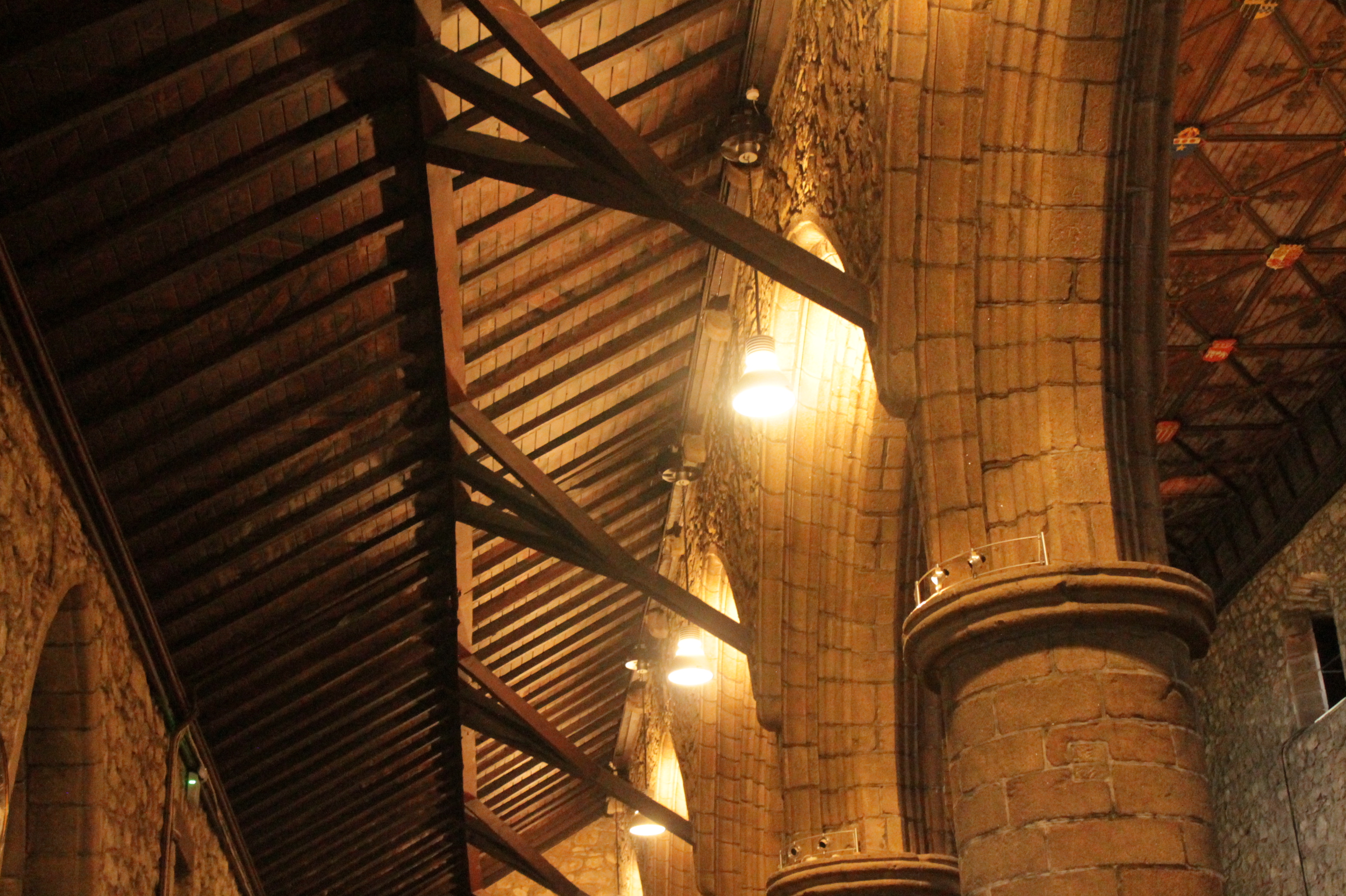
The flat panelled ceiling of the nave, dating from the first half of the 16th century, is unlike anything else in Scotland. Forty-eight heraldic shields are arranged in three rows of sixteen, displaying the coats of arms of the contemporary kings of Europe and the chief earls and bishops of Scotland. Pope Leo X occupies the centre. Henry VIII of England, James V of Scotland, and the Holy Roman Emperor Charles V appear in their multiple royal capacities. A frieze around the perimeter lists every bishop of the see from Nechtan in 1131 to William Gordon at the Reformation in 1560, followed by the Scottish monarchs from Malcolm II to Mary, Queen of Scots. The ceiling is a snapshot of European power frozen at a specific moment in the early 16th century.
Wallace in the Walls
After William Wallace's execution in 1305, his body was divided and sent to the corners of Scotland as a warning to dissenters. His left quarter ended up in Aberdeen and is said to be buried within the walls of the cathedral. The claim is impossible to verify but has been part of local tradition for seven centuries. The cathedral also suffered its own dismemberment: the chancel was demolished during the Scottish Reformation in 1560, and the bells and lead from the roof were loaded onto a ship bound for Holland -- which sank near Girdle Ness. The central tower collapsed in a storm in 1688, destroying the choir and transepts. What remains is only the nave and aisles, the western towers standing like sentinels over the ruin of what was once a much larger building.
A Fortress of Faith
St Machar's is technically no longer a cathedral -- it has not been the seat of a bishop since 1690 -- but a high kirk of the Church of Scotland. Its twin western towers, built in the fashion of fourteenth-century tower houses with walls thick enough for spiral staircases and battlements, make it a fortified kirk, a place of worship that could double as a place of defence. In 1987, bells from a deconsecrated church in Ealing were restored and installed, making St Machar's one of the few Scottish churches equipped for change ringing. A 1.85 million pound project in 2020 re-slated the roof and cleaned the heraldic ceiling. The cathedral endures, diminished in scale from its medieval peak but still anchoring Old Aberdeen as it has done since the 6th century.
From the Air
Located at 57.17N, 2.10W in Old Aberdeen, on the banks of the River Don. The twin western towers with their distinctive spires are visible from moderate altitude. Nearest airport: Aberdeen (EGPD), approximately 4 miles northwest.