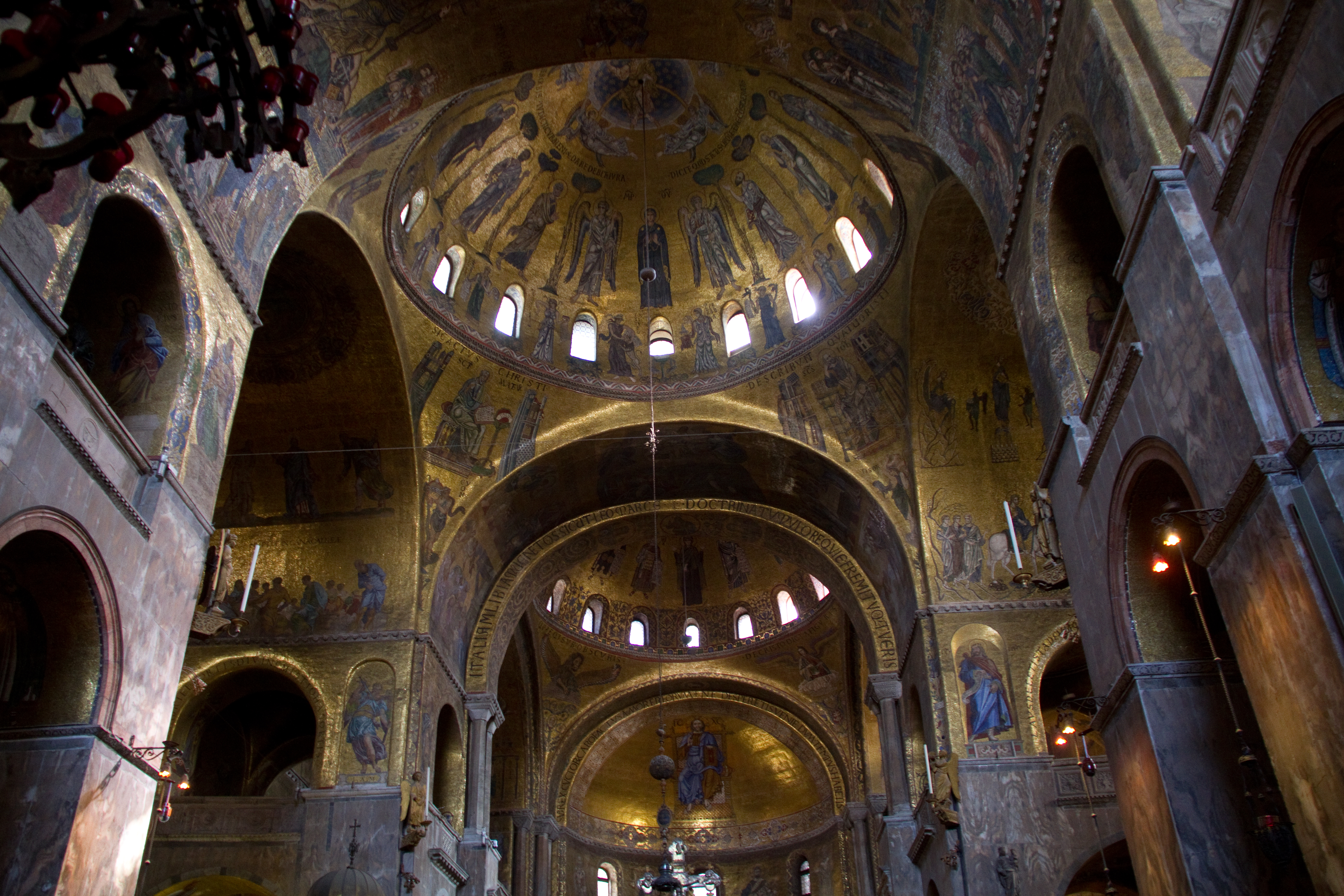
St Mark's Basilica
Four gilded bronze horses stand on the facade of St. Mark's Basilica, the only surviving equestrian team from classical antiquity. They once adorned the Hippodrome in Constantinople. Venetian soldiers brought them home after the Fourth Crusade in 1204, and by the mid-thirteenth century they were mounted above the main portal as trophies of imperial conquest. The horses are copies now — the originals were moved indoors in 1974 to protect them from pollution — but the statement they make has not changed in eight centuries. St. Mark's Basilica was built to declare Venice a power equal to Rome, Constantinople, and any other city that claimed divine favor. Everything about it, from the gold mosaics covering 8,000 square meters of its interior to the relics of Saint Mark himself beneath the high altar, serves that declaration.
Stealing a Saint
The basilica exists because of a theft. In 828, Venetian merchants smuggled the remains of Saint Mark the Evangelist out of Alexandria, reportedly hiding the relics under a layer of pork to discourage Muslim customs officials from searching the cargo. The republic had been looking for a patron saint more prestigious than the existing one, Saint Theodore, and the evangelist who wrote the second Gospel fit the ambition perfectly. A church was built to house the relics, but it burned in a revolt in 976. The current basilica, the third on the site, was begun in 1063 under Doge Domenico Contarini and consecrated in 1094. Its plan follows a Greek cross, modeled on Constantinople's Church of the Holy Apostles, with five domes rising above the crossing and each arm. The choice of a Byzantine model over a Western Romanesque one was deliberate: Venice looked east, traded east, and intended its most sacred building to announce that orientation.
Eight Thousand Square Meters of Gold
The interior of St. Mark's is sheathed in mosaics that took centuries to complete. The oldest, in the niches of the entry porch, may date to as early as 1070, executed by mosaicists who had left Constantinople to work on the cathedral of Torcello and then remained in the Veneto. The decorative program is encyclopedic. The apse shows Christ Pantocrator flanked by saints Nicholas, Peter, Mark, and Hermagoras of Aquileia — protectors of the Venetian state. The Dome of Immanuel above the high altar presents a young Christ surrounded by the Virgin and Old Testament prophets bearing scrolls that foretell the Incarnation. An extensive Life of Christ cycle stretches along the longitudinal axis, from the Annunciation through the Passion to the Ascension. What makes these mosaics extraordinary is not just their scale but their evolution: twelfth-century panels show skilled Greek-trained mosaicists working in a classical Byzantine style, while later additions reflect distinctly Venetian sensibilities, and Renaissance masters including Titian contributed designs for later restorations.
The Doge's Private Chapel
For most of its history, St. Mark's was not a public church. It was the cappella ducale — the Doge's private chapel. The primicerius, who oversaw religious functions, was appointed by the Doge personally, and despite repeated attempts by the Bishop of Castello to claim jurisdiction, the chapel remained under ducal authority alone. The Doge entered through a private doorway near the choir chapel of Saint Clement I, and a window above connected to his apartments so he could attend mass without leaving the palace. Beginning in the ninth century, the Doge also appointed procurators to manage the church's finances, construction, and decoration. By the mid-thirteenth century, these procurators de supra were elected by the Great Council and wielded substantial authority over every aspect of the building's upkeep. They hired the proto — the chief architect — and oversaw the musicians. St. Mark's only became the cathedral of Venice after the fall of the Republic in 1797, when the patriarchal seat was transferred from San Pietro di Castello. The building the Doges had kept for themselves finally belonged to the city.
Sound Between the Domes
The acoustics of St. Mark's shaped the history of Western music. By 1316, the basilica already had more than one organ, and the instruments were repeatedly renewed over the centuries. But it was the appointment of Adrian Willaert as maestro di cappella in 1527 that transformed the basilica into a laboratory for polychoral music — compositions written for two or more choirs singing from different galleries, their voices weaving through the domed spaces. The tradition attracted a succession of composers that reads like a history of Venetian music: Andrea and Giovanni Gabrieli, Claudio Monteverdi, Antonio Lotti, Baldassare Galuppi, and others served as organists or choirmasters. Documents record performances involving violins, violas, cornetts, sackbuts, bassoons, theorbos, and later flutes, trumpets, and oboes. The number of instrumentalists was fixed at thirty-four in 1685. Organists, singers, and instrumentalists were selected by the procurators through rigorous examination, and by the mid-seventeenth century the orphanages attached to Venice's four state hospices were supplying many of the best musicians. The basilica was not only a place of worship but a concert hall whose reverberant spaces demanded — and rewarded — musical invention.
From the Air
Located at 45.434°N, 12.340°E at the eastern end of Piazza San Marco in Venice. From 3,000–5,000 feet AGL, the basilica's five domes and its prominent position adjacent to the Doge's Palace and the Campanile di San Marco make it unmistakable. The Piazza San Marco, the largest open square in Venice, extends west from the basilica. Venice Marco Polo Airport (LIPZ) is approximately 5 miles north across the lagoon. Venice Lido Airport (LIDO) is 2 miles southeast. Fog is common in the lagoon environment, especially October through January.