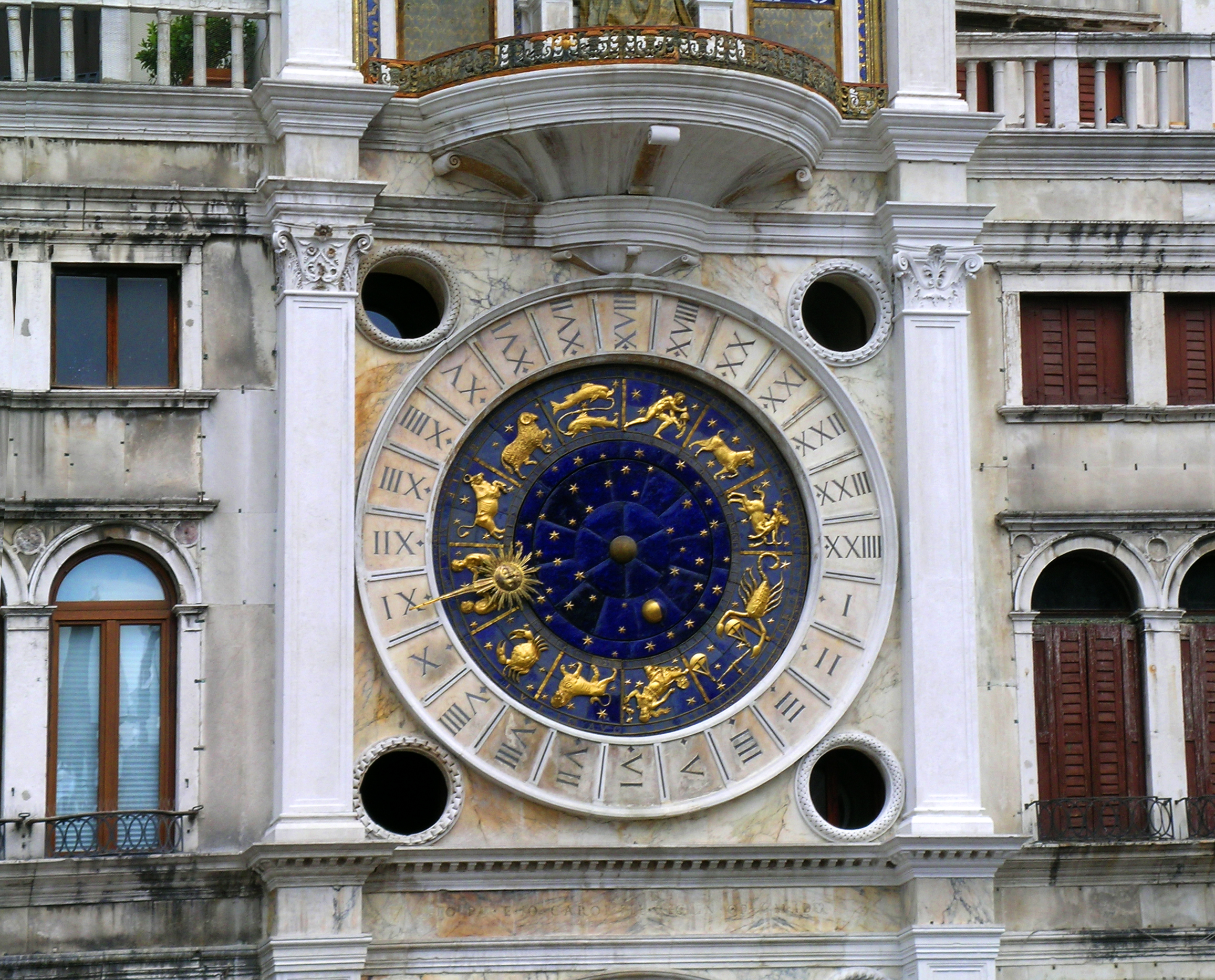
St Mark's Clocktower
Twice a year -- at Epiphany and on Ascension Day -- three mechanical Magi led by a trumpet-bearing angel emerge from a doorway on the face of St Mark's Clocktower, process around a gallery past the Virgin and Child, bow, and disappear through a door on the other side. This has been happening, with interruptions, since 1499. The procession is the most theatrical element of a clock tower that was designed, from its first sketches, as a piece of theater: a monumental archway announcing to anyone arriving by water that Venice was wealthy, ingenious, and in full command of time itself.
Reading the Face
The clock face is a cosmological instrument rendered in blue enamel and gold. A fixed marble circle engraved with 24 hours in Roman numerals frames the display. A golden pointer tipped with an image of the sun tracks the hour as it rotates around the dial. Beneath it, the signs of the zodiac -- original castings from the 1490s -- revolve at a slightly slower pace to show the sun's position in the heavens. At the center sits the Earth, with the moon orbiting to display its phases, surrounded by fixed stars. Above the face, a semicircular gallery holds gilt copper statues of the Virgin and Child. Flanking her, two blue panels display the hour in Roman numerals on the left and minutes in Arabic numerals on the right, updating every five minutes. Higher still, the winged Lion of Saint Mark stands before a field of gold stars. A statue of Doge Agostino Barbarigo once knelt before the lion, but in 1797 the French removed it along with every other symbol of the old regime.
The Moors on the Roof
At the top of the tower, two massive bronze figures strike the hours on a bell cast by Simeone Campanato at the Arsenal in 1497. One figure is old, the other young -- a visual metaphor for time's passage. They are called the Moors not because of any intended representation but because centuries of exposure have darkened their bronze to a deep patina. Originally the figures were gilded, gleaming above the Piazza. Their sculptor remains uncertain: most commonly attributed to Paolo Savin, a 1984 article by Michelangelo Muraro concluded the more likely candidate is Antonio Rizzo. They were cast in bronze in 1494 by Ambrosio Delle Anchor, three years before the tower itself was completed. Their hinged waists allow them to swing forward and strike the bell, a mechanical gesture they have repeated hundreds of thousands of times across five centuries.
Building the Gateway
By 1490, an older clock at the northwest corner of St Mark's church had deteriorated badly. In 1493, the Venetian Senate commissioned a replacement and entrusted its construction to Gian Paolo Ranieri and his son Gian Carlo, clockmakers from Reggio Emilia. Two years later, the Senate chose a site at the entrance to the Merceria, the principal commercial street connecting the Piazza San Marco to the Rialto. The tower's design is attributed on stylistic grounds to Mauro Codussi, though no documents confirm his involvement. Architectural historian Deborah Howard has traced the concept to Leon Battista Alberti's treatise De re aedificatoria, which emphasized the importance of towers to a city and the power of a monumental arch as the entrance to its main thoroughfare. Construction ran through 1496 and 1497, with no expense spared: quantities of ultramarine and gold leaf covered every surface. The inauguration took place on February 1, 1499. The diarist Marin Sanudo recorded the moment, noting that the clock was revealed as the Doge left the Piazza for vespers and that it was 'made with great ingenuity and was most beautiful.'
Five Centuries of Tinkering
The clock has never been left alone for long. By 1531, after the younger Ranieri's death, it was already malfunctioning, and the Council of Ten appointed a permanent keeper to live in a wing of the tower. In 1751, Giorgio Massari began restoring the buildings, and Bartolomeo Ferracina overhauled the mechanism, replacing the original foliot escapement with a far more accurate pendulum system. Ferracina also revived the Magi procession, which had not functioned for years, inaugurating his repair on Ascension Day 1759. In the 1850s, new panels were added flanking the Virgin and Child to display the time in large numerals -- originally backlit by gas lamps for nighttime reading. The machinery required to lift these panels out of the Magi's path during their processions proved troublesome and did not work properly until 1866. Around 1900, workers discovered the original 24-hour ring hidden beneath later modifications and restored it. The most recent major restoration, from 1998 to 2006, marked the tower's five hundredth anniversary and generated controversy among horologists over which changes respected the clock's history and which did not.
From the Air
Located at 45.435N, 12.339E on the north side of the Piazza San Marco in Venice. The clock tower is identifiable from altitude by its position at the entrance to the Merceria, adjoining the Procuratie Vecchie along the north edge of the Piazza. The two bronze Moors on the roof terrace are visible at lower altitudes. Nearest airport: Venice Marco Polo (LIPZ), 8 km north. The tower marks the transition from the Piazza to the dense commercial streets leading to the Rialto Bridge.