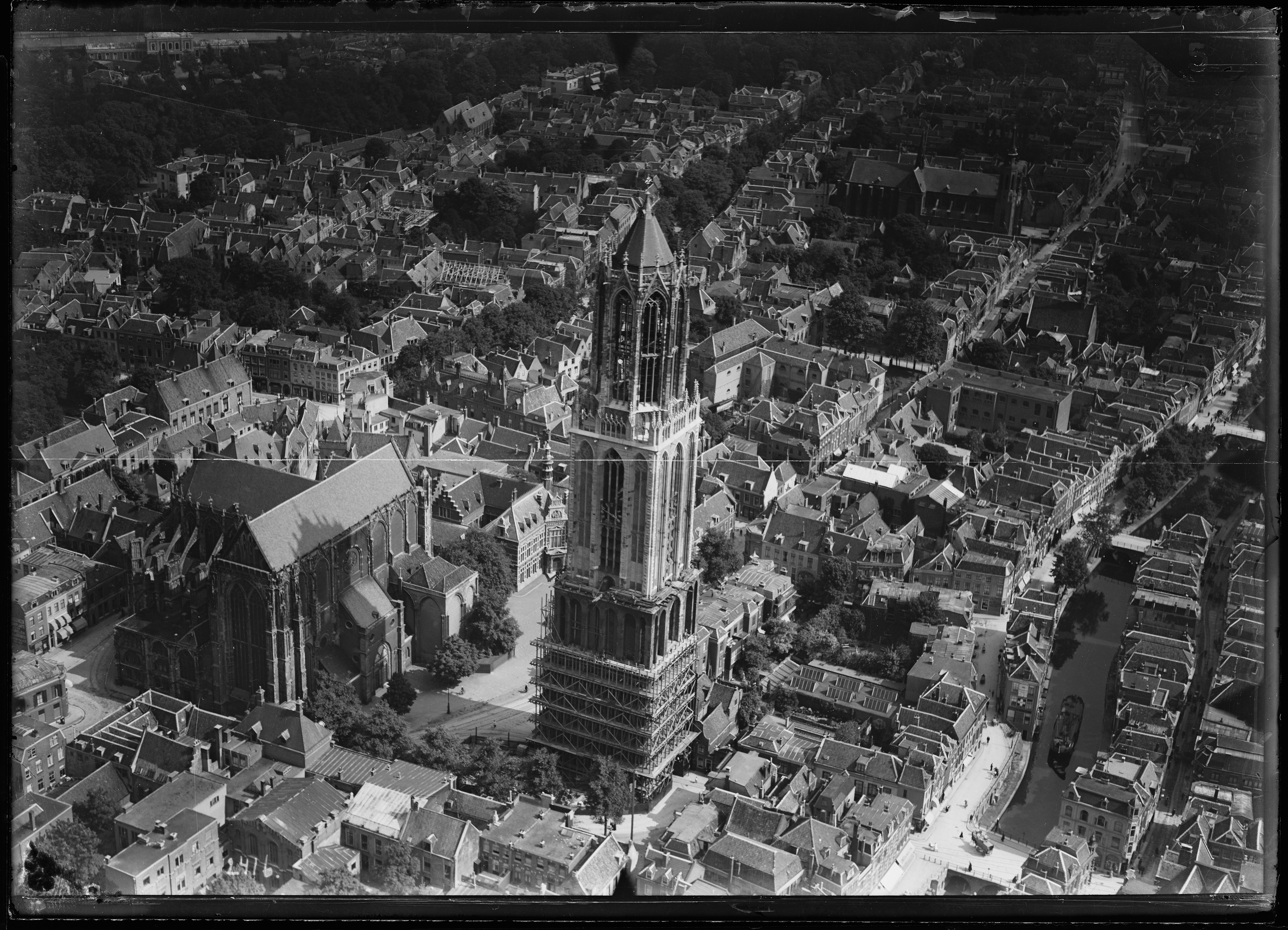
St. Martin's Cathedral, Utrecht
At a little before five o'clock on the afternoon of August 1, 1674, the wind over Utrecht began to scream. A tornado - rare in the Netherlands, almost unheard of in summer - sliced across the city, peeling roofs off houses on the Oudegracht and twisting trees out of the ground. When the storm passed, the nave of St. Martin's Cathedral, the largest church in the country, was on the ground. The choir still stood. The transept still stood. The 112-meter Dom Tower still stood. Everything between them was rubble. The Utrecht authorities looked at the cost of rebuilding and made a decision that has shaped the silhouette of the city for the next three and a half centuries: they would not. They never have.
Layered on the Roman Fort
The first Christian chapel on this site was built around 630 AD by Frankish clergy under the protection of the Merovingian kings, on the ruins of the Roman fort of Traiectum - the very fort that gave Utrecht its name. The Frisians destroyed it almost immediately. Saint Willibrord, the English missionary remembered as the Apostle to the Frisians, founded a second chapel dedicated to Saint Martin of Tours on or very near the same spot before his death in 739. The Normans destroyed that one in the 9th century. Bishop Balderic rebuilt in the 10th century. Bishop Adalbold consecrated a Romanesque cathedral in 1023, which became the center of a cross-shaped arrangement of five churches called the Kerkenkruis - the church-cross - that imprinted the geometry of Christian Utrecht onto the street plan. Then came the fire of 1253, which leveled much of the city, and forced yet another rebuild.
The French Cathedral in a Dutch Town
Bishop Henry van Vianen broke ground in 1254 on something the Netherlands had never quite seen: a true French Gothic cathedral. Other Dutch Gothic churches followed regional variants - the Brabantine school in the south, the Northern Dutch style around Amsterdam. St. Martin's looked instead toward Amiens and Reims. The choir went up first. The Dom Tower was begun in 1321 and finished in 1382, rising 112 meters into the sky - the tallest church tower in the Netherlands then and now. By 1515 the cathedral was nearly complete but money had run out, and the nave that connected tower to choir was still under construction. The roof was on; the walls were up. Buttressing, however, was incomplete.
The Iconoclasts
In 1566 the Beeldenstorm - the Iconoclastic Fury - tore through the Low Countries. Calvinist crowds entered Catholic churches and smashed statues, altarpieces, stained glass, anything they considered an idolatrous image. St. Martin's was stripped. Fourteen years later, in 1580, the Utrecht city council formally devolved the cathedral from the Catholic Diocese to local Calvinists, and Protestant services replaced the Mass. There was one brief interruption: in 1672 and 1673, during the French invasion of the Dutch Republic, Louis XIV's troops occupied Utrecht and Catholic priests were briefly allowed to celebrate Mass again inside the cathedral. The French retreated in 1673. The Catholics lost the building once more. And one summer later, the storm came.
August 1, 1674
The nave had stood unfinished and underbuttressed for nearly 160 years. When the tornado hit, the unsupported walls had no chance. Eyewitnesses described pillars snapping like kindling and the timber roof folding inward; the central section of one of Europe's great churches collapsed in minutes. The choir and transept, properly buttressed, held. The Dom Tower, built as a separate freestanding structure, was untouched. What was left was a Gothic cathedral with a hole in the middle - a tower at one end of a city square, a choir at the other, and an empty space between them. Successive centuries did nothing to close the gap. In 2004, on the 750th anniversary of the original construction, the missing nave was temporarily rebuilt in scaffolding so people could see what had been lost. Then another storm blew it down too.
The Square Between Tower and Choir
The empty space where the nave once stood is now the Domplein, a public square paved with stones that mark the outlines of the lost building. Children play between the original outer walls; cafe tables stand where the high altar once did. The cloister and chapter house to the south survived intact. In that chapter house on January 23, 1579, representatives from the rebellious Dutch provinces signed the Union of Utrecht, the document that founded the Dutch Republic. The chapter house is now a hall of Utrecht University. In the joint 2021-2022 session, UNESCO inscribed the cathedral, the Dom Tower, and the Domplein as a World Heritage Site - not for the cathedral as architecture, but for the Lower Germanic Limes, the Roman archaeological remains beneath the square. The Dom Tower itself reopened in November 2024 after a major restoration. Between November 2021 and July 2022, while its spire was being rebuilt, the Nieuwe Kerk in Delft briefly took its title as the country's tallest church tower. The Dom got the title back the moment the spire returned.
From the Air
Located at the center of Utrecht's historic core, 52.091 N, 5.122 E. The Dom Tower is the single most recognizable landmark in the Dutch Randstad, visible from cruising altitude in clear weather as a 112-meter spire rising from the flat city center. The empty Domplein square is visible as a green gap between the freestanding tower and the surviving choir to the east. Amsterdam Schiphol (EHAM) is about 35 km northwest; Rotterdam The Hague (EHRD) lies about 50 km southwest. Eindhoven (EHEH) is about 65 km southeast. The tower is so prominent it is often used as a visual fix when descending into Schiphol from the south.