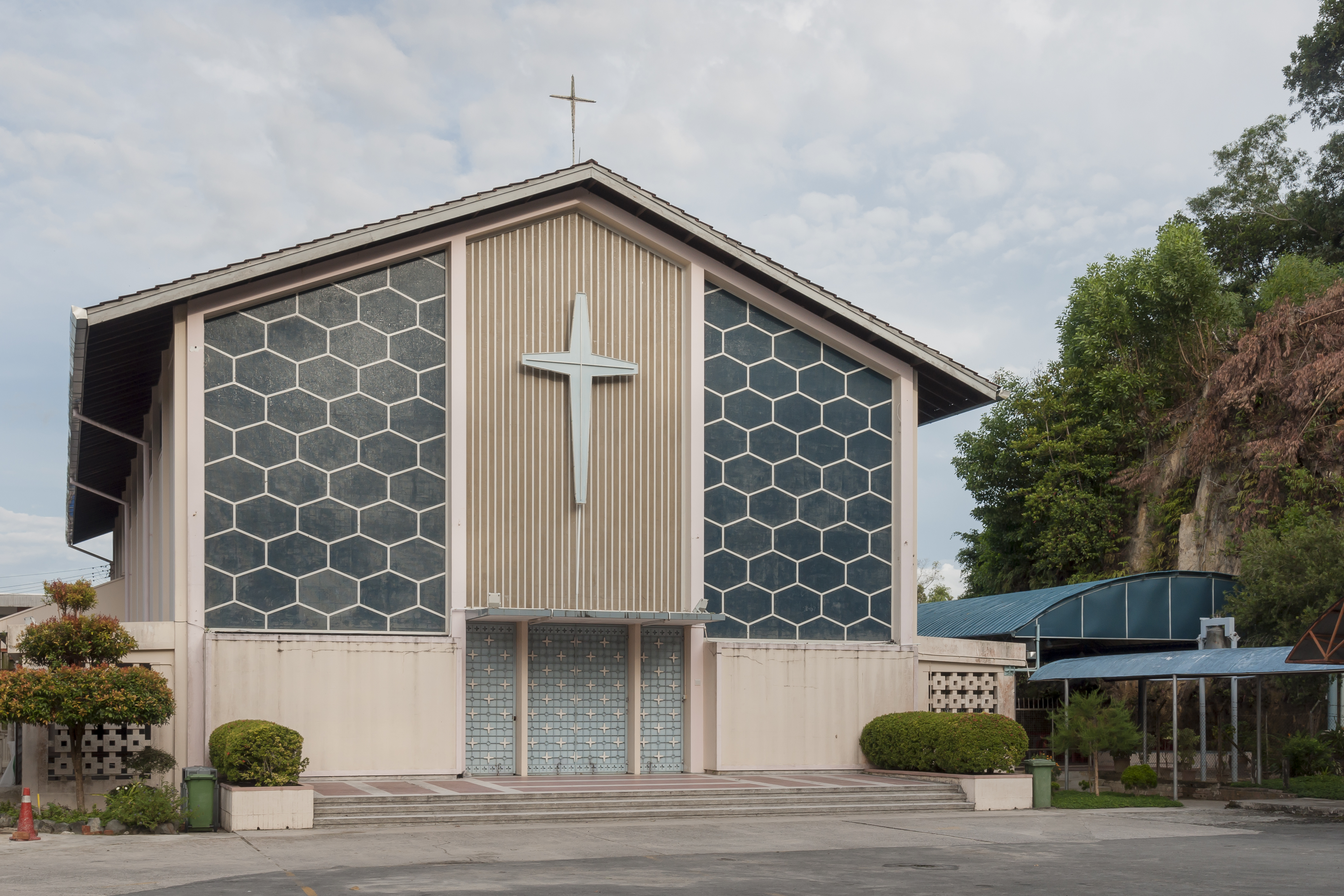
St. Mary's Cathedral, Sandakan
In May 1883, Monsignor Thomas Jackson bought five acres on a hill in Sandakan and sent Reverend Father Alexander Prenger to build a mission. What Prenger built first was a hut made of kajang -- woven pandanus leaves -- which he dedicated to the Blessed Virgin Mary. The whole plot was named St. Mary's Hill. On 24 July 1883, Prenger and a colleague opened St. Mary's School, the first school in North Borneo. Within months there was a proper house, a boys' hostel, and a small church. It was a fragile beginning. Sandakan was subject to frequent pirate raids, the climate was punishing, and Jackson himself would later order the mission closed because the town was "unhealthy" and "Fr. Prenger often ill." The story of what became St. Mary's Cathedral is the story of a church that kept being destroyed and rebuilt, each time a little more permanent than the last.
The Mill Hill Fathers Arrive
The apostolic prefecture of North Borneo and Labuan was established on 27 August 1855. On 19 March 1881, the Vatican assigned evangelization work in the territory to the Saint Joseph's Missionary Society of Mill Hill, England. One of the first places the Mill Hill Fathers traveled to was Sandakan, where Monsignor Thomas Jackson arrived in May 1882 to attend celebrations for the granting of the charter to the North Borneo Chartered Company. He found about 4,500 Chinese residents and saw an opportunity. But the mission's early years were turbulent. After Prenger closed the mission in November 1885 under orders from Jackson, St. Mary's sat empty for two years until Father John Byron visited in July 1886, found 26 Catholics still in town, and reopened the mission in May 1887. From that point the mission grew gradually, with a revolving cast of assistant rectors who rarely stayed more than a few years.
Convent, Refugees, and Growth
In 1891, a school for girls was started, and the White Sisters -- Franciscan Missionaries of St. Joseph -- opened St. Mary's Convent on 5 November 1891, the first convent in North Borneo. The first four sisters were Sr. Theresa, Sr. Peter, Sr. Rose, and Sr. Collete. By 1899, Sandakan was an established mission with a presbytery, a boys' school, a convent, and a church. That same year, Catholic Filipino refugees fleeing the war in the Philippines arrived in large numbers, creating a sudden surge in the congregation. More Filipino refugees followed in 1903. Father Cornelius de Vette built a permanent church in 1904. Through the early twentieth century, the mission continued under a succession of Mill Hill Fathers, many staying only a year or two, until Father Aloysius Stotter brought stability in 1920, building a three-storey school that became the best in North Borneo.
Destruction and Resurrection
The Second World War ended everything the mission had built over sixty years. European priests were arrested and sent to internment camps. The Japanese razed St. Mary's to the ground in 1943. When Father Laurence Parsons returned to Sandakan in November 1946, nothing remained except pillars and concrete walls from the boys' school. An attap roof was placed over the ruins, and the structure served as both church and school when it reopened in 1947. The real rebuilding fell to Father Anthony Mulders, who arrived in 1952. He bulldozed the hilltop to level a site for a permanent church, causing serious erosion problems that had to be solved before construction could proceed. St. Mary's Church was finally completed, opened, and consecrated in 1961 by Bishop James Buis, the Vicar Apostolic of Jesselton -- seventy-eight years after Prenger's pandanus hut.
Cathedral at Last
On 16 July 2007, Pope Benedict XVI established the Diocese of Sandakan, covering the entire East Coast of Sabah, and appointed Father Julius Dusin Gitom as its first bishop. With the creation of the diocese on 15 October 2007, St. Mary's Church was elevated to St. Mary's Cathedral. Covered wing sections were added on both sides, expanding seating capacity to approximately 1,500 parishioners. The cathedral now anchors a parish that includes multiple outstation churches and a mission district in Paitan accessible only by boat. From a pandanus hut on a pirate-raided hilltop to the mother church of a diocese, the building's 140-year trajectory mirrors the arc of Sandakan itself -- a place that has been burned, bombed, abandoned, and rebuilt so many times that persistence has become its defining characteristic.
From the Air
Located at 5.840N, 118.112E on a hilltop in central Sandakan, Sabah. The cathedral is one of the most prominent elevated structures in the town center. Nearest airport is Sandakan Airport (WBKS), approximately 10 km to the west. From the air at 2,000-3,000 feet, the cathedral's position on St. Mary's Hill is visible above the surrounding urban development along Sandakan Bay.