St. Mary's Cathedral, Tallinn
When Tallinn's Toompea hill burned in the great fire of 1684, almost everything wooden up there was lost. The Danish-built fortress walls survived. So did one church. St. Mary's Cathedral, the Toomkirik, came through with its 13th-century stone shell intact, and after the rebuild it became the only medieval building still standing on the hill that gave the cathedral its name. Estonians call it the Dome Church, but that is just translation drift; Toomkirik really means cathedral church, and this one has been a cathedral for almost 800 years.
Built in the Wake of Conquest
A wooden church stood here by 1219, the year King Valdemar II of Denmark seized northern Estonia in the Northern Crusades and made Tallinn (then Reval) a Danish town. In 1229 Dominican friars arrived and started replacing the wooden chapel with stone. In 1233 a vicious quarrel between the Knights of the Sword and supporters of the pope's legate spilled into violence; the friars were killed and the half-built church desecrated. The letter sent to Rome that year asking permission to consecrate it again is the first written record we have of the building. The Dominicans never finished the job, but their successors did, completing a single-aisled stone church by 1240 and dedicating it to the Virgin Mary. Within decades it was being enlarged. The expansion from one aisle to three, in good basilica fashion, took the better part of a century to finish, the new long nave extending 29 meters by the 1430s. By then Tallinn had joined the Hanseatic League and become one of the richest northern ports in Europe, and the cathedral on the hill towered over a town that could afford it.
Reformation and Rebuild
In 1561, four decades into the Reformation, the cathedral became Lutheran, and Lutheran it has remained. Today it is the seat of the Archbishop of the Estonian Evangelical Lutheran Church. The great fire of 1684 was the worst day in the building's history. The wooden furnishings burned out completely, vaults fell, and the apse stonework took severe damage. By 1686 the rebuild was underway. The new pulpit with its carved apostles dates from that year, the altarpiece from 1696, both the work of Christian Ackermann, an Estonian sculptor whose carving still defines what visitors see when they walk in today. Ernst Wilhelm Londicer added the paintings. The Baroque spire that crowns the western tower was built between 1778 and 1779, replacing an earlier one, and it is that spire, not the medieval tower beneath it, that gives the church its instantly recognizable silhouette on the Tallinn skyline.
A Floor of Tombs
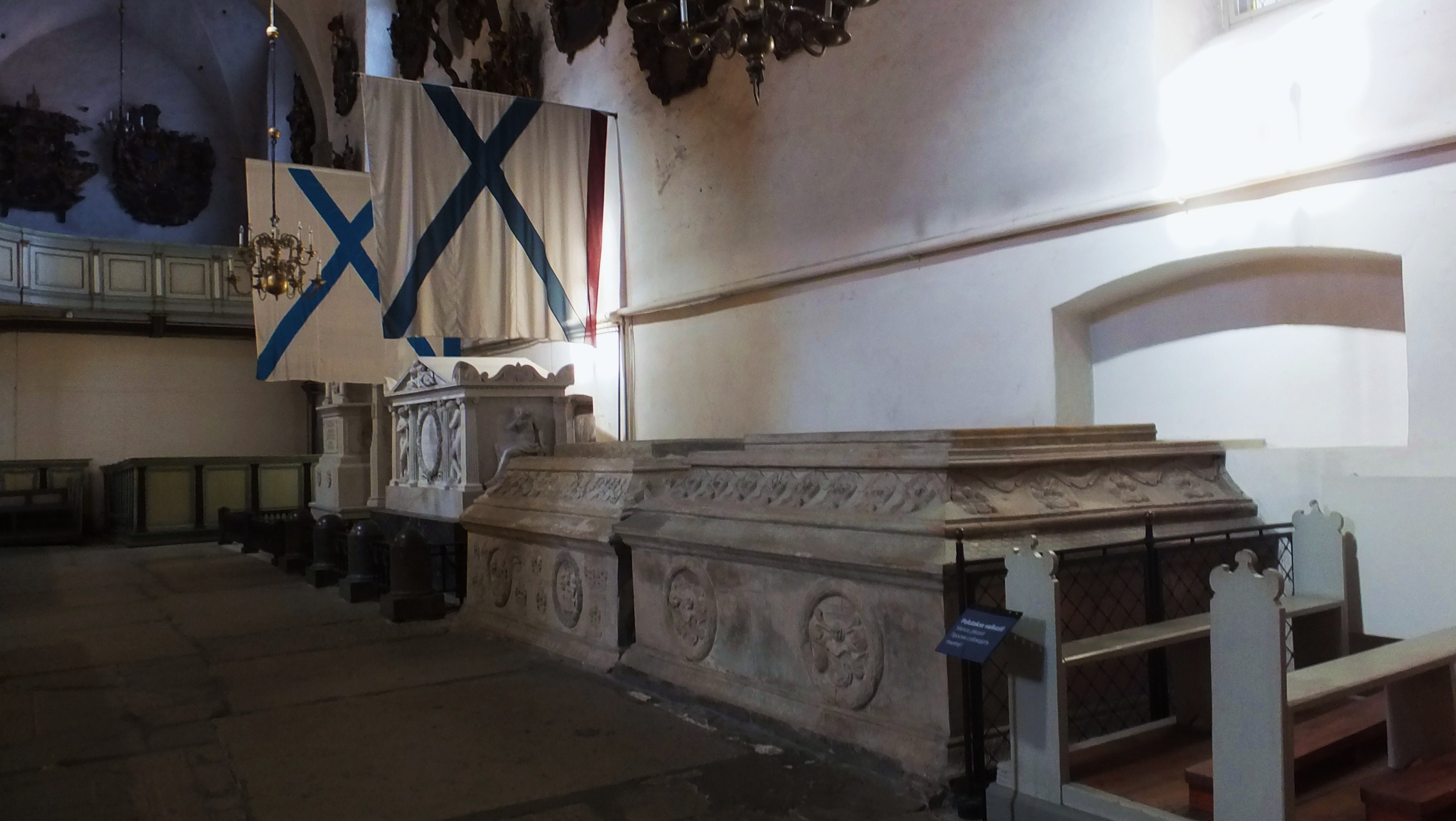
What sets St. Mary's apart from other Baltic Lutheran cathedrals is the density of who is buried under its floor. Walk the nave and you walk over the ribs and shoulders of Baltic German nobility, Swedish field marshals, and at least one famous Russian navigator. Pontus De la Gardie, the Swedish general who captured Narva from the Russians in 1581, lies here with his wife Sofia Johansdotter Gyllenhielm, an illegitimate daughter of King John III of Sweden. Adam Johann von Krusenstern, the first Russian to circumnavigate the globe (1803-1806), is here too. Samuel Greig, a Scotsman who took service in Catherine the Great's navy and rose to admiral, was buried here in 1788. So were Jindrich Matyas Thurn, the Bohemian noble whose 1618 revolt against Emperor Ferdinand II touched off the Thirty Years' War, and Margareta Eriksdotter Vasa, sister of Sweden's King Gustav I. The walls and floor are crowded with stone-carved coats of arms, cartouches, and 17th-century sarcophagi, an entire archive of Baltic power politics laid out in stone.
What Survives
The carved tombstones range from the 13th to the 18th century, the oldest predating the Reformation by 250 years. Two of the four bells date from the 1600s, two from the 1700s. The organ is from 1914, the last major addition. The church was made a national cultural monument of Estonia on 20 September 1995. Standing on Toompea today, looking down past the cathedral spire to the red-roofed merchant town below and the Gulf of Finland beyond, you see a layered city: the Danish fortress walls, the Hanseatic warehouses, the Russian Orthodox onion domes of Alexander Nevsky Cathedral built in 1900 just down the hill as a tsarist statement of Russification. Every wave of conquest left a building. St. Mary's predates them all.
From the Air
St. Mary's Cathedral sits on Toompea hill at 59.44 N, 24.74 E, the high point of Tallinn's Old Town. View from 3,000-5,000 feet to see the Baroque spire against the Old Town's red roofs. Tallinn Airport (EETN) is 5 km southeast. Helsinki across the Gulf of Finland is 80 km north. Clear weather mid-spring through early autumn gives the best visibility; winter brings frequent low cloud.