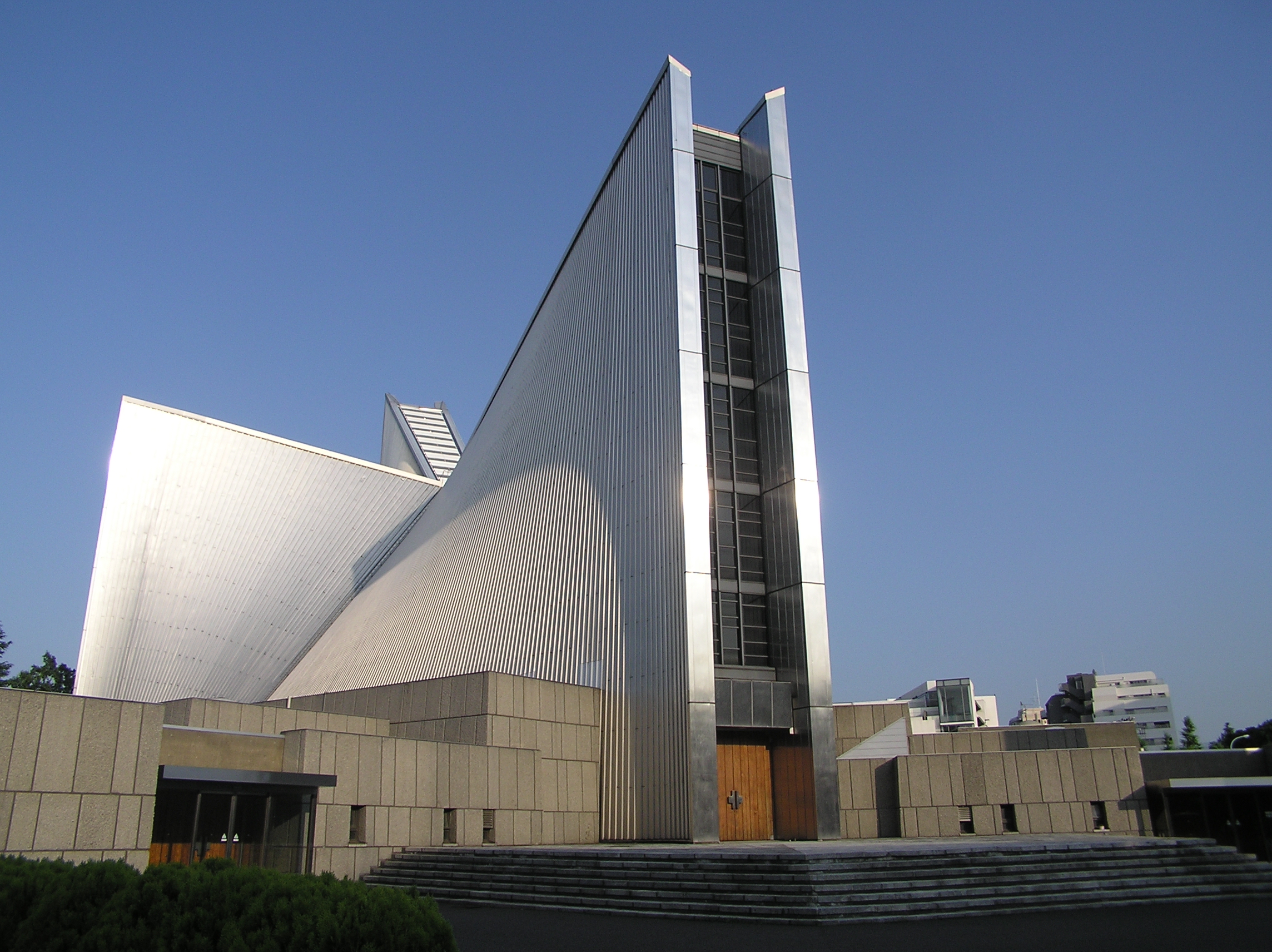
St. Mary's Cathedral, Tokyo
Eight concrete shells sheathed in stainless steel twist upward from a quiet residential street in Bunkyo, each curve calculated to the millimeter so that the gaps between them form a perfect cross of light visible only from above. St. Mary's Cathedral in Tokyo is one of those buildings that rewards the aerial view -- what looks like a gleaming metallic roof from the sidewalk reveals its cruciform secret at altitude. Designed by Kenzo Tange and completed in 1964, the cathedral replaced a Gothic wooden church that survived the 1923 Great Kanto Earthquake but could not survive the firebombing of Tokyo two decades later. The story of its rebuilding is as layered as its geometry: a war-scarred German archdiocese reaching across the world to help a war-scarred Japanese one, and a competition that produced one of the most structurally audacious churches of the 20th century.
From Ashes to a Quonset Hut
The first St. Mary's was a wooden Gothic church built in 1899 by French missionaries. It stood through the catastrophic earthquake of 1923 that leveled much of Tokyo, but the American firebombing raids of 1945 reduced it to rubble. For two years the Catholics of Tokyo gathered in the ruins. In 1947, services moved into a Quonset hut on the grounds, and then to the first floor of an adjacent Catholic school building. The school proved too cramped, so diocesan services shifted to St. Ignatius Church upon its completion in 1949, and later to the Church of Francis Xavier, which served as a pro-cathedral from 1953 to 1964. For nearly two decades, Tokyo's Catholic community worshipped in borrowed and improvised spaces, waiting for the cathedral to rise again.
Cologne's Gift Across the Ruins
The catalyst arrived in 1960, when the Archdiocese of Tokyo announced a design competition to mark the centennial of Catholicism's reintroduction to Japan. Funding came from an unlikely partner: the Archdiocese of Cologne, Germany. In 1954, Cardinal Josef Frings had asked the Catholics of Cologne -- still surrounded by the wreckage of Allied bombing -- to sacrifice financially for Tokyo's postwar church recovery. It was an extraordinary gesture of solidarity between two cities that had been on opposite sides of the same war. Three finalists emerged from the competition: Yoshiro Taniguchi, Kunio Maekawa, and Kenzo Tange. Tange's entry was the only cruciform design, and its use of thin-shell concrete structures set it apart entirely. Cardinal Archbishop Peter Doi was ambivalent about the modernist proposal, and future Archbishop Peter Shirayanagi approved the plans only reluctantly. Construction ran from April 1963 to December 1964.
Geometry as Theology
Tange's design begins with a contradiction: the ground floor is a rhombus, not a cross. But as eight hyperbolic parabolic shells rise from the diamond-shaped base, their curves rotate the geometry, and by the time they reach the roof the building's plan has become a perfect cruciform. The gaps between the shells run the full height of the facades, flooding the interior with natural light that traces the shape of a cross. It is structural engineering deployed as spiritual metaphor -- the cross is not drawn or carved but emerges from the mathematics of the curved surfaces themselves. A detached reinforced-concrete bell tower stands to the west. The exterior cladding of stainless steel gives the building a cool, almost industrial sheen that contrasts sharply with the warm light inside. Tange's approach also embedded Japanese temple traditions: visitors enter through a Lourdes Grotto that echoes the progression of passing through a Torii gate, then a Sanmon, then down a Sando path before reaching the sacred center.
Praise, Criticism, and a Funeral
The Vatican recognized Tange's achievement in 1970 with the Order of St. Gregory the Great, one of the highest papal honors for a layperson. Yet architectural critics were divided. Some called the design the lesser work in Tange's catalog, accusing it of relying on cliche. Architectural historian David Stewart dismissed it curtly, writing that the less said about Tokyo Cathedral, the better. Tange's design did inspire imitation: San Francisco's own St. Mary's Cathedral, completed in 1971, adopted a similar hyperbolic paraboloid structure. In 2004, the Italian organ-building firm Mascioni installed a large pipe organ inside. Rain leakage had plagued the building since construction, and a comprehensive 2007 renovation renewed the stained glass, repaired the steel shell, and finally stopped the water. When Tange himself died in March 2005, his funeral was held inside the cathedral he had designed four decades earlier -- a fitting closure for the architect and his most spiritually charged building.
From the Air
Located at 35.714N, 139.727E in the Sekiguchi neighborhood of Bunkyo, Tokyo. The cathedral's stainless-steel roof forms a distinctive cross shape visible from above, set among dense residential blocks. The detached bell tower stands to the west. Look for the green grounds of Chinzan-so Garden immediately to the northeast as a reference landmark. Nearest airport is Tokyo Haneda (RJTT), approximately 16 km to the south. Narita International (RJAA) is about 65 km east-northeast. Tokyo Heliport (RJTI) is closer at roughly 10 km southeast. Recommended viewing altitude: 2,000-3,000 feet to appreciate the cruciform roof shape.