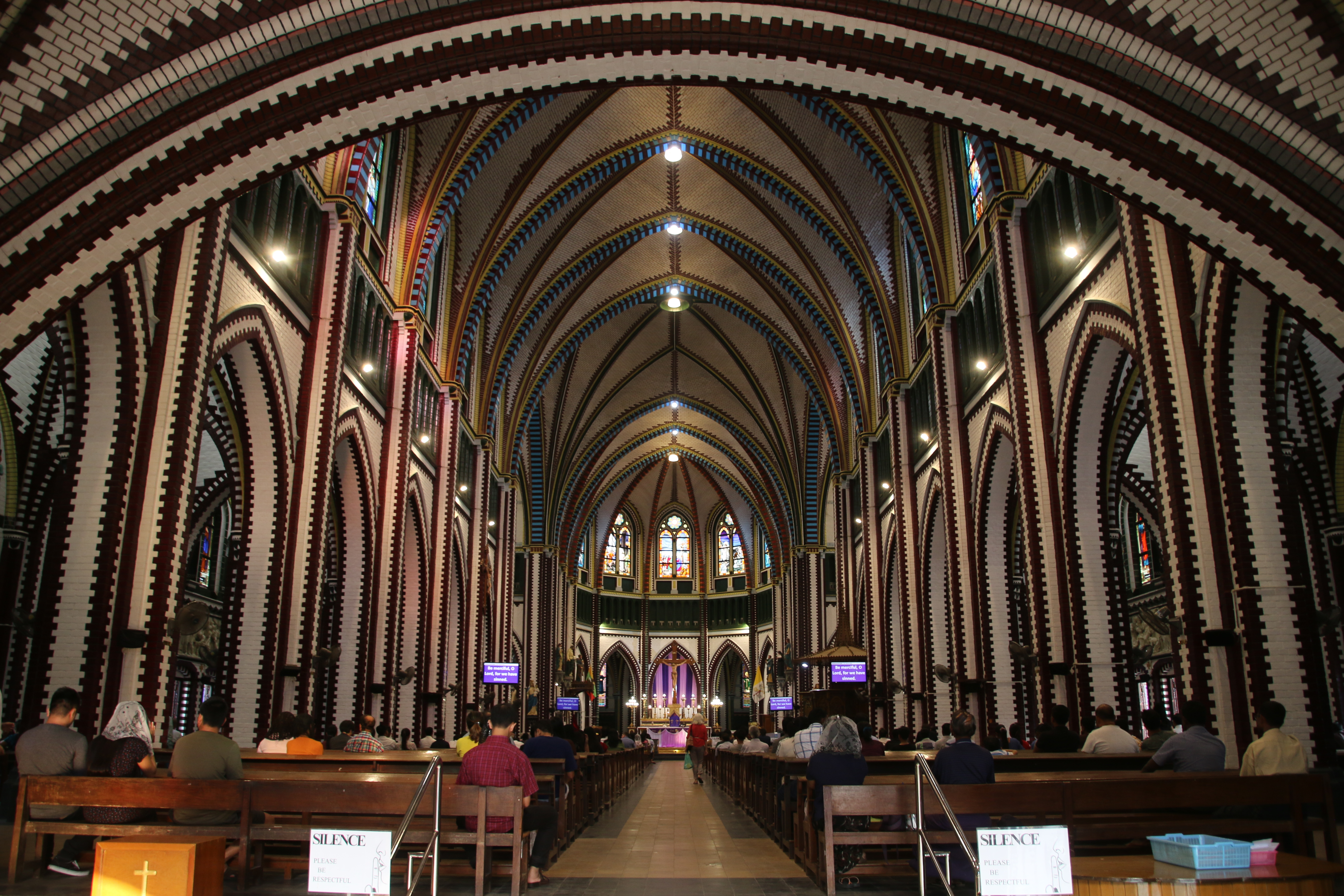
St. Mary's Cathedral, Yangon
Father Hendrick Janzen was dying when Bishop Cardot found him. Tuberculosis had hollowed the Dutch priest to a pallid, emaciated figure among the seminary students assembled for ordination in France. But Janzen had something the bishop desperately needed: he had studied architecture under Pierre Cuypers, the man who designed the Rijksmuseum in Amsterdam, and had collaborated with Cuypers' son Joseph on that very building. The bishop needed an architect. The priest needed a purpose. Together, they sailed for Rangoon in November 1898, and the cathedral that Janzen would spend the rest of his shortened life constructing still stands on the corner of Bogyoke Aung San Road and Bo Aung Kyaw Street -- the largest Catholic cathedral in Myanmar.
Foundations in the Marsh
The cathedral's story begins with ambition meeting geography. Bishop Paul Bigandet had envisioned a grand new cathedral for Yangon's growing Catholic community, securing government permission to sell the old cathedral site on Barr Street and use the proceeds. He died before construction could begin. His successor, Bishop Alexandre Cardot, inherited the dream and a deed of grant but soon discovered that the chosen site sat on a marshy, yielding substratum. Engineers drove pyinkado hardwood piles -- eighteen feet long and three feet around -- deep into the saturated ground. This tedious work consumed four years, from June 1895 to January 1899. The original plan called for a Byzantine-style cathedral with a dome, drawn up by H. Hoyne-Fox, the consulting architect to the Burmese government. But when both Cardot's health and Hoyne-Fox's leave forced them out of the country simultaneously, the entire design pivoted. Cardot went searching for an architect in Europe and returned with Father Janzen and an entirely new vision: a Neo-Gothic cathedral designed by Joseph Cuypers.
The Priest Who Built with His Hands
Janzen arrived at the construction site to find bricks, cement, untrained laborers, and a few Chinese foremen. No sophisticated equipment, no experienced craftsmen. He adapted the existing Byzantine foundations to the new Gothic plan, extending the structure thirty feet longer than originally intended, bringing the total to 291 feet in length and 101 feet in breadth, with seating for 1,500 people. His method was patience made physical. He carved wooden rules and frames so his workers could replicate precise measurements. Using reinforced concrete and wooden molds, he fabricated decorative blocks of every description, boring through many of them to save weight without sacrificing strength. When the towers began sinking unevenly, threatening to crack the main structure, Janzen sawed through the connection between towers and nave from top to bottom -- a bold structural gambit that worked. On August 11, 1907, he slipped on a plank and fractured his thigh in three places. He emerged from the hospital permanently crippled. His Chinese assistant, Ah Yen, who had worked beside him for eight years, kept construction moving forward.
A Work of Genius in a Broken Body
The Archbishop of Sydney, visiting Rangoon, described what he witnessed in terms that border on awe. Father Janzen lived in a single ground-floor room with the plainest technical apparatus, working on scant funds, uncertain about the future. For months after his accident, he could not stand to celebrate Mass. Yet the cathedral continued to rise, the twin spires climbing 86 feet above the towers, their surmounting crosses drawing the eye of every visitor approaching the city. The Archbishop called it "a work of genius" and marveled at the "wonderful spirit that dwells in the dying and broken body of this devoted priest." The cathedral was dedicated as Our Lady of Immaculate Conception on February 22, 1911. Five months later, on August 1, Father Janzen died. He was interred at the entrance to the nave he had built, beneath a plain inlaid marble slab. The inscription reads: "Life's fitful fever -- he sleeps well."
Surviving What the Century Threw
The red-brick cathedral has absorbed more than a century of upheaval. The 1930 Pegu earthquake, which caused widespread damage across southern Burma, brought down only two interior vaults and cracked two arches near the towers -- repaired within months. Japanese bombing during 1941-42 failed to topple the structure. But the Allied bombing of December 14, 1944, blew every stained glass window to smithereens. They were replaced with ordinary locally made glass -- a wartime expedient that became permanent. In May 2008, Cyclone Nargis struck Myanmar with devastating force, and the cathedral's windows were shattered again. This time, tarpaulin sheets covered the gaps, because replacement glass was simply too expensive. The cathedral endures as it always has: damaged, patched, standing. Its exterior of red brick, its spires and bell tower, its Neo-Gothic lines designed by a Dutchman in a dying priest's notebooks -- all remain visible from the busy intersection where Yangon's colonial past and Buddhist present overlap.
From the Air
Located at 16.78°N, 96.17°E in Botahtaung Township, central Yangon. The red-brick cathedral with twin spires is visible among the dense urban grid near the Yangon River waterfront. Recommended viewing altitude 3,000-5,000 feet. Nearest airport: Yangon International (VYYY), approximately 10 nm north. Look for the cathedral's distinctive spires near the intersection of Bogyoke Aung San Road and Bo Aung Kyaw Street.