St. Mary's Church, Osnabrück
Dig under the floor of St. Mary's and the church gets older. Archaeologists working between 1950 and 1992 found foundations of three predecessor buildings stacked beneath the present Gothic hall - a single-nave hall from the 10th century, a slightly larger version with a 14-meter tower from the 11th, and a three-aisled Romanesque basilica from the 12th. Each was built on top of the last. The market church standing on the Markt today is at least the fourth structure on this spot, raised between 1430 and 1440 on a sandy knoll the Saxons chose more than a thousand years ago.
The Sandy Knoll
The earliest church here went up in the 10th century, a single-nave hall standing on what was then an island-like rise in marshy ground - a piece of dry land where a market could safely assemble. The robust 2.3-meter-wide stonework suggests the building doubled as part of a fortified compound; it could shelter people as well as host worship. The 11th-century replacement reused materials from the original and added a 14-meter western tower. The 12th-century rebuild stretched the plan into a three-aisled Romanesque basilica with three semicircular apses. The core masonry of today's western tower descends directly from that Romanesque phase. Most churches in Germany have a single beginning. St. Mary's has four.
Building a Cube
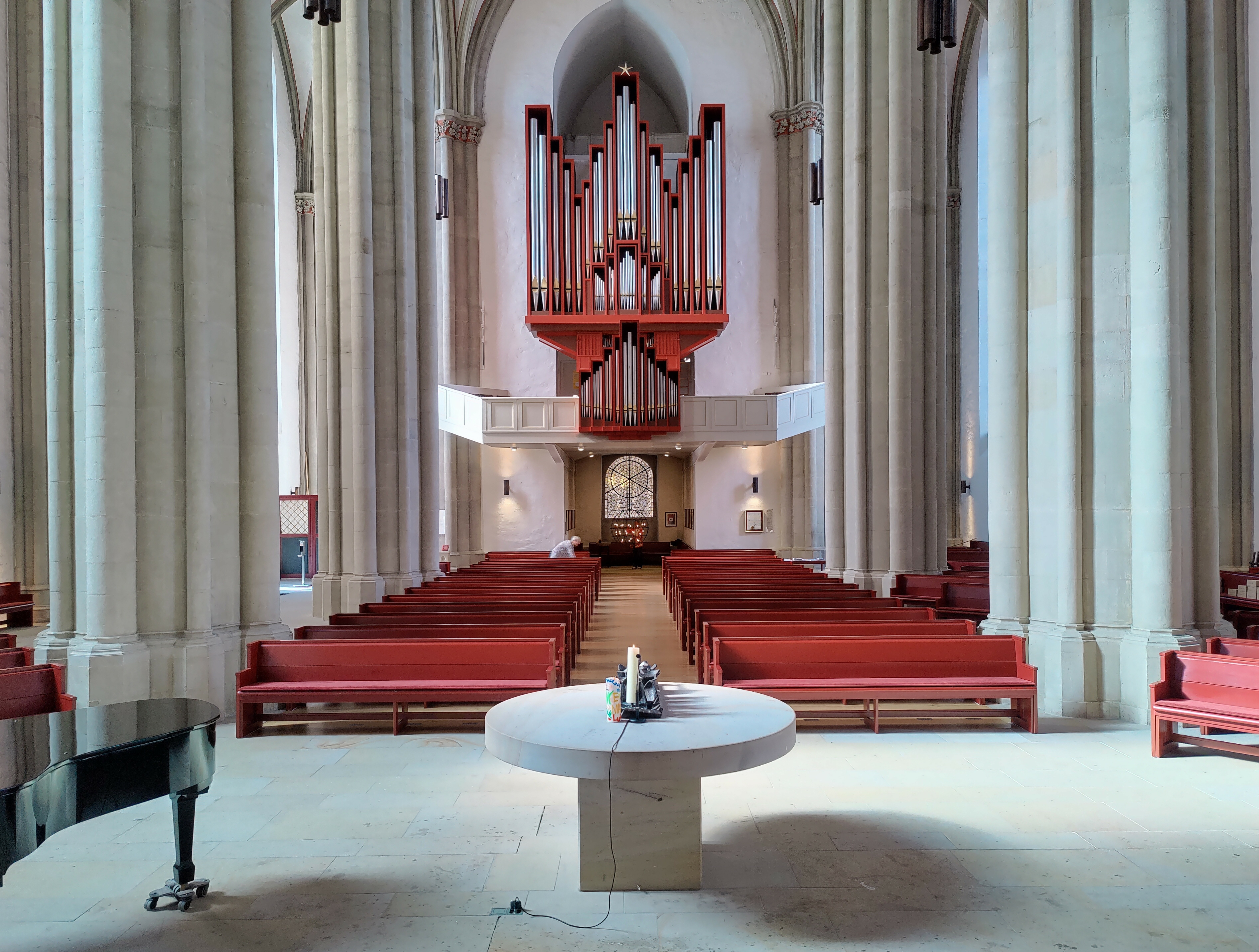
When the Gothic conversion came in the 13th and 14th centuries, the masons made a curious choice. They built a hall church with a nave 20.56 meters long, roughly 25.5 meters wide, and 24.5 meters tall overall - dimensions that produce almost a cube. The central nave is only slightly wider than the side aisles, so the building reads as a single undirected room rather than a long axis pointing toward the altar. The ribbed vaults of all three naves climb to 21 meters at the crown. Compound piers like those at Minden and Paderborn cathedrals carry the load, their capitals decorated with the naturalistic foliage found at the Elisabethkirche in Marburg. Stand inside and the orientation slips: you cannot quite tell which way the church is facing. That was the point.
The Brides' Portal
On the south side, facing the marketplace, stands the Brautportal - the Brides' Portal, the main ceremonial entrance. Stone figures of the Wise and Foolish Virgins flank the door, drawn from the parable in Matthew's gospel. Five Wise Virgins on the left are led by Ecclesia, the personification of the Christian Church. Four Foolish Virgins on the right follow Synagoga, traditionally personifying the older Jewish covenant - the iconography is medieval Christian polemic, and modern viewers see it as such, not as theology to endorse. The figures of Ecclesia and Synagoga standing on the columns represent the New and Old Covenants. Above them on the tympanum is a Coronation of the Virgin in stone. The current figures are 19th-century replicas; the original early 14th-century sculptures are preserved in Osnabrück's Kulturgeschichtliches Museum.
The Antwerp Altar
Inside, the main altar is itself a small immigrant. It was made in Antwerp in 1520 - one of the carved and painted altarpieces that streamed out of Flemish workshops to fill churches across northern Germany in the late Middle Ages. Twelve painted panels on its hinged wings tell the story of Christ from Annunciation to Pentecost. The carved center holds six small alcoves with scenes from his early life, and three larger scenes of the Passion - the bearing of the cross, the crucifixion, and the descent. Above the altar hangs an even older treasure: a triumphal rood from the late 13th century, in the Gothic Dreinageltypus style that pierces Christ's feet with a single nail rather than two, intensifying the sense of suffering. The original predella of the altar was destroyed by bombs in 1945; it had been painted around 1390 by the Master of the Berswordt retable, a workshop likely based in Cologne.
The Bombs and the Dutch Organ
Incendiary bombs in World War II gutted the Marienkirche. Reconstruction began immediately and was complete by 1950, led by Osnabrück architect Max H. Berling. The excavations that revealed the church's deep stratigraphy were carried out alongside the rebuilding work. The current organ was built in 1967 by the Dutch firm Flentrop, with 47 registers across four manuals and pedals, manually operated, the Brustwerk fitted with a swell mechanism. It was extensively renovated in 1998. Five bells in the tower, named Hosianna, Gloria, Amen, Kyrieleis and Halleluja, were recast in 1959 by the Rincker bell foundry. The Marienkirche stands directly on the market square beside the town hall and the old city weighing house - one of four medieval churches that ring the Innenstadt, the oldest town church of Osnabrück, still doing the work it was built for in the 10th century.
From the Air
St. Mary's stands at 52.28°N, 8.04°E on the Markt of Osnabrück. Recommended viewing altitude: 2,000-3,500 ft AGL. The church's western tower and four tracery-crested gables are visible above the rooftops of the old town, immediately beside the historic town hall where the Peace of Westphalia was signed in 1648. Nearest airport: Münster Osnabrück International (EDDG / FMO), about 31 km south.