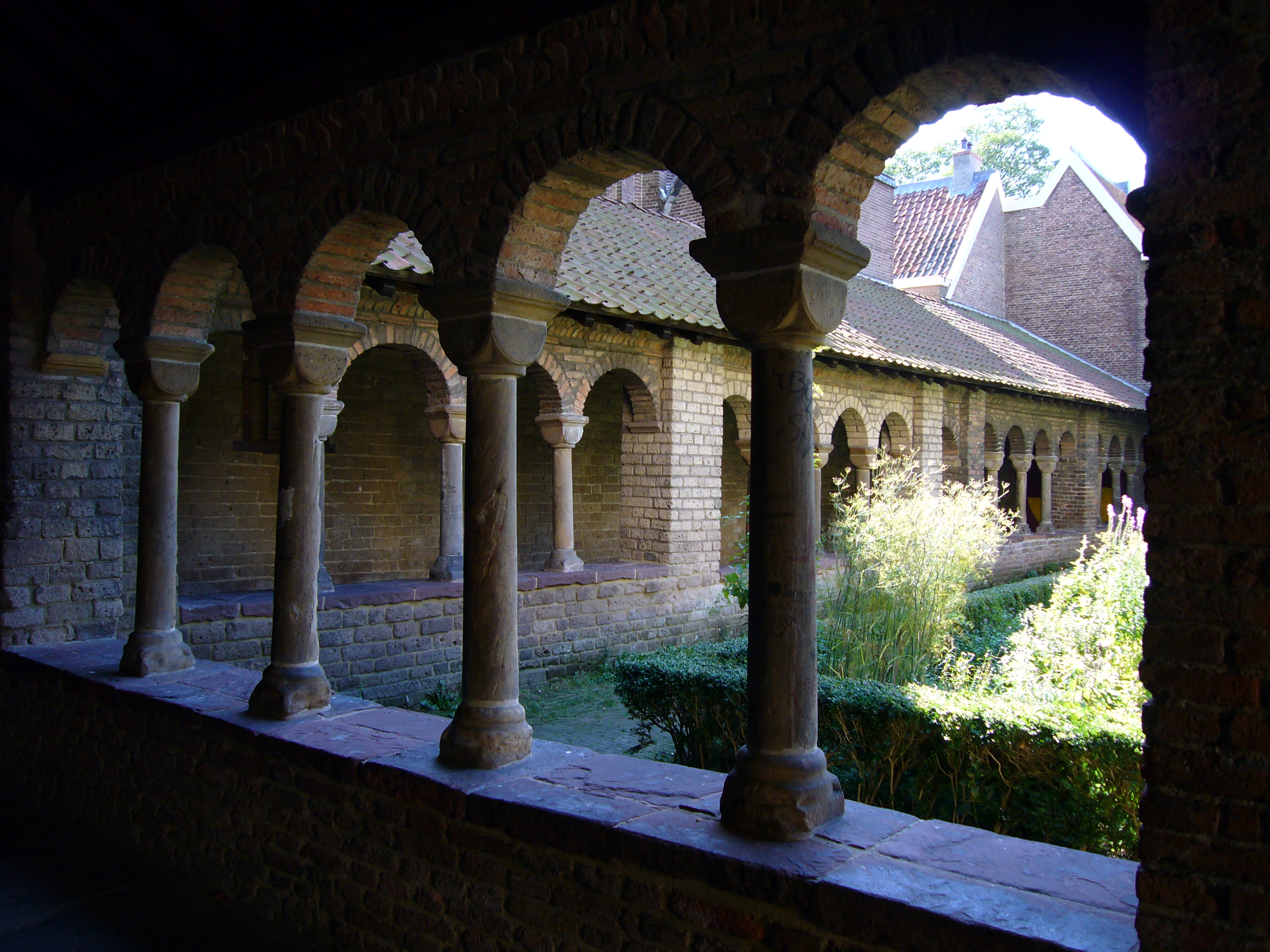
St. Mary's Church, Utrecht
Pieter Saenredam painted the inside of the Mariakerk seven times. He worked slowly, in pale tones of bone and parchment and pearl gray, recording the columns and the vaults of a building that had stood in Utrecht for five and a half centuries by the time he picked up his brush. Look at any Saenredam canvas of the Mariakerk and you see the same thing: vast stone arches, an Italian sense of light, an oddly southern church in the middle of a northern city. The paintings hang now in the Rijksmuseum and the Centraal Museum and at the National Gallery in London. The building itself is gone. Napoleon ordered it demolished in 1813 to sell the stone. By 1816 it had been carted away. Today only the cloister remains, hidden behind a music conservatory at the Mariaplaats, and you have to know it is there to find it.
The Western Arm of the Cross
Medieval Utrecht laid out its great churches in the shape of a cross. The kerkenkruis - church cross - was a sacred geometry as much as a town plan: five collegiate churches arranged so that the lines between them formed a Christian cross over the city. St. Martin's Cathedral was the center. St. Salvator's, the Pieterskerk, and the Janskerk anchored three of the arms. The fifth - the western arm - was St. Mary's. It could not be built right next to the cathedral because the immediate west of the old Roman Traiectum was already crowded with the merchant district of Stathe and the Buurkerk. So the Mariakerk went further west, on what was then the edge of the city, and from there became the visible terminus of the kerkenkruis. The arrangement gave Utrecht the densest concentration of major Romanesque churches in the medieval Low Countries.
An Italian Church in a Dutch City
St. Mary's was founded jointly around 1085 by Emperor Henry IV and Conrad, Bishop of Utrecht - Conrad was Henry's loyal supporter during the Investiture Crisis, present at the imperial coronation in 1084 and increasingly settled in Utrecht in the years after. The church was modeled on Speyer Cathedral, Henry's own dynastic burial church and the most important church of the Salian emperors. As such, the Mariakerk was a political statement in stone: a piece of imperial Germany planted in the bishop's seat. Conrad was murdered in 1099, just as the choir was being inaugurated, and construction halted. It resumed only after a strange episode in 1133, when the rebel Floris the Black barricaded himself inside the unfinished walls during his raids on the diocese. When work began again the new master mason worked in Lombard style - the First Romanesque vocabulary of northern Italy. Two towers were added on either side of the westwork around 1160. The result was magnificent and almost unique: vaulted entirely in stone, with two transepts instead of one, stands above the aisles, and an Italian profile against the gray Dutch sky.
The Painter Who Was Buried Inside
St. Mary's was served by a chapter of thirty canons - one of the wealthiest religious foundations in the city. In 1421 the modest Romanesque choir was torn down and replaced by a much larger Gothic one. In 1524 the painter Jan van Scorel - just back from Rome, where he had been the custodian of the papal antiquities under the Utrecht-born Pope Adrian VI - became a canon of the Mariakerk. He designed a rood screen and stained glass windows for it. When he died in 1562 he was buried inside the church, in a tomb so elaborately carved and decorated that it became the first such monument ever given to an artist in the Netherlands. The grave is gone too, demolished with the rest. What survives of Scorel today is portraits, altarpieces, and the influence he had on his students - chief among them Maarten van Heemskerck and Antonis Mor, two of the most important Dutch painters of the sixteenth century.
Demolition by the Foot
Decline came in pieces. During the siege of Vredenburg in 1576, in the chaos of the Dutch Revolt, the north tower of the Mariakerk was destroyed by cannon fire. After the Reformation, the building was given over for use to the Anglican Communion and the Gothic choir was repurposed as an exhibition space. The remaining tower came down in 1682. The whole west side was demolished in 1715. In 1764 the surviving choir was converted into a concert hall - which is how Saenredam's paintings, made in the 1630s and 40s, became increasingly valuable as records of a building that was already vanishing. The death sentence came in 1811 when Napoleon's administration dissolved the chapter. In 1813 the Emperor ordered the church demolished for the proceeds from selling its stone. By 1816 the nave and west works were gone; the concert-hall choir held on until 1844, when it too came down to make way for the Gebouw voor Kunsten en Wetenschappen, which today houses the Utrecht Conservatory. Only the cloister survived - spared because it stood on Old Catholic Church land at the moment of demolition. You can still walk through its arches at the Mariaplaats, tuff replaced with brick during later repairs but the sandstone columns and capitals intact, the silence of the place pressed up against the sound of student musicians practicing through the conservatory windows.
From the Air
Coordinates 52.09 N, 5.12 E - the Mariaplaats sits in the medieval core of Utrecht, about 350 m west of the Dom Tower. From altitude the site shows as a small open square surrounded by tile rooftops, the surviving cloister tucked behind the Gebouw voor Kunsten en Wetenschappen (the Utrecht Conservatory building) at the western edge. Schiphol (EHAM) is 38 km west, Lelystad (EHLE) 35 km north. Recommended viewing altitude 1,500-3,000 ft AGL.